
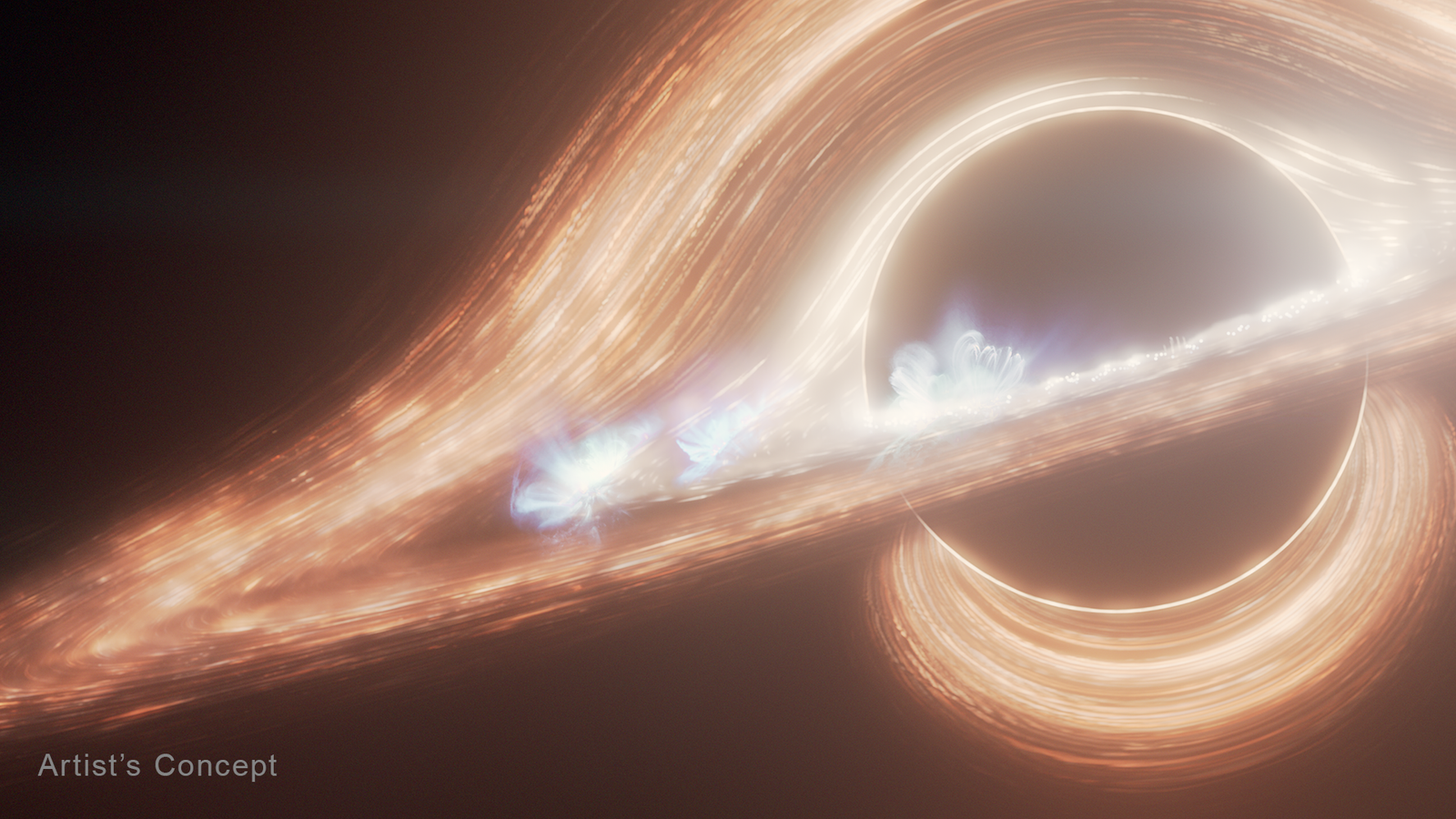
Artist’s concept of Sagittarius A*, the Milky Way’s central black hole, used here to illustrate the surrounding gas astronomers study. Credit: NASA, ESA, CSA, Ralf Crawford (STScI).
The most surprising thing about some of Webb’s black holes may turn out to be the way astronomers have been weighing them.
Objects that appeared to be cosmic heavyweights could be less massive, but growing much faster. That possibility has returned to the spotlight following September coverage of a study examining one of the early universe’s most intriguing puzzles: black holes that seem unusually large for their young galaxies. Space.com’s interview with the lead researcher
The peer-reviewed study, published in the June 2026 issue of Astronomy & Astrophysics, reanalysed 14 objects using both Webb’s broad emission lines and Chandra’s X-ray non-detections. Its preferred interpretation puts many at roughly one million to ten million solar masses, with very rapid feeding. These are model-based estimates, not direct measurements of their weight. Trinca and colleagues’ paper
Webb black hole masses depend on the surrounding light
A black hole cannot pose for an ordinary portrait. Light crossing its event horizon cannot escape, so astronomers study what happens around it. Hot gas can shine as it spirals inward, while nearby stars can reveal an unseen object’s gravitational pull. NASA describes these as distinct ways to investigate objects that do not themselves emit light. NASA’s black hole guide
For distant systems, researchers often estimate mass from the width and brightness of particular lines in the gas’s spectrum. The width reflects gas moving at different velocities. Applying relationships calibrated closer to home can become misleading if the distant gas has a different geometry or illumination. That is central to the new interpretation. Study methods
The distinction matters when reading an enormous number in a headline. A measurement of the light and an inference about the object producing it are connected, but they are not the same thing.
The missing X-rays become part of the evidence
An actively feeding black hole can have a corona: an extraordinarily hot, turbulent region near the inner disc of gas. NASA explains that this region produces high-energy X-rays, although its precise shape and extent remain active research questions. The glowing material outside the black hole supplies the signal; radiation is not escaping from inside the event horizon. NASA’s guide to black hole anatomy
The researchers model a thick feeding disc with a narrow funnel that confines and cools the corona. This can suppress hard X-rays while the system continues accreting rapidly. Combined with the gas-line evidence, that favours smaller, faster-growing black holes over the extremely massive alternative. Primary paper
Think of it as checking an explanation against a second instrument. An interpretation must account for the signal Webb records and the X-rays Chandra does not detect. A blank patch in one observation can still carry useful information.
Rapid growth has a physical explanation
Astronomers call the familiar balance between inward gravity and outward radiation pressure the Eddington limit. As material heats up around a black hole, its radiation pushes back against incoming gas. Exceeding the usual limit involves the details of how that gas and radiation behave; it does not mean gravity has stopped working.
There is a wider observational context. In September 2025, NASA reported a separate, X-ray-bright black hole, RACS J0320-35, whose inferred growth rate exceeded that benchmark. Its circumstances differ from the X-ray-quiet sample, but it illustrates why episodes of unusually fast feeding are being investigated seriously. NASA’s Chandra report
A promising explanation still needs a stronger test
Smaller starting estimates would reduce the amount of mass that needs assembling in a young universe. But this analysis does not reweigh every early black hole, and it does not settle how the first ones formed.
In the September interview, lead researcher Alessandro Trinca pointed to deeper X-ray observations, better spectra and independent mass measurements as important tests. Nearby objects with similarly extreme feeding could also provide a clearer view of the underlying physics. Researcher interview
Closer to home, stars racing around the Milky Way’s central black hole offer a different way to probe an invisible object through its surroundings. The distant-universe challenge is extracting comparable confidence from far less accessible evidence.
The exciting possibility is that some apparent monsters are telling us more about extreme feeding than extreme size. Astronomy advances when an appealing explanation survives another way of looking.
Leave a Reply