
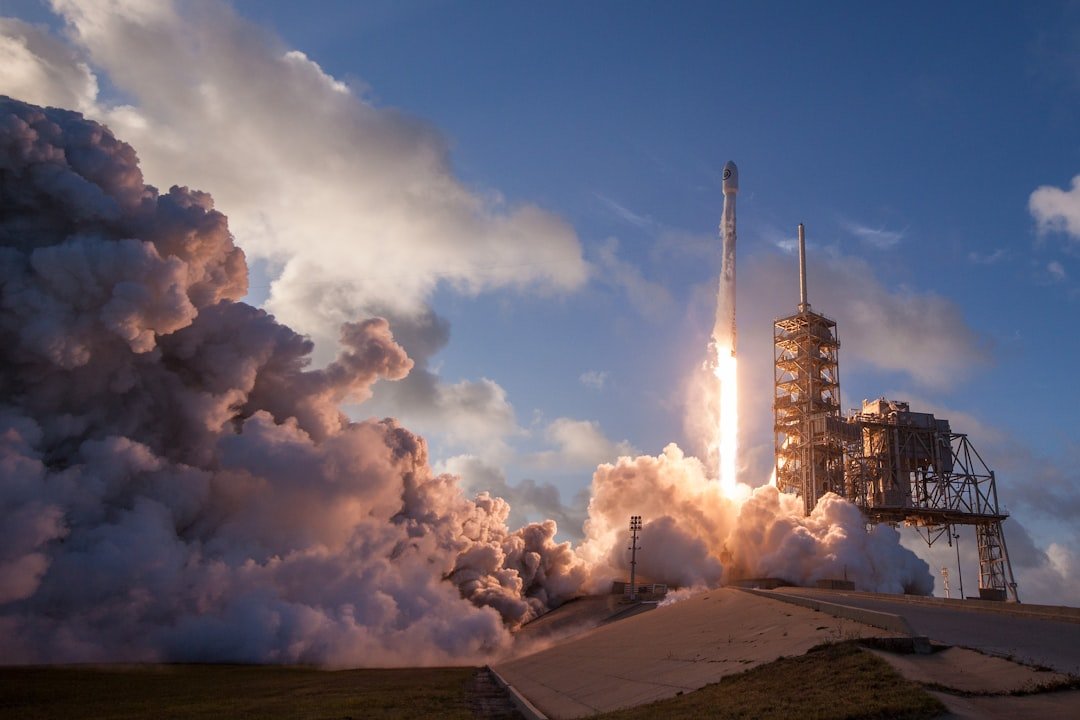
Archive photograph of a Falcon 9 launch; this is not the September 2026 SES mission. Credit: SpaceX / Unsplash.
A rocket rising above Florida can look spectacularly familiar. On 13 September 2026, that familiarity was the story.
A Falcon 9 carried three SES communications satellites into space on the 700th mission of SpaceX’s Falcon rocket family. Its first-stage booster was making its 29th flight and returned to a droneship after launch, according to Space.com’s launch report. The 700 figure refers to Falcon-family missions, not 700 Falcon 9 flights or a claim that every mission succeeded. Space.com launch report
It is a useful snapshot of the business SpaceX has built: a reusable launch system repeatedly carrying other companies’ infrastructure into orbit.
For SES, the payload was the main event. The launch delivered satellites 11, 12 and 13 of O3b mPOWER, completing the launch deployment of its 13-satellite constellation. SES expects the newest trio to enter service by mid-2027. A successful launch therefore marks a major step, while additional operational capacity follows later. SES launch announcement
Another network, a different job
O3b mPOWER operates in medium Earth orbit and is aimed at customers including businesses, governments and transport operators. SES describes a system combining software-defined satellites with ground technology, allowing capacity to be directed towards customer requirements. Its emphasis is on managed connectivity for demanding applications, including locations that are difficult to serve with terrestrial networks. SES system overview
Think of the distinction between buying a household internet connection and arranging reliable communications for a remote industrial operation. Both involve moving data, but the commercial requirements can be very different. Coverage, service arrangements and the ability to allocate capacity all become part of the product.
That helps explain why space connectivity is bigger than a single consumer broadband brand. SpaceX can be developing its own next-generation Starlink network while also providing the launch service for a separate operator’s infrastructure.
The significance is commercial as well as technical. Each completed customer mission is a concrete example of launch capability being converted into somebody else’s service. The satellites still belong to SES; the ride into orbit demonstrates SpaceX’s role in enabling the project.
Repetition is becoming the achievement
Our view is that the most telling number from this mission is the booster’s flight count. It gives reuse a physical meaning: the same major piece of hardware can return for another assignment.
It does not reveal the mission’s profit margin, the exact cost of refurbishment or a future reliability guarantee. Those cannot be calculated from a launch video. But it makes the operating model visible in a way that a distant target cannot.
There are now two milestones to watch. SpaceX has another completed mission behind it. SES must bring its newly launched satellites into service and deliver the additional network capability it has described.
The launch itself is already real. That is what makes this a strong SpaceX story: repeated execution is helping turn ambitious plans in orbit into infrastructure other businesses can use.
Leave a Reply