
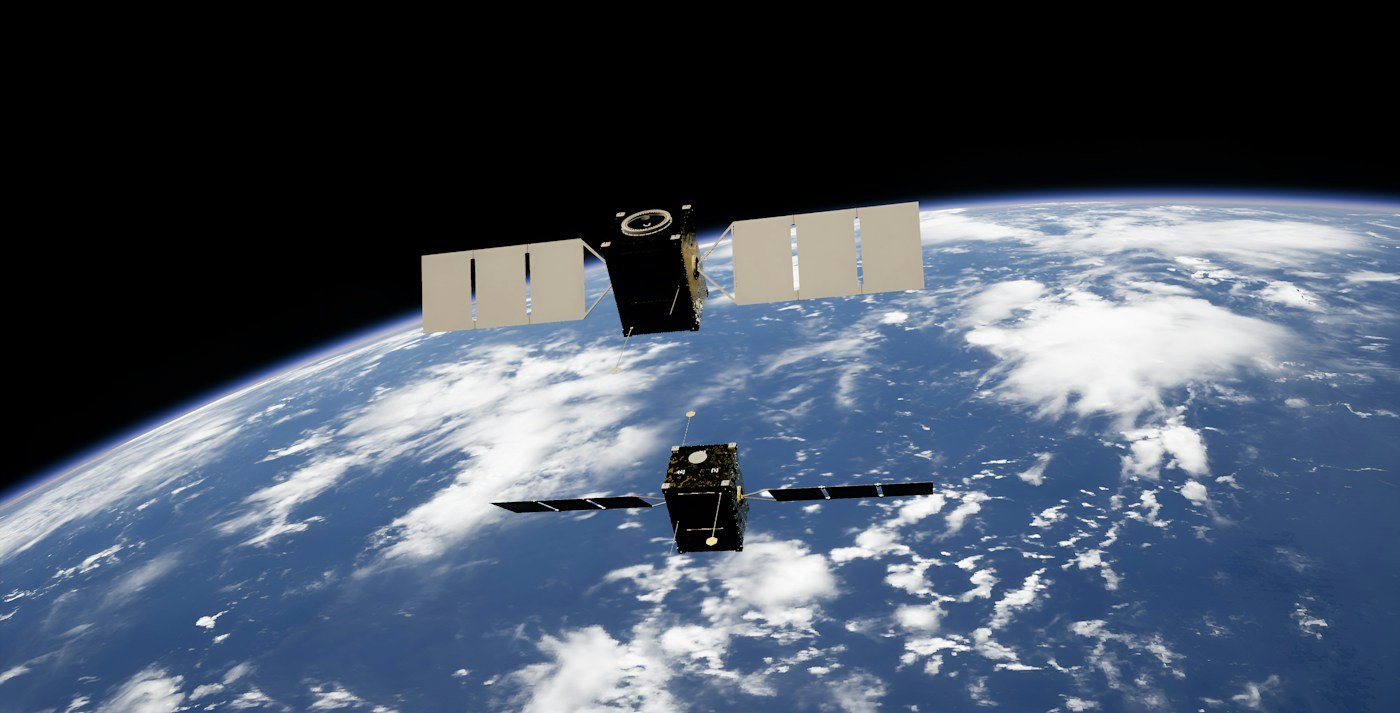
Illustration of satellites in orbit by Obruta. It does not depict an IMM Apex installation. Credit: Kevin Stadnyk / Obruta / Unsplash.
Rocket Lab IMM Apex takes aim at a less glamorous part of the space race: the hardware that keeps a spacecraft working after the rocket has gone.
On 8 September 2026, Rocket Lab announced the production release of the new solar cell. It reports 31.5% conversion efficiency at the beginning of a mission and 40% lower cell mass. It also says the design eliminates the germanium substrate used in conventional space solar cells. Those are manufacturer-reported specifications, not results from an independent comparison. Rocket Lab announcement
The attraction is straightforward: useful electrical output without as much material to launch.
What Rocket Lab IMM Apex changes
A substrate is a supporting base on which a semiconductor device is built. Removing the germanium base changes the materials required for the cell, and Rocket Lab presents that as a way to reduce exposure to mineral supply constraints.
The company also describes Apex as compatible with the mechanical and electrical requirements of its heritage cells. If that holds for a customer’s design, it could make adoption easier than rebuilding an entire power system around an unfamiliar component. Commercial availability has been announced; actual integration decisions remain with spacecraft builders. Product release details
The 40% figure needs the right denominator
The headline saving applies to cell mass. It does not mean a complete solar array, satellite or launch suddenly weighs 40% less.
A solar-power system includes other hardware. Even an extremely light cell still needs to be integrated into a structure that survives launch and operates in space. Rocket Lab’s separate panel offering describes substrates, cell assemblies and mission-specific integration. Solar panels and substrates
A simple hypothetical shows why the distinction matters. If cells accounted for one-quarter of a system’s mass, reducing only their mass by 40% would reduce that whole system’s mass by 10%, assuming everything else stayed the same. That is arithmetic to explain the claim, not a measured result for an Apex-equipped spacecraft.
Launch-day efficiency is only the start
“Beginning of life” describes performance before the mission’s operating environment has taken its toll. Spacecraft designers also care about output later in the mission, including the effects of radiation and temperature.
Rocket Lab’s existing catalogue separates cell products by mission conditions and quotes different beginning- and end-of-life measures. A single efficiency number therefore cannot settle which product suits a particular orbit or lifetime. Space solar-cell specifications
For readers following expanding satellite networks, including Starlink’s next-generation plans, this is the quieter engineering story underneath the constellation headlines. Communications, computing and instruments all need a workable power budget.
The next useful evidence will be spacecraft integrations, delivered quantities and performance over time. A lighter cell is a promising component. Its ultimate value will be measured in dependable power throughout a mission.
Leave a Reply