
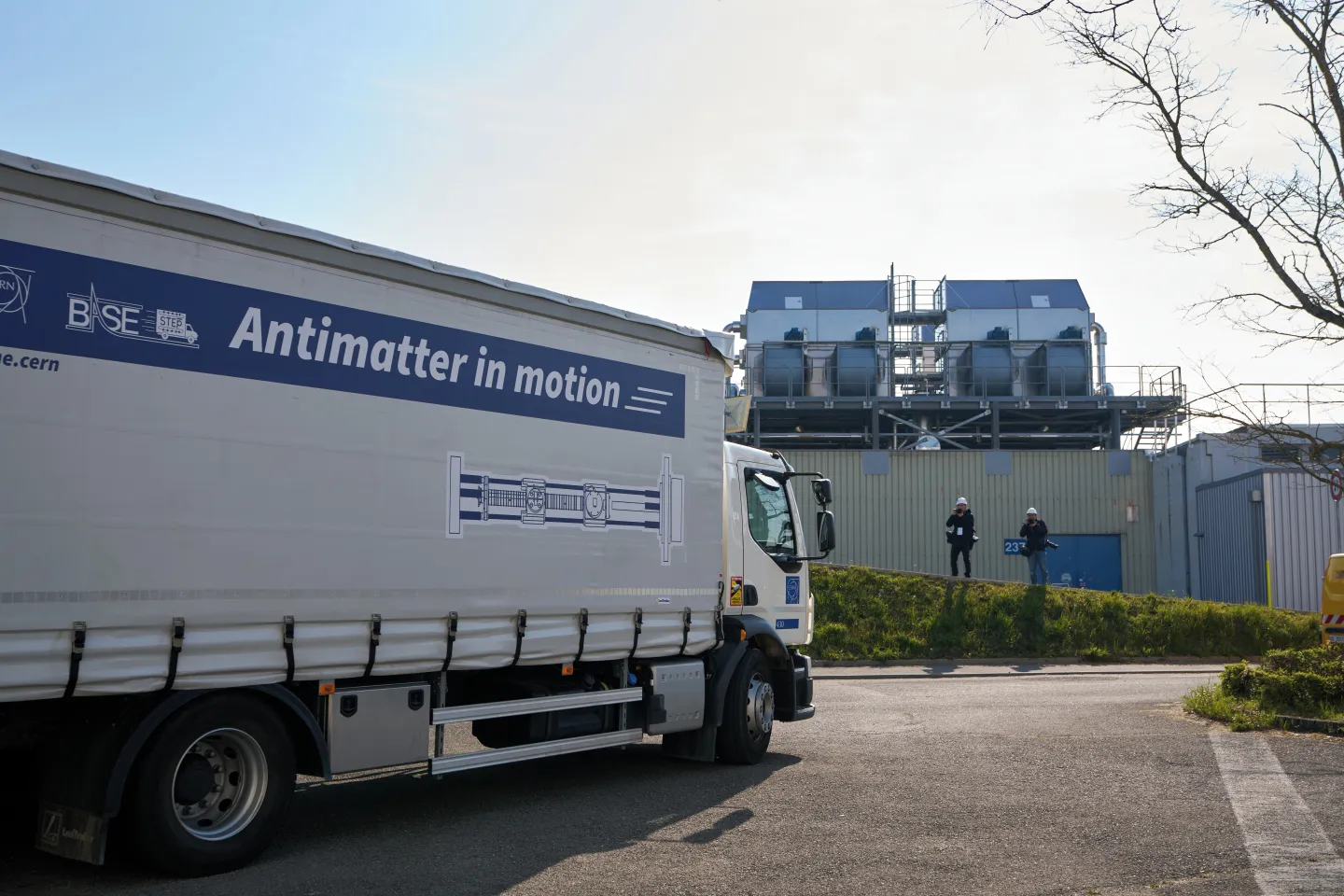
The cargo was almost impossibly small. The equipment protecting it was not. In a test of antimatter transport, CERN researchers loaded a specialised trap onto a truck, drove it around the site and brought back every one of its 92 antiprotons.
The journey took place on 24 March 2026. A paper published in Nature on 16 September now reports the scientific result: a 7.5-kilometre trip without losing a particle or measurably degrading the trap’s vacuum. The new development this week is the paper, rather than a newly completed trip across Europe. CERN’s March announcement; Nature paper.
A container that must never touch its contents
An antiproton is the antimatter counterpart of a proton. Bringing it into contact with ordinary matter destroys it through annihilation. The solution is not an unusually tough bottle. It is a system that keeps the particles suspended away from the walls.
BASE-STEP uses a Penning trap: electric and magnetic fields confine charged particles inside an extremely good vacuum. Cryogenic cooling helps maintain that environment. The team at Heinrich Heine University describes a chamber kept near liquid-helium temperature, with residual gas freezing onto cold surfaces instead of remaining available to collide with the stored particles. BASE-STEP’s technical explanation
Transport adds problems a stationary experiment can avoid. The apparatus must keep working after being disconnected, lifted and subjected to motion and vibration. The paper reports that the complete transport assembly weighs about 850 kilograms—a substantial machine protecting a microscopic payload. Research paper
The destination matters more than the distance
CERN is exceptionally good at producing the particles these experiments need. It is less ideal for the quietest possible measurements. Nearby machines cause tiny magnetic-field fluctuations, and experiments that compare protons with antiprotons are sensitive enough for those fluctuations to matter. CERN
The ambition is to take antiprotons to laboratories with a calmer magnetic environment. There, researchers could compare matter and antimatter properties more precisely and test the symmetries built into fundamental physics. The authors discuss the prospect of substantially improved tests; the truck journey itself did not discover a new asymmetry or explain why the Universe contains so much more matter than antimatter. Scientific motivation
A delivery network still has to be built
The university team describes long-distance transport as a future milestone. Its portable system can operate autonomously for up to four hours, while a longer journey would require upgraded power and cooling arrangements. Receiving the particles at another experiment is also a delicate part of the plan. Project status and next steps
This is what makes the result more interesting than a novelty road trip. An experiment that can travel changes which laboratories can participate and where the best measurements might happen. It separates the place that produces a scientific resource from the place best equipped to study it.
Antimatter transport is still specialised research engineering. But keeping all 92 particles intact turns a remarkable idea into a demonstrated capability—and gives physicists a practical next journey to plan.
Related reading: what experiments actually tell us about gravity and antimatter.
Featured photograph: truck transporting CERN’s BASE-STEP trap in March 2026. Image: CERN, via its press announcement.
Leave a Reply