
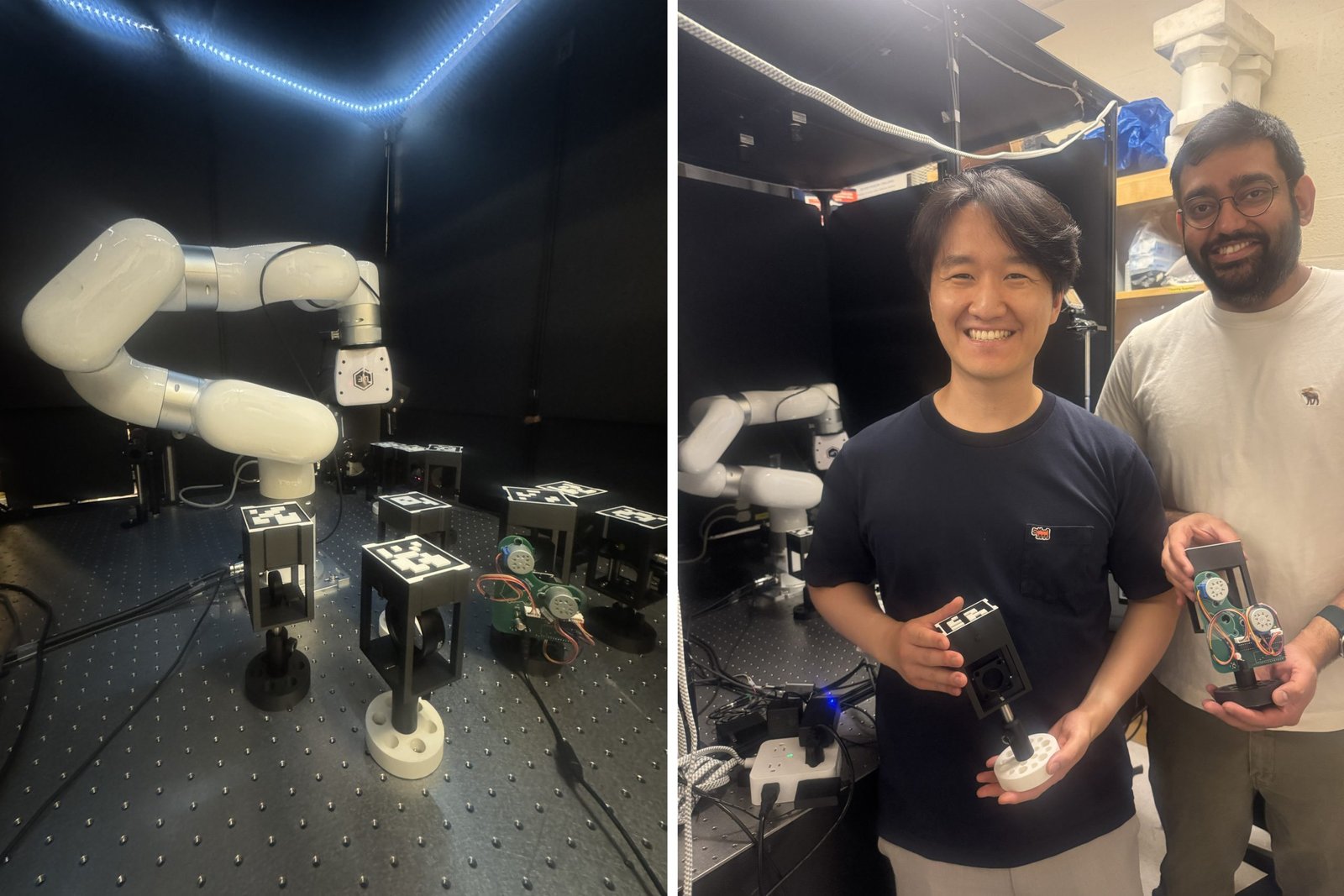
There is a moment in many laboratory experiments when the clever idea has to become a collection of real objects that work together. Mirrors must face the right way. Lenses must sit in the right place. A tiny adjustment can decide whether the experiment works at all.
An MIT team has built a robot that can handle part of this painstaking work. In a demonstration described on 17 September 2026, it assembled and aligned a working tabletop laser in about 30 minutes, using a sequence of around 50 manoeuvres. MIT’s report
The compelling part is the physical feedback. The system measures what its actions achieve and adjusts accordingly.
Precision comes from checking, then correcting
The setup combines a robotic arm, cameras and specially adapted optical components. QR markings help identify parts, magnetic bases simplify placement, and a motorised tool makes fine adjustments to the equipment. Human researchers still specify the intended experimental layout. Research paper
The associated research describes a framework for constructing and aligning optical systems, then restoring them when their alignment is disturbed. Its demonstration begins with components distributed around the work area and ends with an operating laser cavity: an arrangement in which light repeatedly travels between mirrors. Research paper
This is a useful illustration of a broader engineering principle. A robot does not always have to place an object perfectly on its first attempt. It can combine reasonably accurate movement with a much more sensitive measurement of the result.
For an optical experiment, the light itself supplies information about whether the arrangement is working. That turns assembly into a process of placement, observation and refinement.
Recovering from a knock matters
In the paper’s disturbance tests, the system recovered from lens displacement in all ten trials. It recovered from induced mirror misalignment in nine of ten trials. These are small, controlled tests, not evidence that every laboratory mishap can be fixed automatically. Full research paper
Even so, recovery is an important capability to investigate. A machine that can complete a perfect demonstration but cannot deal with a displaced component may still require frequent human attention. Detecting and correcting a problem could make automation more useful during longer experiments.
The research manuscript was posted in March; MIT’s September announcement brings the work to a wider audience ahead of its planned robotics-conference presentation. It remains a research system. Paper history, MIT announcement
The demonstrated task is also bounded. Building a specified experiment is different from choosing an important scientific question and deciding what its results mean.
That boundary makes the achievement easier to appreciate. Our assessment is that automating skilled setup work could be valuable even before laboratories gain anything resembling an autonomous scientist. Researchers could spend less time repeatedly rebuilding equipment and more time deciding which experiments deserve to run.
A robot patiently adjusting mirrors may look less dramatic than a humanoid walking across a stage. For a laboratory waiting on its next working experiment, it could be the more useful performance.
Related reading: Turning research papers into working AI agents.
The experimental robot and researchers Seou Choi and Sachin Vaidya. Credit: Jennifer Chu, MIT. Image supplied through MIT News for editorial use.
Leave a Reply