
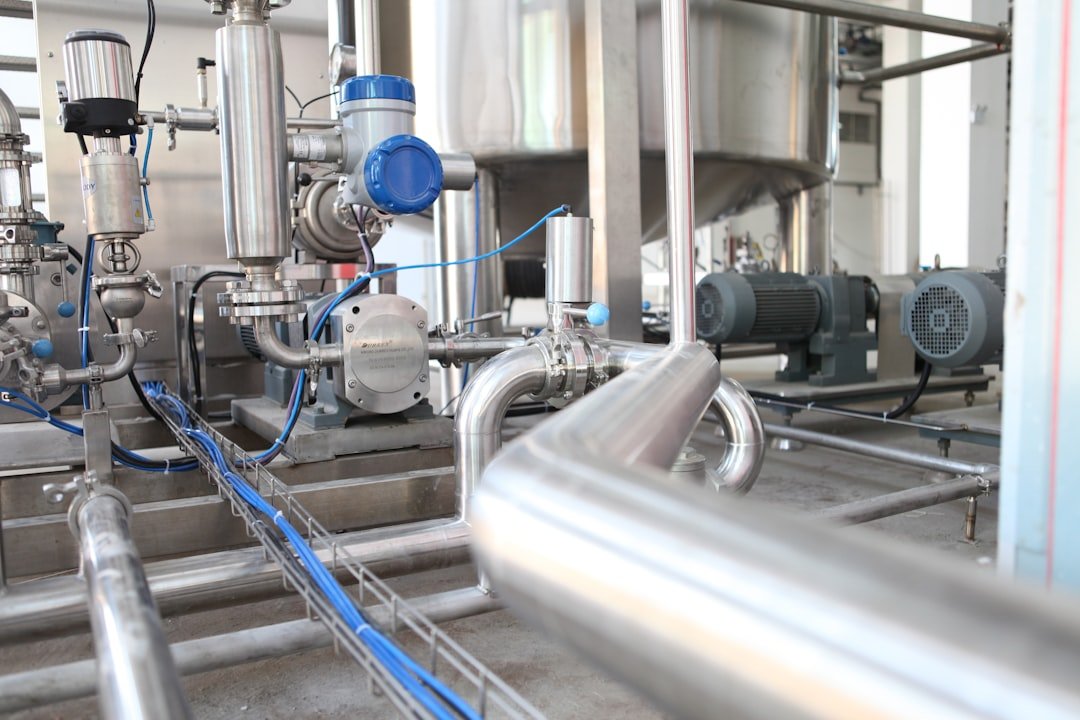
Featured image: Industrial pipework illustrates the kind of continuous heat demand thermal storage can serve. Contextual photograph; not the Pratt project. Photo: Crystal Kwok / Unsplash. Unsplash licence.
Factories cannot schedule every hot process around a sunny afternoon. That is the practical problem behind Antora Energy’s latest thermal storage announcement: buy electricity when it is favourable, store it as heat, and deliver that heat when production needs it.
On 1 October 2026, Antora announced a 5.8 gigawatt-hour project for the Pratt biorefinery in Kansas. The company says delivery will start in 2027, under a long-term heat purchase agreement. This is an announced commercial project, with construction and operating performance still to be demonstrated at this site. Antora’s project announcement is the source for those commitments.
A heat battery stores a different product
Antora’s technology uses electricity to heat solid carbon blocks. Instead of keeping the energy in an electrochemical cell, it holds energy in hot material and releases it later for industrial use. The company describes resistive charging and multi-day storage on its technology page.
The distinction matters. A factory buying steam or process heat does not necessarily need the stored energy converted back into electricity. The US Department of Energy defines thermal energy storage as heat held for later use, including industrial processes and electricity generation. Choosing the useful output at the start changes how a project should be judged.
The headline number also needs care. Gigawatt-hours describe a quantity of stored energy, not a continuous power output. The announcement does not mean a 5.8-gigawatt electricity generator has been built. Nor should a thermal storage figure be treated as interchangeable with the usable electrical capacity of a lithium-ion battery.
The contract brings another kind of engineering
Antora says the project is fully equity financed, with financing led by Copenhagen Infrastructure Partners’ Credit platform alongside Grok Ventures and the University Pension Plan Ontario. The long-term heat offtake agreement ties the system to an industrial customer. These are commercial arrangements described by the developer, rather than independent measurements of future performance. Project financing and offtake details.
An offtake agreement is a commitment to buy an output, in this case heat. Its importance is easy to miss in photographs of glowing storage blocks. Equipment has to be built and paid for before a stream of customer revenue can support it.
Our assessment is that this makes the announcement useful as a scale-up milestone. It moves the discussion from whether a storage material can get hot to whether an entire project can deliver a service that a working industrial facility will keep buying. That is a different test from a laboratory efficiency result.
Heat delivery should not be confused with future power conversion
Antora also works on thermophotovoltaics, or TPV: devices that turn light from very hot material into electricity. Its current technology description identifies integrated TPV conversion as a feature of future products. The Pratt announcement should therefore be read as an industrial heat project, without assuming that a future TPV system is part of it.
This distinction helps keep technology reporting honest. A company can have several valid engineering pathways, while the product being financed today uses only one of them. A roadmap is not a completed installation.
The next evidence will come from the operating site
The useful follow-up will be evidence about heat delivery, availability and integration once the project starts operating. Storage capacity alone cannot answer how reliably the biorefinery receives heat across maintenance periods, changing electricity prices and varying production schedules.
There is also an emissions question. Shifting electricity use into different hours can be valuable, but the carbon benefit depends on the electricity that actually charges the system and the fuel it displaces. A large thermal battery is a tool for changing energy use, not a guarantee that every hour of operation is carbon free.
The announcement is significant because it puts a large heat store inside a commercial industrial relationship. The stronger claim—reliable, economical performance over years—will require evidence from the facility after delivery. That is where this next stage of industrial storage becomes measurable.
Reporting and source checks completed on 5 October 2026. By FutureTechDose Editor.
Leave a Reply