
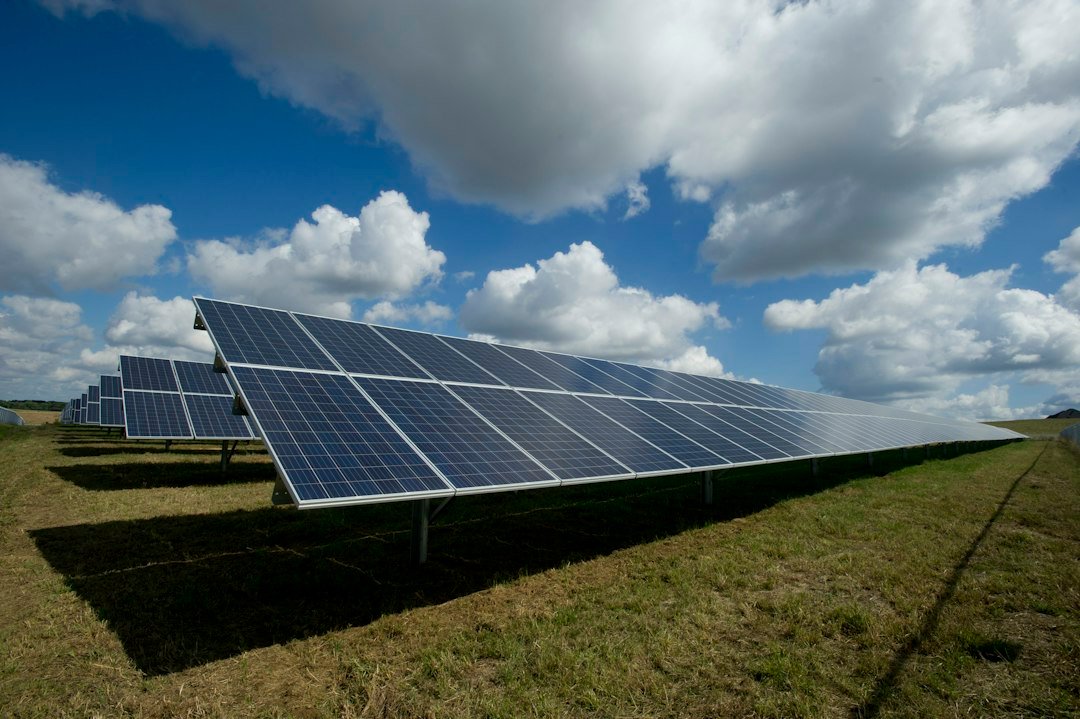
Featured image: Solar panels illustrate generation that storage can shift to another time. Contextual photograph; not Cerignola or a verified Italian installation. Photo: American Public Power Association / Unsplash. Unsplash licence.
Two batteries can deliver the same power while running for very different lengths of time. That difference often disappears when an announcement gives only one large capacity number.
Cerignola, a battery energy storage project in Apulia, southern Italy, makes the distinction unusually clear. BW ESS’s current project profile lists 97 MW of power and 828 MWh of stored energy. It says the project is in construction and targets operation in 2028. This is a project explainer, rather than a claim that the battery has started supplying electricity.
Megawatts measure rate and megawatt-hours measure quantity
A megawatt measures the rate at which a system supplies or absorbs electricity. A megawatt-hour measures an amount of energy. At a steady 1 MW, a system delivers 1 MWh over an hour.
Dividing Cerignola’s published energy capacity by its power rating gives 828 ÷ 97 = approximately 8.54 hours. This is a simple nominal energy-to-power ratio, not a verified discharge test. Usable energy, operating limits and conversion losses can affect what is delivered.
The calculation explains why the two numbers belong together. A higher power rating can serve a larger instantaneous load. More energy behind that rating can sustain the load longer.
For comparison, a hypothetical 97 MW system with four hours of nominal duration would contain 388 MWh. That is a mathematical example, not a specification for another actual project.
Duration changes the service a battery can provide
The national laboratory’s 8 November 2021 discussion of long-duration storage explains why the term has no single universal meaning. Definitions in the literature ranged from several hours to multiple days, with ten-plus hours frequently cited.
BW ESS describes Cerignola as long-duration storage. Readers can assess that description more precisely using the published power and energy ratings rather than relying on the label alone.
The laboratory also distinguishes duration from application. How long storage needs to run to provide dependable capacity depends on the electricity system, demand and generation mix.
Our assessment is that the engineering value lies in covering a defined period of need. An eight-hour class system can address a different time window from a two-hour system. It does not automatically solve a shortage lasting several days.
A larger energy reservoir also needs opportunities to recharge. Its contribution therefore depends on the sequence of generation, consumption and charging conditions, not just the energy listed on a specification sheet.
Italy is procuring storage to shift renewable electricity
Terna, Italy’s transmission-system operator, held its first MACSE storage auction on 30 September 2025. Its 1 October 2025 announcement reported procurement of 10 GWh in southern Italy and the islands, with the contracted battery facilities scheduled for 2028.
MACSE stands for Italy’s electricity storage procurement mechanism. Terna’s explanation of the framework describes commitments to build facilities, make storage available for energy trading and provide balancing services. Battery contracts run for 15 years.
BW ESS says Cerignola has a MACSE contract. Its project page describes the award as October 2025; the system operator dates the first auction to 30 September. These sources establish an earlier procurement round, rather than a newly held auction this week. Project-specific contract information.
The system’s purpose is to move electricity from times of surplus to times of greater need. A battery stores electricity produced elsewhere. The charging source and operating schedule therefore matter when assessing its environmental contribution.
Construction must still turn a specification into a service
The project’s current status separates the engineering design from demonstrated operation. Commissioning, verified performance and reliable availability will determine how the planned equipment serves the grid.
Useful later disclosures would state usable energy at the connection point, tested power, efficiency under defined conditions and performance over repeated cycles. A nameplate energy figure alone cannot answer all of those points.
Cerignola’s significance is its substantial energy capacity relative to its power rating within a coordinated storage programme. The two-number description gives readers a clearer view of its intended role. The 2028 target identifies when that planned role is expected to become an operating service.
Leave a Reply