
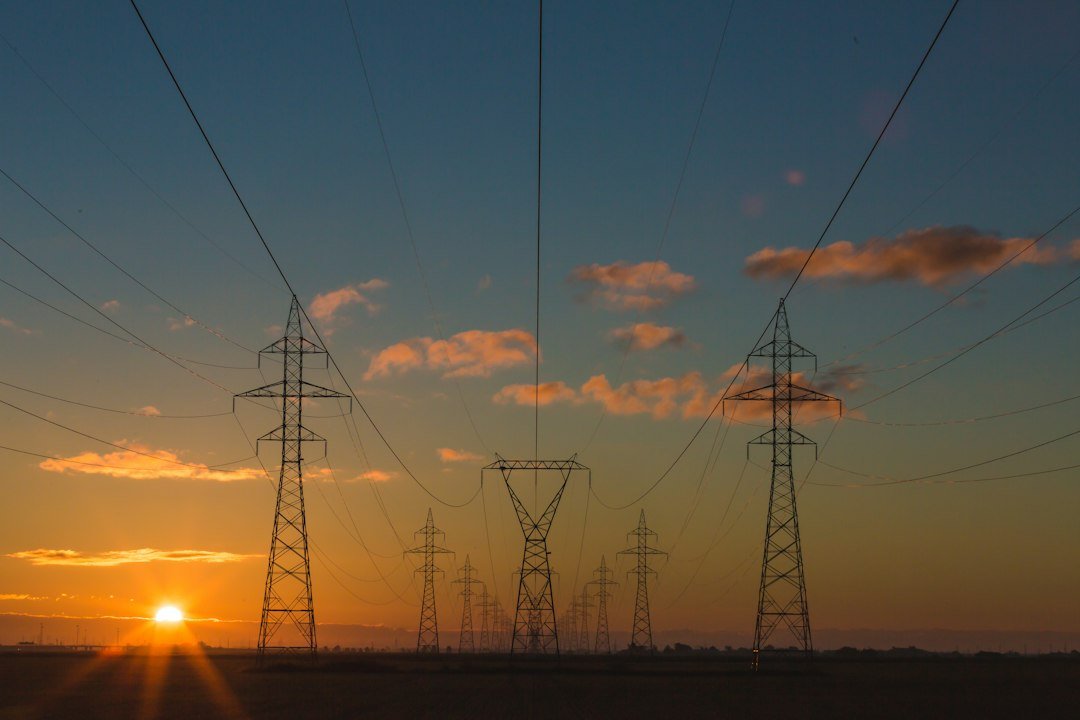
Featured image: Transmission lines illustrate electricity-network infrastructure. Contextual photograph; not Marinus Link, the Heybridge converter station or the undersea route. Photo: Matthew Henry / Unsplash. Unsplash licence.
An undersea electricity cable depends on substantial infrastructure on land. For Marinus Link, the converter station at Heybridge in northern Tasmania is one of the places where a long-distance connection must become part of an operating grid.
On 13 October 2026, Marinus Link reported that the Tasmanian Civil and Administrative Tribunal had affirmed the station’s planning permit without changing its conditions. The Tasmanian Government also confirmed the decision. It is a planning milestone for a specific component, not the completion of the interconnector.
The converter connects two different electrical systems
Marinus Link is designed to carry electricity between Tasmania and Victoria using high-voltage direct current, or HVDC. Existing regional electricity networks use alternating current. Converter stations change electricity between those forms so power can pass into and out of the link.
The project’s published overview describes a 345-kilometre cable route: 255 kilometres under Bass Strait and 90 kilometres underground in Gippsland. The system also includes fibre-optic cables and stations at each end.
The developer describes delivery in two stages, beginning with 750 MW and a second 750 MW link later. That distinction matters: the complete 1,500 MW design should not be treated as capacity available from the first stage or already operating today.

A permit answers a planning question
The project company says the decision followed a merits review with written submissions and expert evidence, including a hearing in June. Its announcement states that the permit conditions remain unchanged.
This reporting is based on the developer and government statements. It does not independently analyse the tribunal’s complete reasoning. Nor does affirmation of this permit imply that every other component has the same approval status.
Our interpretation is that the decision reduces uncertainty around one part of the land-based infrastructure. The remaining delivery questions include construction sequencing, equipment installation and demonstrating that the connection performs as designed.
Transmission moves flexibility rather than generating power
The project is intended to allow more electricity to flow in both directions. Its overview describes importing surplus mainland renewable electricity while conserving Tasmanian hydropower, then exporting hydroelectricity when mainland demand makes it useful.
That is the developer’s intended operating logic. A transmission link does not create an additional wind farm or refill a reservoir by itself. Its value depends on the generation, storage and network conditions on both sides when electricity is needed.
The government argues that Project Marinus will improve energy security and keep prices lower than otherwise. That is a policy claim about future benefits. The permit decision provides no new measurement of household savings and should not be reported as one.
Delivery and commissioning remain the decisive tests
The developer’s overview targets first-stage completion by 2030. A target date is a schedule expectation, not a guarantee. Large cable projects require coordination between marine works, underground routes, converter stations and the wider network.
Commissioning is the stage where installed equipment is tested together before routine service. For an interconnector, that means proving the functioning system rather than relying solely on individual components meeting their specifications.
The most useful future reporting will track what has actually been installed, the stage it belongs to, its approval and testing status, and any changes to the schedule or budget. That makes progress comparable without counting a permit, a contract and an operating cable as the same achievement.
Heybridge’s permit affirmation is meaningful because the converter is essential to the planned connection. It advances a defined part of the project. The wider promise of moving Tasmania’s flexibility across Bass Strait still depends on the complete chain reaching operation.
Reporting and source checks completed on 14 October 2026. By FutureTechDose Editor.
Leave a Reply