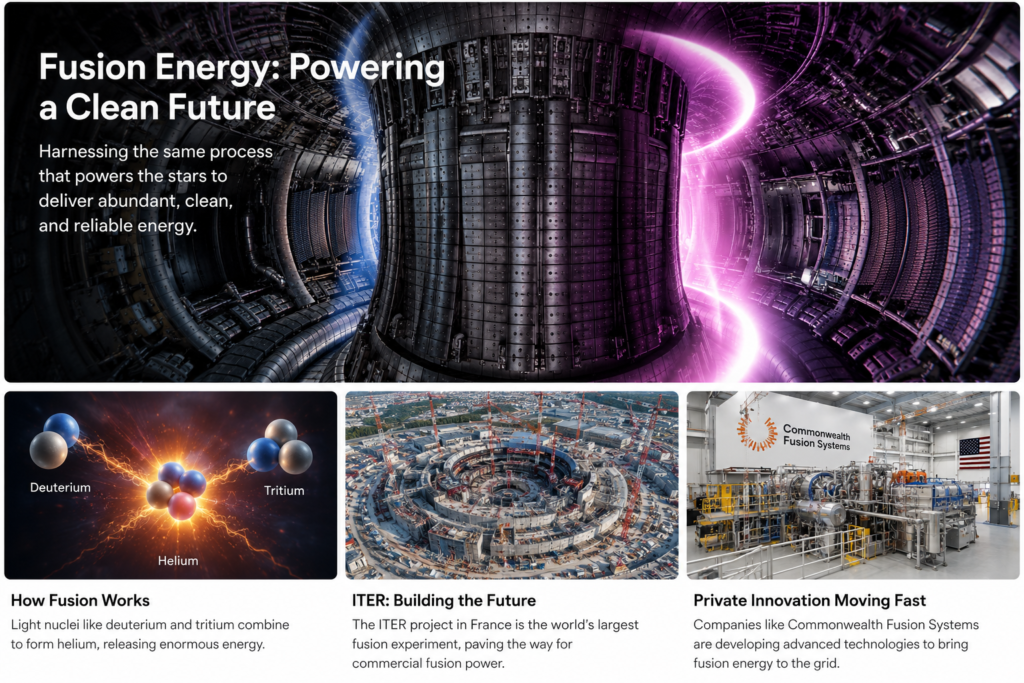
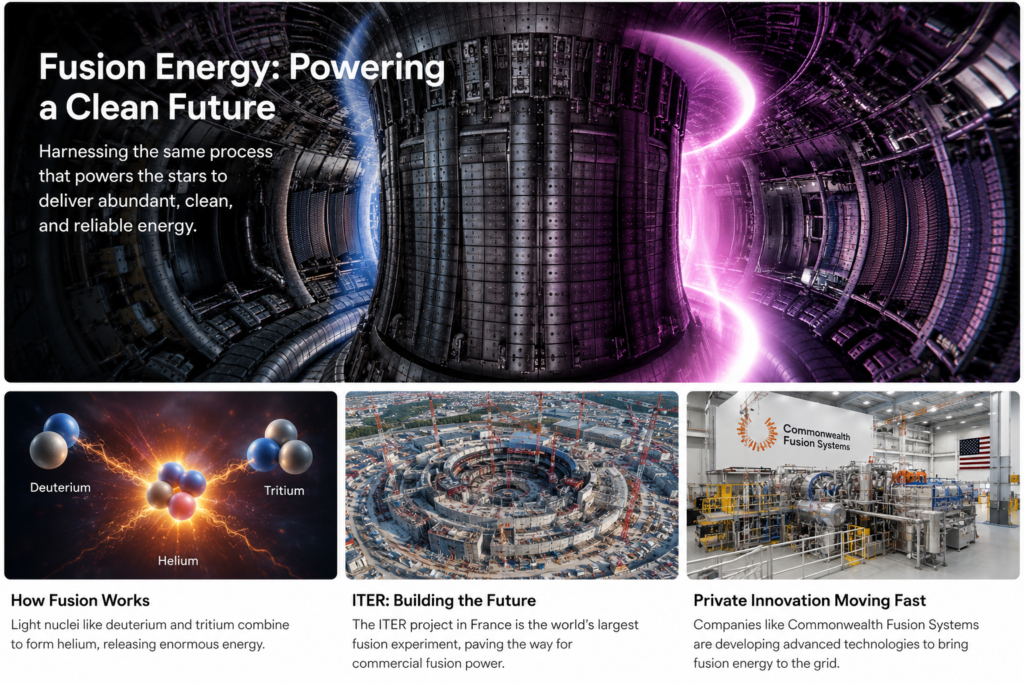
Fusion energy has long been described as the ultimate clean-power dream. It promises abundant fuel, very high energy density, no direct carbon emissions during operation, and far less long-lived radioactive waste than traditional nuclear fission. For decades, however, fusion remained mostly a scientific challenge rather than a commercial energy source.
That is beginning to change. Breakthroughs at major research facilities, rising private investment, and growing demand for reliable clean electricity have pushed fusion back into the global energy conversation. As artificial intelligence, data centers, electrification, and industrial demand put pressure on power grids, fusion is increasingly being discussed as a possible long-term solution.
But there is an important reality: fusion is not ready to power the world today. The technology has made major progress, but commercial fusion still needs to prove it can produce reliable electricity, connect to the grid, operate economically, and scale beyond experimental machines.
What Is Fusion Energy?
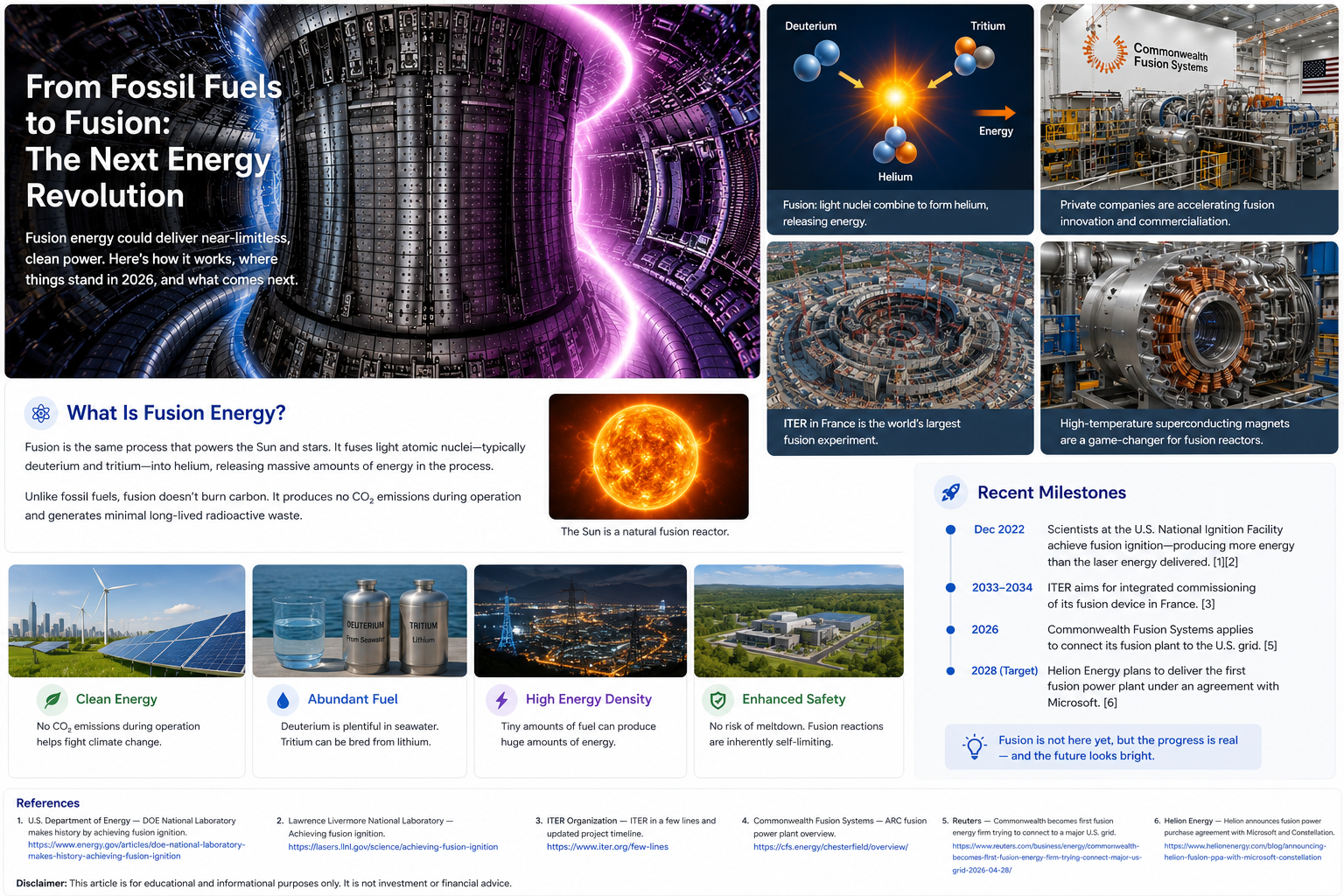
Fusion is the same process that powers the Sun and stars. In a fusion reaction, light atomic nuclei combine to form a heavier nucleus, releasing energy in the process. Many fusion approaches focus on hydrogen isotopes such as deuterium and tritium.
The attraction is clear. Fusion fuel can be extremely energy-dense, and fusion does not burn coal, gas, or oil. A successful fusion power plant could provide clean, firm electricity without depending on weather conditions. That makes fusion very different from solar and wind, which are clean but variable.
Fusion is also different from today’s nuclear fission reactors. Fission splits heavy atoms such as uranium. Fusion combines light atoms. Both are nuclear processes, but fusion has a different risk profile and does not rely on the same kind of chain reaction used in conventional nuclear plants.
The 2022 Ignition Breakthrough
A major milestone arrived in December 2022, when the U.S. Department of Energy announced that researchers at the National Ignition Facility had achieved fusion ignition. In that experiment, the fusion reaction produced more energy than the laser energy delivered to the target. The DOE described it as the first time researchers had produced more energy from fusion than was used to drive it in that specific experiment [1].
Lawrence Livermore National Laboratory reported that the December 2022 shot produced 3.15 megajoules of fusion energy output from 2.05 megajoules of laser energy delivered to the target [2].
This was a historic scientific achievement. However, it did not mean fusion power plants were suddenly ready. The total electricity required to operate a large laser facility is much higher than the energy delivered to the tiny target. Turning a laboratory ignition event into a commercial power station requires repeated reactions, efficient energy capture, durable materials, and affordable engineering.
ITER and the Long Road to Demonstration
ITER, the large international fusion project under construction in France, is one of the most important efforts in magnetic-confinement fusion. The project is designed to test whether fusion plasma can be sustained and studied at a scale far beyond most previous experiments.
ITER’s schedule has changed over time. According to the ITER Organization’s updated baseline summary, the project moved toward major milestones such as cryostat closure in 2033 and integrated commissioning in 2033–2034 [3].
This timeline shows why fusion requires patience. Even large, well-funded international projects move slowly because fusion machines are extremely complex. They need superconducting magnets, plasma control systems, heat-resistant materials, precision engineering, tritium handling, and advanced cooling systems.
Private Fusion Companies Are Moving Faster
The most exciting change in fusion is the rise of private companies. Instead of relying only on government megaprojects, startups are testing new reactor designs, high-temperature superconducting magnets, direct energy conversion, and faster development cycles.
Commonwealth Fusion Systems is one of the most watched companies in the sector. The company says its planned ARC power plant in Chesterfield County, Virginia, is designed to produce about 400 megawatts of clean electricity, enough to support large industrial or commercial customers [4].
In April 2026, Reuters reported that Commonwealth Fusion Systems had applied to connect its planned Virginia fusion plant to PJM Interconnection, a major U.S. grid operator. That matters because it shows fusion is beginning to move from laboratory discussion toward real grid-planning processes [5].
Helion Energy has also attracted attention through its power-purchase agreement with Microsoft. Helion announced that Microsoft agreed to purchase electricity from its first fusion power plant, which Helion said was scheduled for deployment in 2028 [6].
These private-sector moves are important because they create pressure, funding, and competition. However, timelines remain ambitious. Fusion startups still need to prove that their machines can operate reliably, generate net electricity at plant scale, and compete with other energy sources.
Why Fusion Matters for AI and Data Centers
The world is entering an era where electricity demand may grow faster than many expected. AI data centers, electric vehicles, heat pumps, chip manufacturing, and industrial electrification all require reliable power. This is why the energy conversation is shifting from simple “clean energy” to “clean, firm, scalable energy.”
Fusion could eventually fit that need. A successful fusion plant could provide round-the-clock power without the intermittency of wind and solar. It could support data centers, industrial parks, and dense urban grids. It could also reduce the need to rely heavily on fossil-fuel backup generation.
But fusion will not solve the immediate AI power shortage. The next few years will still depend on a mix of grid upgrades, renewables, batteries, natural gas, fission nuclear, demand response, and efficiency improvements. Fusion is more likely to be a 2030s and beyond story than a near-term fix.
The Biggest Challenges
The first challenge is physics. Fusion requires extremely high temperatures and stable plasma conditions. Keeping plasma confined long enough to generate useful energy is difficult.
The second challenge is materials. Fusion environments can damage reactor components. Future power plants need materials that can survive heat, neutron bombardment, and repeated operation.
The third challenge is economics. Even if fusion works technically, it must be affordable. Utilities and data-center operators will compare fusion with nuclear fission, renewables, storage, natural gas, and transmission upgrades.
The fourth challenge is reliability. Power grids need electricity every day, not only during experiments. A commercial fusion plant must run safely and predictably for long periods.
Fusion Is Promising, But Investors Should Be Careful
Fusion is one of the most exciting energy technologies in the world, but it is also highly uncertain. The sector has enormous potential, yet many companies are still pre-commercial. Investors should be careful with hype, especially when timelines sound too aggressive.
The strongest fusion companies may eventually become major energy players. But the path from scientific breakthrough to commercial power plant is long. It requires engineering success, regulatory approval, supply-chain development, grid integration, and real customers willing to pay for the electricity.
What to Watch Next
The most important fusion milestones to watch are not only press releases. The real signs of progress will be first plasma, repeated net-energy experiments, grid-connection approvals, construction permits, power-purchase agreements, financing, and successful electricity delivery to the grid.
Commonwealth Fusion Systems, Helion Energy, ITER, the National Ignition Facility, and other major fusion programs will continue to shape the story. If even one commercial fusion plant succeeds, it could change the future of energy.
Conclusion
Fusion energy is moving from science fiction toward serious engineering. The 2022 ignition breakthrough proved that fusion can pass a major scientific threshold. ITER continues to develop the world’s largest fusion experiment. Private companies are now trying to move faster and bring fusion into the grid era.
Still, fusion should be viewed as a long-term opportunity, not an immediate solution. The world needs clean power now, and fusion is not ready to replace today’s energy system. But if the technology succeeds, it could become one of the most important energy breakthroughs of the century.
The next energy revolution may not arrive overnight. But fusion is now close enough that governments, companies, investors, and data-center operators are paying attention.
References
[1] U.S. Department of Energy — DOE National Laboratory makes history by achieving fusion ignition.
[2] Lawrence Livermore National Laboratory — Achieving fusion ignition.
[3] ITER Organization — ITER in a few lines and updated project timeline.
[4] Commonwealth Fusion Systems — ARC fusion power plant overview.
[5] Reuters — Commonwealth becomes first fusion energy firm trying to connect to a major U.S. grid.
[6] Helion Energy — Helion announces fusion power purchase agreement with Microsoft and Constellation.
Disclaimer: This article is for educational and informational purposes only. It is not investment or financial advice.