
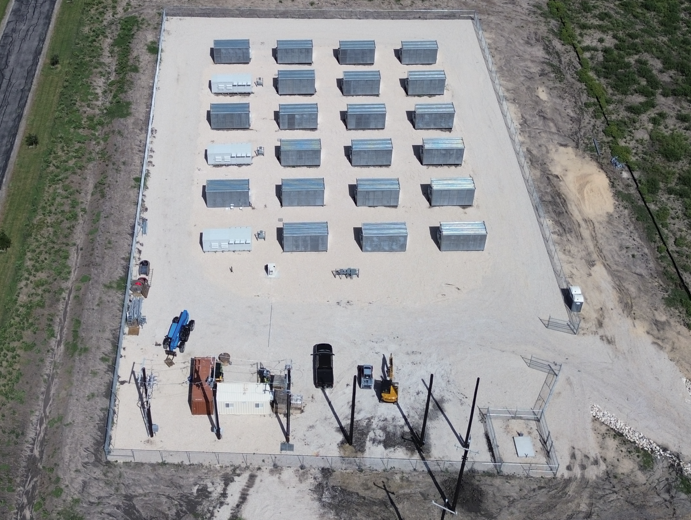
Battery storage project photograph. Credit: B2U Storage Solutions.
A battery can finish its life in a car without finishing its useful life. That opens up an intriguing possibility: the pack that once helped someone commute could spend its next chapter supporting the electricity grid.
On 9 September 2026, B2U Storage Solutions announced that its Bexar Martinez project near San Antonio had entered commercial operation. The facility uses repurposed electric-vehicle batteries and has 28 megawatt-hours of storage capacity. It connects within CPS Energy’s service territory and participates in the ERCOT electricity market, which covers most of Texas. B2U’s project announcement
The appeal is easy to grasp. Manufacturers have already invested materials, energy and money in those batteries. Finding a productive second job for suitable packs can extend the value of that investment before their materials are eventually recovered.
The battery gets a different job
Car batteries work under demanding conditions. They must fit inside a vehicle and supply power through changing temperatures, driving patterns and charging routines. Losing some capability can make a pack less attractive for that original role while leaving useful storage capacity for another application.
Researchers at Oak Ridge National Laboratory have investigated this opportunity for years. Their work shows why second-life storage requires suitable power electronics and controls, including systems that coordinate packs with different ages, chemistries, voltages and capacities. That research provides background to the wider field; it is separate from B2U’s Texas project. Oak Ridge’s second-life battery research
For a stationary installation, the central question changes. Operators need to know how much usable energy the batteries can deliver, how reliably they can deliver it and how their condition changes with use. Nobody needs the cabinet to accelerate onto a motorway.
The software has to manage the differences
B2U’s approach uses complete EV battery packs in purpose-built storage cabinets. Its technology interfaces with packs from different vehicle manufacturers and controls their charging, discharging, connection and disconnection.
The company describes monitoring temperature, voltage balance and unusual behaviour, while an energy-management system coordinates the cabinets and the wider plant. This matters because used batteries do not arrive with identical histories or remaining capacities. The system must manage those differences instead of simply assuming every pack will perform alike. B2U’s technology explanation
There is a useful distinction in the headline number, too. 28 MWh measures stored energy, not electricity generated and not instantaneous power. Think of it as the amount available in the tank. The rate at which the plant can release that energy is a separate measurement, expressed in megawatts. The new announcement does not give enough detail to establish its full-power discharge duration.
The next test is years of dependable service
Bexar Martinez brings B2U’s operating Texas storage portfolio above 50 MWh. Across Texas and California, the company reports roughly 100 MWh in operation and more than 5,000 repurposed EV batteries. Those battery numbers refer to the wider fleet, not just this new site. B2U’s September update
That is a commercial deployment milestone. It does not settle every question about cost, maintenance or long-term performance. B2U argues that its approach offers cheaper storage, but a buyer comparing projects would still need the assumptions behind that claim: remaining battery life, testing, installation, replacements and operating costs.
There is also a basic limit that applies to every battery plant. It must charge before it can discharge, and some energy is lost along the way. Its value comes from moving electricity to a more useful time and providing grid services, rather than creating an additional energy source.
The interesting shift is that an EV battery’s story increasingly has room for another chapter. Bexar Martinez makes that idea tangible: used packs, assembled into a managed system, doing paid work on an electricity network. The strongest evidence from here will be the less glamorous kind—reliable output, manageable maintenance and useful service year after year.
Leave a Reply