
A truck is not bought to win a battery benchmark. It is bought to deliver a load, reach the next job and do it again tomorrow. That makes long-distance freight a demanding test of the electric-vehicle transition.
On 14 September 2026, CATL unveiled TECTRANS II, a commercial-vehicle battery platform whose maximum configuration, the company says, can support up to 1,000 kilometres of driving range. CATL also claims charging to 80% in 25 minutes using megawatt-level equipment. These are manufacturer claims, not independently verified results from a fleet operating across different routes and seasons. CATL’s launch announcement
The same day, CATL and DHL announced a framework for exploring electric freight corridors in Europe. Together, the announcements point to something more interesting than a longer-range battery: an effort to make the vehicle, its energy supply and the delivery schedule work as one system. CATL–DHL announcement
The truck market is already moving
This is not a market starting from zero. The International Energy Agency’s Global EV Outlook 2026, published in May, reports that electric truck sales doubled to over 400,000 in 2025, representing 9% of worldwide truck sales. Those figures include medium and heavy freight vehicles, not just the largest long-haul trucks. IEA market analysis
The geography matters. China accounted for more than 90% of those electric truck sales. The IEA says much of its deployment has involved relatively short, predictable routes around ports, mines and industrial sites. Success on those routes does not automatically settle the harder case of a truck travelling long distances between unfamiliar charging stops. IEA
A range claim is not a delivery guarantee
TECTRANS II uses standardised packs that can be combined for different vehicle requirements. CATL says the platform supports both charging and battery swapping, with common interfaces intended to accommodate later upgrades. That design could make adapting batteries to different trucks less cumbersome. CATL
But buyers still need vehicle-specific evidence. The IEA notes that there is no harmonised international regime for measuring electric heavy-duty vehicle range. Headline distances therefore need context before they become useful comparisons. IEA’s range discussion
Our assessment is that the revealing test would follow a loaded truck over its actual route: energy consumed, stops required, charging time and deliveries completed. A large number on a launch slide cannot answer all four.
The charger has to fit the truck—and the timetable
Megawatt charging means power on the scale of a million watts. Achieving it requires compatible equipment and an adequate electricity supply; a battery’s charging capability is not a promise that every stop can provide it.
The IEA identifies public charging suitable for heavy vehicles as crucial to longer-distance electrification. Physical access matters as well as electrical power: a charging site designed around cars may not leave room for a truck to manoeuvre or park. Its analysis also warns that grid upgrades at larger depots can take years. IEA charging analysis
That gives the DHL agreement a practical purpose. The memorandum identifies possible work on route selection, vehicle-manufacturer involvement, stationary and mobile charging, and battery-swapping pilots. It is a framework for cooperation—not evidence that a completed European network is already operating, or a disclosed order for a specified fleet of TECTRANS II trucks. The agreement’s stated scope
Diesel’s challenger needs a complete system
Our reading is that the strongest idea here is coordination. A fleet does not necessarily need the largest possible battery if dependable charging fits its routes. Conversely, an impressive truck can become an expensive idle asset when the supporting infrastructure arrives late.
This connects with the broader shift towards batteries working alongside the power grid. The IEA identifies storage at charging hubs as one way to ease grid-connection requirements, rather than relying solely on ever-larger connections. IEA
The next convincing milestone will be repeatable freight operations, with transparent costs and reliability data. CATL has presented a battery platform and a route towards that test. It has not yet demonstrated that diesel has lost every route—or that the same economics will work everywhere.
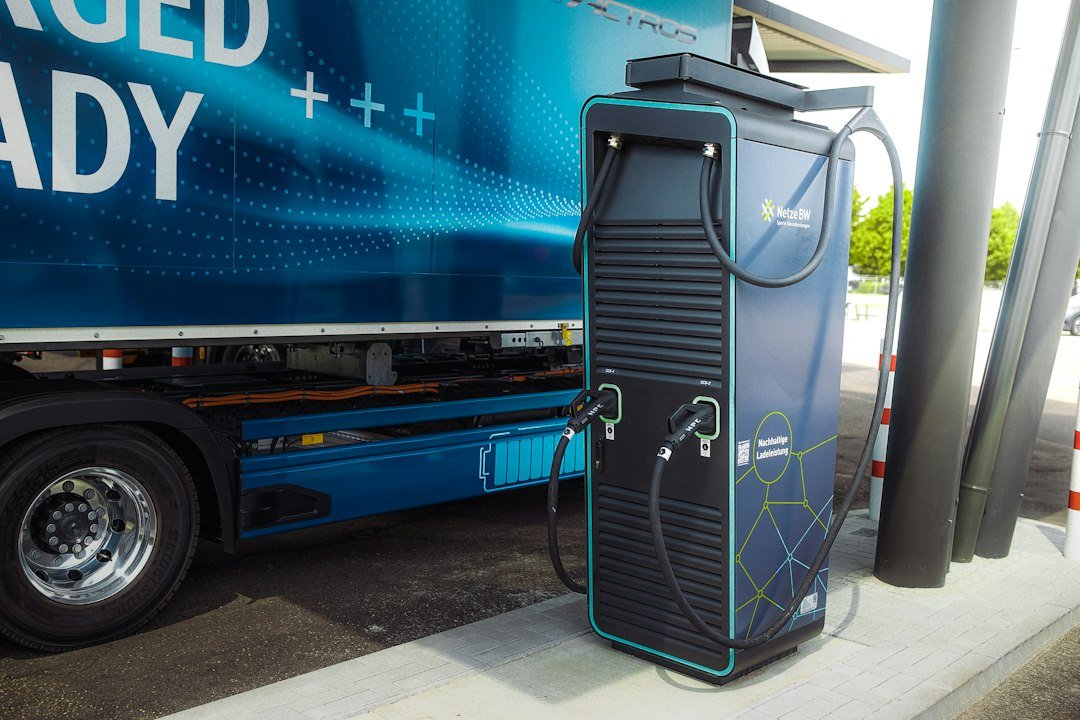
Featured photograph: electric truck charging, by Netze BW / Unsplash. Representative image, not a TECTRANS II demonstration.
Leave a Reply