
A DNA computer sounds futuristic. A droplet in a laboratory tube looks an unlikely place to find one. At Maynooth University, it is where researchers have made molecules carry out programmed calculations.
Their study, published in Nature on 16 September 2026, describes a scaffolded DNA computer tested on ten programs, including arithmetic. The idea is to design the molecules so that a favourable final arrangement encodes the answer. Nature paper
Think of constructing a puzzle in which the rules of the pieces help determine the solution. The analogy is imperfect, but it captures why this experiment is interesting: computation is built into how matter settles into a structure.
A DNA computer puts the program in the chemistry
Maynooth’s description involves short DNA strands, a longer scaffold, water and salt. Heating and cooling allow the strands to interact and assemble. The researchers report a small addition taking around 30 seconds, while a larger calculation required up to 14 hours. Maynooth University’s account, distributed through Tech Xplore
Those timings keep the achievement in perspective. This is research into another physical way to compute. It gives no reason to replace a laptop calculator with a test tube.
The more interesting question is whether some tasks could eventually benefit from working in a molecular environment in the first place. If the input is already chemical, an electronic machine may not always be the only useful design to investigate.

What “100-bit” actually means
The paper’s larger addition demonstration combined two 25-bit input numbers with carry and output information, totalling 100 bits of computation. That description should not be confused with a general-purpose 100-bit processor or a comparison with quantum-computer qubits.
The study also demonstrated reuse: one simple program was renewed 25 times by adding new input strands and repeating the thermal process. That is more precise than saying the machine ran 25 different complex programs. Nature
A new direction, with a long engineering list
Maynooth presents possibilities such as molecular systems that might one day operate in cells. Those are future research directions, not demonstrated medical applications. Maynooth University
The engineering questions extend beyond whether a reaction can produce an answer. A useful computer must accept inputs, give readable outputs and perform predictably enough for its intended job. For an energy comparison, making the DNA, heating the sample and reading the result would also belong in the accounting. An absence of continuous electrical switching inside the reaction is not proof of a zero-energy system.
That leaves a compelling result without needing to exaggerate it. Computing can be explored through the arrangement of molecules as well as the switching of electronic devices. This experiment makes that alternative tangible, even while practical applications remain open.
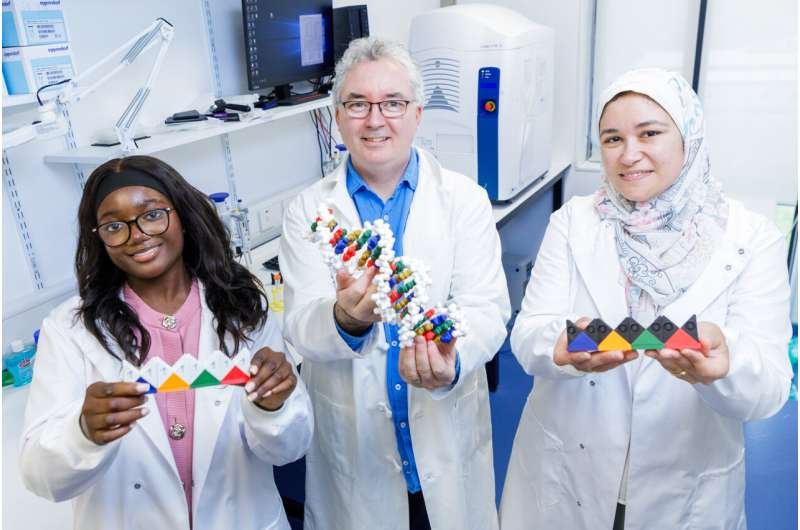
Featured image: Janet Adio, Damien Woods and Abeer Eshra of Maynooth University’s DNA computing team. Image: Maynooth University.
For another route to smaller computing hardware, see our coverage of atomically thin transistors and their electrical-contact problem.
Leave a Reply