
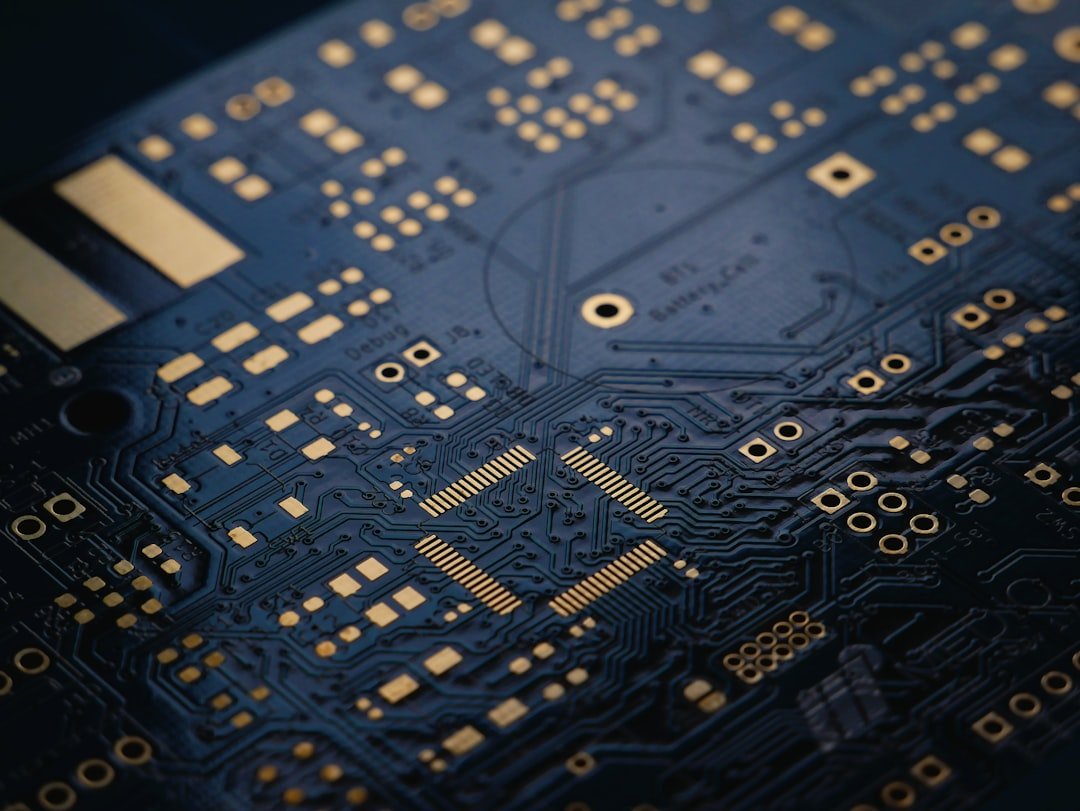
Featured image: Gold contacts on a printed circuit board illustrate hardware design. Contextual photograph; not an AMD or World Labs product. Photo: Vishnu Mohanan / Unsplash. Unsplash licence.
AI that writes a paragraph and AI that builds a navigable scene face different technical demands. AMD’s proposed acquisition of World Labs brings the second kind of research closer to a company that designs the hardware used to run AI.
On 28 September 2026, AMD announced a definitive agreement to acquire World Labs in an all-stock transaction valued at approximately US$8.2 billion. It expects closing by the end of 2026, subject to regulatory approval and other conditions. The official announcement is a deal announcement, not confirmation that the acquisition has closed.
Spatial AI makes a world that can be explored
World Labs works on models that generate and represent three-dimensional environments. “Spatial” refers to relationships in space: the positions, shapes and arrangement of objects, rather than only the words used to describe them.
Its 16 September 2025 introduction to Marble is useful background. It described generating persistent, navigable 3D scenes from inputs such as images and text, with users able to explore the resulting space. That product description predates the acquisition announcement and should not be presented as a new launch this week.
Marble’s published description includes exports in formats using Gaussian splats. These represent a scene with many small, coloured elements that a renderer combines into an image. The company also described its Spark renderer for bringing those scenes into web-based applications. World Labs’ technical product overview.
A scene that can be viewed from several positions is different from a single flat image. That difference creates useful possibilities for interactive design and other applications, while also creating more ways for an output to be inconsistent.
The agreement connects research with architecture choices
AMD says World Labs’ work will inform its hardware and software roadmaps, including applications such as robot learning and simulation. The planned arrangement would bring founder Fei-Fei Li into an executive and chief scientist role after closing. AMD’s stated integration plans.
The company’s securities filing records the merger agreement and its conditions. Its role is to document the transaction. Neither the filing nor the purchase price is a benchmark showing faster model training, better simulation or a proven improvement in robot performance.
Our assessment is that the interesting connection lies in feedback between workloads and chip design. Researchers can identify what a model spends time doing; hardware teams can examine which computations and data movements are worth improving. The announcement establishes an intention to create that connection, not a measured result from it.
A convincing scene is not a validated physical simulation
A visually believable room can still have the wrong dimensions, unstable object relationships or behaviour that would not occur in reality. Those distinctions matter if a system is used to train a robot rather than simply display an environment.
World Labs’ Marble description establishes a concrete scene-generation and rendering capability. It does not by itself establish that generated scenes obey reliable physical rules for every intended use. That further claim would need its own evaluation.
For readers assessing future announcements, the useful questions are about the task and the measurement. Better image quality, consistent geometry and successful transfer to real-world robot behaviour are different results. One should not silently stand in for another.
The same discipline applies to infrastructure claims. A proposed hardware improvement needs a stated workload, comparison and measure of performance. Without them, a roadmap remains a roadmap.
The next milestones are both corporate and technical
The first milestone is whether the acquisition closes under its announced conditions. The next is what the combined teams actually produce and how those systems are evaluated.
It will be useful to see whether later work provides transparent tests of consistency, useful application performance and computing requirements. That would help distinguish an attractive demonstration from a dependable tool.
The development matters because spatial AI research and AI hardware design are being connected through a substantial proposed transaction. It broadens the kind of workload a chipmaker is preparing for. It does not establish general intelligence, validated physics or an operating advantage simply through the announcement of a deal.
Reporting and source checks completed on 5 October 2026. By FutureTechDose Editor.
Leave a Reply