
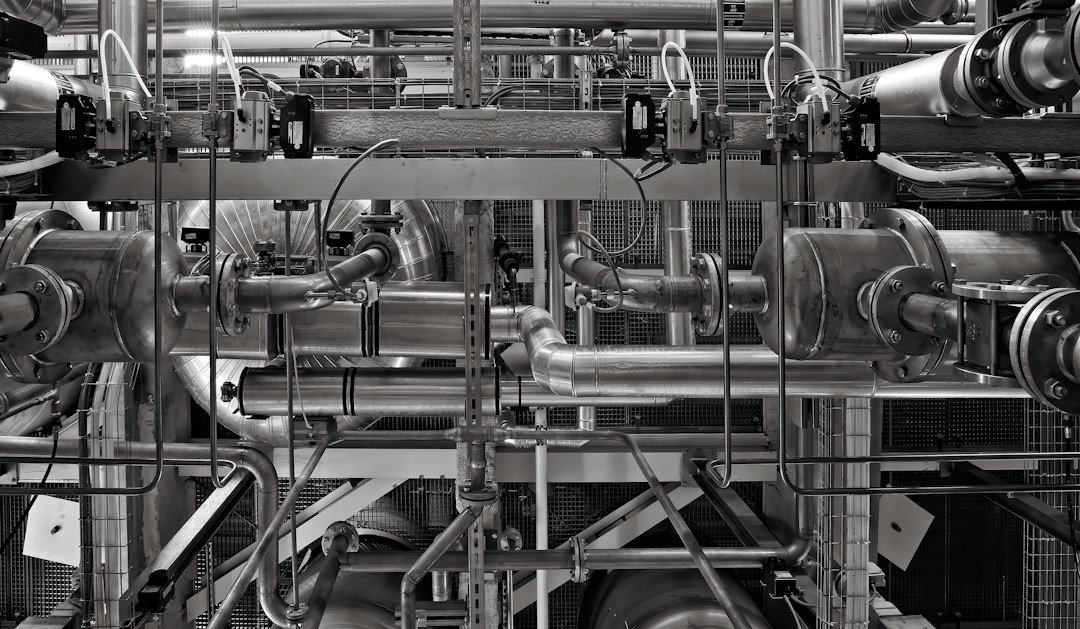
Featured image: Industrial pipework provides context for the physical infrastructure behind energy supply. It does not depict Chiba or an LNG terminal. Photo: Ricardo Gomez Angel / Unsplash. Unsplash licence.
AI infrastructure is increasingly being designed around the power supply that can reach it. In Japan, a proposed collaboration connects that design problem all the way back to liquefied natural gas procurement.
On 1 October 2026, JERA, Dell Technologies and RHAELM signed a memorandum of understanding to develop a standardized model for AI infrastructure. Their official announcement identifies the Chiba project, supported by power capacity of up to 400 MW, as the first basis for developing the approach. Operations are targeted to begin around 2028.
The model begins with generation, rather than a server order
The companies intend to coordinate power generation, electrical infrastructure, cooling and AI computing from the beginning. JERA contributes its LNG and generation capabilities, Dell its computing infrastructure and RHAELM its development capabilities. The stated division of roles.
LNG is natural gas cooled into a liquid for transport. The chain includes procurement, shipping, import, conversion back to gas and combustion in a power station. A computing campus connected to that generation still depends on the fuel chain.
Dell’s 20 May 2024 AI Factory overview provides background on its integrated computing, networking, software and services portfolio. A rack-scale system combines equipment at the rack level. That can reduce some integration work inside a facility, while leaving the facility’s energy and cooling requirements to be solved.
Our assessment is that the collaboration addresses the interfaces between these layers. Standardizing a rack alone cannot determine whether a site has power, cooling, land and the operational arrangements needed to use it.
Behind the meter changes the connection path
The Chiba plan places infrastructure adjacent to JERA’s operating thermal power station. The announcement describes it as behind the meter, using the existing generation asset, and presents this arrangement as a route to earlier delivery than conventional grid-connected development. The project description.
Behind the meter generally describes equipment on the customer or facility side of the relevant metering point. In this project, it indicates a close connection between generation and the computing development. It does not mean the entire infrastructure chain disappears.
The headline 400 MW is an upper power-capacity figure. It should not be converted directly into a number of installed GPUs. Servers, electrical systems, cooling arrangements and operating conditions all affect how a facility uses available power.
The companies’ timing claim is a development expectation. Evidence of a shorter schedule will come from completed stages and commissioned operation, rather than from the location alone.
An LNG-backed AI plan has an emissions consequence
The US Energy Information Administration’s natural-gas backgrounder explains that burning gas produces carbon dioxide and that leakage releases methane, a greenhouse gas. This is general fuel-chain context; it is not a measured emissions inventory for Chiba.
Reliable power and low-emissions power are different characteristics to assess. A project can aim to provide steady computing capacity while still having a fossil-fuel footprint.
A useful future disclosure would describe fuel consumption, measured operational emissions, the boundary used for the calculation and any changes intended over time. A general corporate ambition cannot substitute for those project-specific measurements.
The agreement establishes a plan for repeatable development
The memorandum is a framework for collaboration. The announcement says Apollo intends to act as a strategic investment and financing partner for RHAELM. It does not present that intention as a completed financing transaction for every development phase.
The wider context is an uneven race between computing and energy construction. The IEA’s 2025 analysis describes longer planning periods for energy infrastructure and substantial uncertainty in future data-centre demand. Its projections are scenarios, rather than guaranteed demand for a particular site.
A repeatable model could help teams avoid redesigning every interface on each project. Its success would still need to be shown through costs, schedule, reliability and measured operation at the first site.
Chiba matters because it makes the power-to-compute chain explicit. The next meaningful milestones are concrete development progress and operating capacity around the stated target date. The memorandum provides a direction for those milestones; it does not establish that the proposed campus is already delivering them.
Leave a Reply