

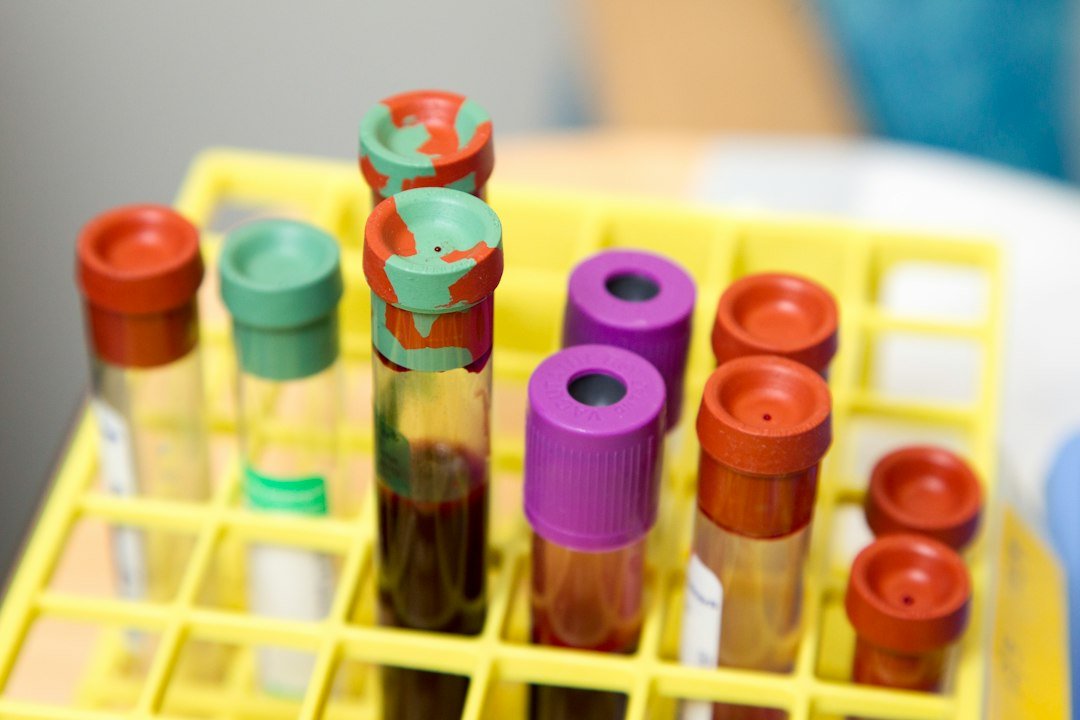
Featured image: Microscopy illustrates biomedical investigation. Contextual photograph; not AZUR-1 participants, a Jemperli treatment or a measured cancer response. Photo: Lucas Vasques / Unsplash. Unsplash licence.
A cancer treatment can matter not only because it attacks a tumour, but because of what a patient may avoid afterwards. For rectal cancer, preserving an organ rather than removing it is a substantial goal in its own right.
On 19 October 2026, the US Food and Drug Administration granted accelerated approval to a new use of Jemperli, also called dostarlimab. It may allow some patients to avoid chemotherapy, radiation and surgery. This is a specific regulatory decision, not evidence that rectal cancer has been universally cured.
The tumour’s repair system defines the eligible group
The approval covers Jemperli alone for adults with previously untreated stage II or III locally advanced rectal cancer. Tumours must be mismatch repair deficient, abbreviated dMMR, or microsatellite instability-high, MSI-H, as established by an FDA-authorised test. It does not cover every rectal tumour or disease that has spread to distant organs.
The National Cancer Institute defines mismatch repair deficiency as a problem involving genes that help correct mistakes when DNA is copied. Such cells often accumulate many mutations. That is a biological characteristic of the tumour, not a synonym for how advanced the cancer has become.
Jemperli blocks PD-1, an immune-checkpoint protein. The NCI’s explanation of checkpoint inhibitors describes how these molecular brakes normally restrain immune responses, and how cancers can exploit them. Removing a brake can allow immune cells to attack a tumour; it does not mean directly repairing the tumour’s DNA.
A Phase II trial can support an approval without becoming Phase III
The official AZUR-1 registry record, NCT05723562, describes a Phase II, single-arm, open-label study with 154 participants. Single-arm means there was no randomly assigned comparison group receiving another approach. Open-label means treatment was not concealed from participants and investigators.
Its primary outcome is a complete clinical response sustained for 12 months, assessed by independent central review. Clinical response concerns what the assessments can detect. It is different from examining an entire surgically removed tumour, and it is not a lifetime guarantee against recurrence.
The registry also lists longer-term outcomes, including organ preservation and survival. These separate measures matter: disappearance of detectable disease, avoidance of surgery and lasting survival benefit are related goals, not interchangeable labels for one result.
Its organ-preservation measure specifically tracks avoidance of total mesorectal excision and permanent colostomy over three years. That asks what intervention was ultimately needed, rather than treating a response assessment alone as the final patient outcome.
The response percentages need their denominators
In its 19 October announcement, GSK reported investigator-assessed 12-month sustained clinical complete responses in 98 of 144 evaluable patients, or 68%. The separate independent-central-review dataset had reached that endpoint in 54 of 116 evaluable patients, or 47%, with data still maturing.
Those are different assessments and evaluable populations. They should not be blended into one success rate. GSK’s exploratory 76% figure also includes patients whose complete response was established after surgery, so it cannot be presented as a 76% surgery-avoidance result.
The company reported serious adverse reactions in 20% of treated patients. The FDA warns that immune-mediated reactions can damage healthy organs and can be severe or fatal. Avoiding surgery does not make treatment risk-free.
Accelerated approval leaves a continuing evidence obligation
The FDA’s accelerated-approval framework permits earlier approval for serious conditions using an endpoint expected to predict clinical benefit. It still requires confirmation of that benefit. Failure to confirm it can lead to withdrawal.
The practical scientific question now extends beyond an encouraging response: how durable is organ preservation, and what happens over longer follow-up? For this narrow patient group, the approval changes what is licensed in the United States. It does not establish approval in Australia, replace ongoing assessment or offer an individual treatment recommendation.
Reporting and source checks completed on 20 October 2026. By FutureTechDose Editor.
Leave a Reply