The nuclear energy story is changing quickly. For many years, nuclear power was viewed as slow, expensive, politically difficult, and exposed to long construction delays. But the rise of artificial intelligence, huge data centers, grid pressure, and the global need for reliable clean electricity has pushed nuclear energy back into the spotlight.
One company attracting attention in this new nuclear race is NuScale Power. The company is developing small modular reactor technology, also known as SMRs. NuScale is not yet a mature utility business, and it is not producing large-scale reactor revenue today. However, it sits at the center of one of the most important energy themes of the next decade: the search for clean, always-on power.
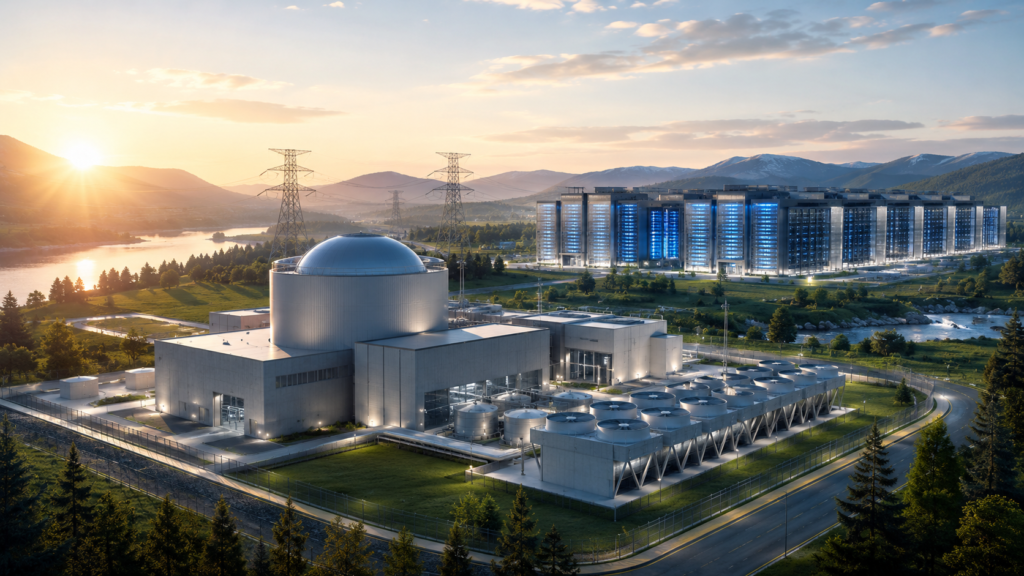
Small modular reactors are designed to be smaller and more repeatable than traditional large nuclear plants. Instead of building one massive custom reactor project, the idea is to manufacture standardized modules and deploy them in groups depending on how much power is needed. NuScale’s Power Module is designed to generate up to 77 megawatts of electricity per module [1]
This modular design matters because it could reduce construction risk, improve financing flexibility, and make nuclear power more suitable for utilities, industrial sites, and large data-center customers. NuScale has also received important regulatory recognition in the United States, with the U.S. Nuclear Regulatory Commission certifying its SMR design [7]. In the nuclear industry, regulatory approval is a major milestone because it is one of the biggest barriers between a promising design and a real operating plant.
The reason NuScale and other nuclear companies are receiving more attention now is not only climate policy. It is also electricity demand. Artificial intelligence data centers require enormous amounts of power. They need electricity that is reliable, available day and night, and scalable. Renewable energy such as solar and wind can help, but they are variable. Batteries are improving, but they do not fully solve every long-duration reliability problem at very large scale.
This is where nuclear energy becomes attractive again. Nuclear power can provide low-carbon electricity around the clock. The International Energy Agency has projected that global data-center electricity consumption could roughly double by 2030, reaching about 945 TWh in its base case [5]. The U.S. Energy Information Administration has also projected strong growth in electricity consumption from data-center servers over the coming decades [4].
For AI companies, hyperscalers, and data-center developers, power is becoming a strategic bottleneck. The winners may not only be the companies with the best chips or software. They may also be the companies that can secure long-term access to reliable electricity.
Recent U.S. government support has also improved the background for nuclear energy. In June 2026, the U.S. Department of Energy announced $17.5 billion in conditional loans to support nuclear supply chains and help utilities purchase long-lead nuclear components [3]. This program is focused on large Westinghouse AP1000 reactors, not directly on NuScale’s SMR technology. Still, it matters because it shows that the U.S. government is again willing to support nuclear energy as critical infrastructure.
For NuScale, the direct benefit from this specific loan program may be limited. The indirect benefit is more important. Nuclear energy is becoming a national priority again, and the rebuilding of nuclear supply chains could support the wider industry over time.
NuScale’s most important challenge is commercialization. The company has interesting technology, but investors need to see real projects move from planning to signed contracts, financing, construction, and operation. In its first-quarter 2026 update, NuScale highlighted progress with ENTRA1 Energy and the Tennessee Valley Authority, the RoPower project in Romania, supply-chain expansion with Framatome, and around $1 billion in liquidity and capital resources [2]The TVA opportunity is especially important. NuScale has said ENTRA1 is working with TVA on planning for up to 6 gigawatts of NuScale SMR capacity [2].
If this eventually becomes a binding commercial agreement, it could be a major catalyst for the company. However, investors should be careful. Planning discussions and early frameworks are not the same as final contracts, secured financing, and completed power plants.
Romania is another important part of the NuScale story. The RoPower project aims to deploy NuScale SMRs at a former coal plant site in Doicești, Romania [2]. This is strategically interesting because it shows how SMRs could potentially replace older fossil-fuel infrastructure while using existing energy-site advantages. But like all first-of-a-kind nuclear projects, the key risks are financing, execution, regulation, and timeline delays.
South Korea is another potential catalyst. Reports have suggested that South Korea has been discussing possible nuclear investments in the United States as part of a broader investment framework [6]. This does not mean NuScale has already secured Korean funding. It means nuclear energy is part of a wider strategic conversation involving governments, energy companies, and industrial partners. For investors, this is promising but still speculative.
NuScale’s recent contract with Paragon/Mirion for final design work on protection and control systems is also worth watching [1]. This type of engineering progress supports deployment readiness, but it is not the same as a major customer order. Investors should separate technical progress from commercial proof.
The opportunity for NuScale is large, but the risk is also large. The company remains in an early commercial stage. It does not yet have the stable earnings profile of a mature energy company. The stock is therefore highly sensitive to news, expectations, interest rates, funding developments, and investor sentiment toward nuclear energy.
The main risks are customer conversion risk, financing risk, construction risk, competition risk, and valuation risk. NuScale needs potential customers to become real customers. It needs projects to become financed projects. It needs designs to become operating reactors. Until that happens, the stock may continue to move sharply on news and speculation.
At the same time, the upside case is clear. If NuScale can turn its regulatory advantage and commercial pipeline into real deployed reactors, it could become one of the key companies in the new nuclear era. The AI data-center boom, government support for nuclear energy, and growing demand for clean baseload electricity all support the long-term story.
The most important catalysts to watch are binding power-purchase agreements, final project financing, confirmed customer orders, construction timelines, government-backed deployment programs, hyperscaler or data-center partnerships, and progress in Romania, TVA, Japan, or South Korea.
In conclusion, NuScale Power is one of the most interesting companies in the nuclear energy revival. It has regulatory credibility, a modular reactor design, active project discussions, and exposure to the AI power-demand theme. It also has significant liquidity, which gives it time to continue developing its commercial pipeline [2].
However, NuScale is not a low-risk infrastructure company yet. It is still a high-risk, high-upside nuclear technology and commercialization story. The key question is not whether nuclear energy is becoming more important. The key question is whether NuScale can turn its first-mover advantage into signed contracts, financed projects, and operating reactors.
If it succeeds, NuScale could become a major winner in the clean energy and AI infrastructure era. If it fails to commercialize quickly enough, the stock may remain vulnerable to hype cycles, delays, and sharp corrections.
Disclaimer: This article is for educational and informational purposes only. It is not financial advice. Investors should do their own research and consider their own risk tolerance before buying or selling any stock.
References:
[1] NuScale Power — Paragon awarded contract to complete final design work supporting NuScale’s small modular reactor.
[2] NuScale Power — First Quarter 2026 results and business update.
[3] U.S. Department of Energy — American nuclear supply chain loans.
[4] U.S. Energy Information Administration — Data-center server electricity consumption outlook.
[5] International Energy Agency — Energy demand from AI and data centers.
[6] Reuters — South Korea nuclear investment discussions in the United States.
[7] U.S. Department of Energy — NRC certification of NuScale’s small modular reactor design.