
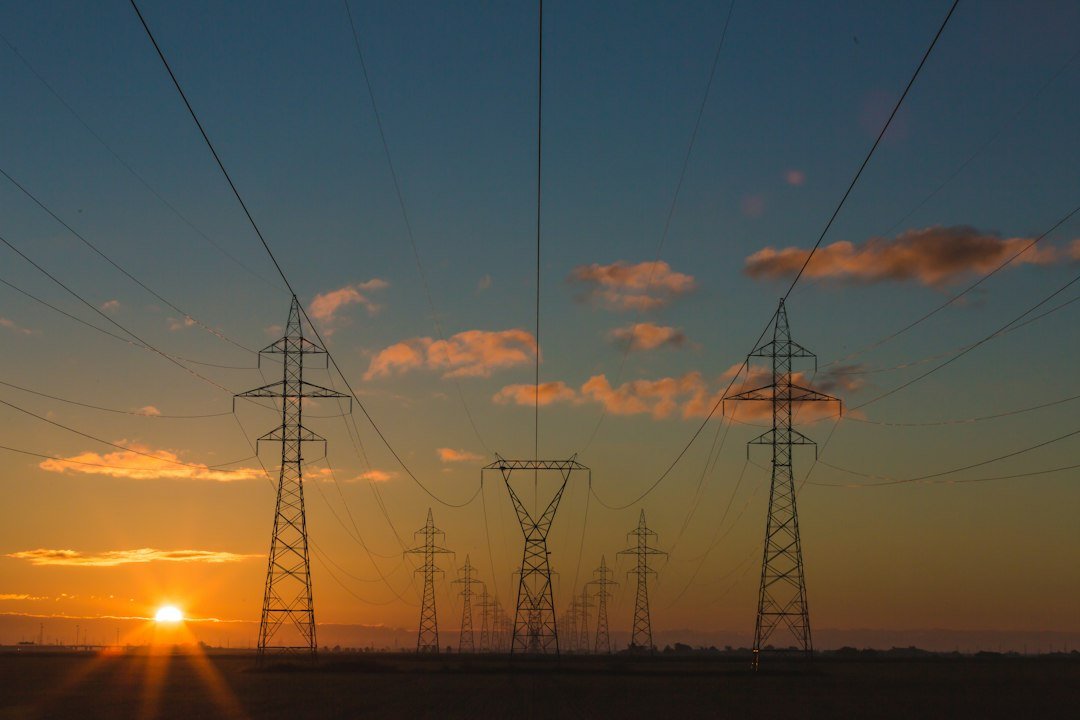
Featured image: Electricity pylons illustrate power-network infrastructure. Contextual photograph; not the planned Cheyenne project or a verified Wyoming location. Photo: Matthew Henry / Unsplash. Unsplash licence.
An AI data centre needs electricity before it can deliver intelligence. Its arrival also creates a difficult public question: who carries the cost if the wires and power plants are built but the expected demand never arrives.
On 6 October 2026, Black Hills announced definitive agreements to serve Google’s planned Cheyenne data centre. The company plans US$1.8 billion in new generation and says the contract structure makes Google responsible for service costs. These are commercial commitments and construction plans, rather than an operating power supply. Read the company announcement.
Three power numbers describe different parts of the plan
Black Hills plans 564 megawatts of company-owned natural-gas generation. It will provide up to 590 MW of grid-connected service, while managing approximately 2.1 gigawatts of third-party resources through a private microgrid. The announced 2.7 GW resource mix includes reserve margins; it should not be read as the data centre’s continuous demand. Generation and service details.
A megawatt measures power at a moment, while a megawatt-hour measures energy over time. Reserve capacity helps cover a shortage or outage. Adding equipment ratings therefore does not tell us how much electricity a customer consumes in a year.
A microgrid is a locally coordinated group of electricity resources and loads. The US Department of Energy describes its capacity to operate as a controllable entity, connected to the wider grid or separately where the design permits. That general definition does not establish every operating capability of the Cheyenne project. DOE’s microgrid background.

Large-customer service is a different arrangement
Black Hills’ published Wyoming service overview describes its Large Power Contract Service model for new or growing loads of at least 13 MW. Its general provisions combine a negotiated contract, access to market electricity and customer-owned backup generation dispatched by the utility. This is background to the service model, rather than the complete new Google contract. The utility’s tariff overview.
The distinction helps explain why a large digital campus can require more than a conventional connection request. Generation ownership, dispatch, backup resources and the price of service can be split among different parties. The utility must coordinate the electrical system even when it does not own every power source.
For readers, that makes the contract as important as the headline capacity. Two projects with the same megawatt rating can leave very different obligations with their customers, utilities and neighbours.
Cost protection needs more than a promise
Black Hills says the agreements cover cost pass-through, recovery of generation investment, early termination and credit protection. It plans energy service from late 2027, ramping to peak load in 2030; the generation investment runs from 2027 to 2029. The agreements have terms through 2048. These dates remain forward-looking. Contract protections and schedule.
A stranded asset is infrastructure whose cost remains after its expected use disappears. A long-term commitment can allocate that risk, but the strength of the protection depends on enforceable terms and the customer’s ability to meet them. The public announcement is evidence of the stated structure, rather than an independent audit of its eventual performance.
Electricity prices already recover more than fuel alone. The EIA explains that generation, transmission, distribution, operating costs and regulation all influence prices. That is why the allocation of a new project’s infrastructure costs can matter to customers who never use its servers. EIA’s electricity-price explanation.
The next milestones are physical and contractual
The useful next evidence is the arrival of equipment, completion of infrastructure and actual service under the agreements. Announced capacity must become dependable delivered electricity. Cost protections must also remain effective if construction, demand or financing conditions change.
This deal illustrates an emerging part of the AI build-out: energy infrastructure comes with obligations extending well beyond a server’s useful life. The public-interest test is whether a large new customer pays for the system it requires as the project moves from contract to operation.
Leave a Reply