
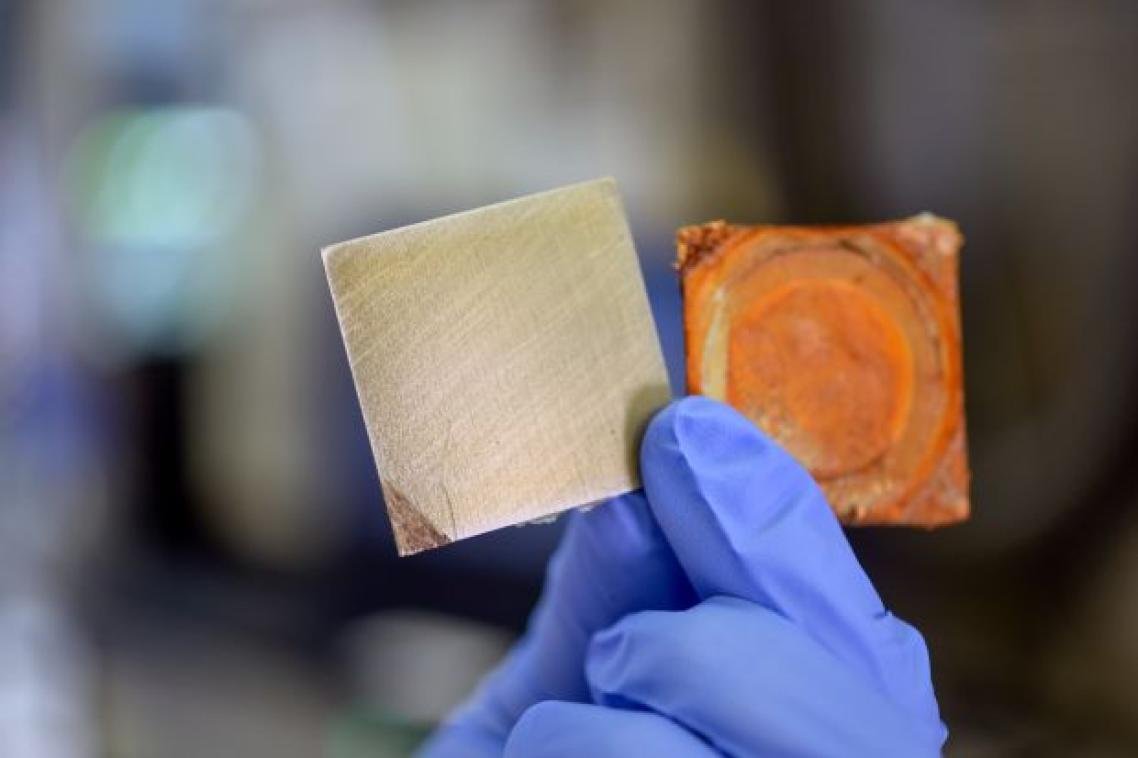
The weak point in a protective coating is often a small scratch. A self-repairing rust coating being developed at the University of Queensland tries to respond at that weak point, releasing protective molecules when the local chemistry signals trouble.
UQ highlighted the work on 16 September 2026. Researchers led by Dr Asep Nugraha built tiny containers that can be mixed into a water-based coating. The containers hold a corrosion inhibitor and release it in response to changes in acidity. UQ’s announcement describes promising laboratory results and planned pilot testing, rather than a coating already deployed across bridges or buildings.
A reserve of protection inside the paint
The peer-reviewed Small Science paper, first published on 22 August, describes a layered container for benzotriazole, a rust-inhibiting chemical. Its structure helps keep the chemical in place under ordinary conditions while allowing greater release when the surrounding chemistry changes.
In everyday terms, the coating carries a reserve of protection close to where it may be needed. The research concerns chemical protection at damaged areas. It should not be read as paint that can reconstruct missing steel or make a damaged structure sound again.

A striking laboratory number
The paper reports a corrosion rate of about 0.0000372 millimetres per year, equivalent to roughly 37 nanometres, calculated from electrochemical testing. It also describes protective performance during 39 days in a salt solution. UQ compares the rate with 0.025 millimetres per year for certain high-performance coatings, producing its headline of more than 600 times slower corrosion.
These numbers deserve careful interpretation. An annualised corrosion rate is a way of expressing test results. It is not the same as leaving a bridge outdoors for a year, let alone demonstrating a century of protection. The comparison also cannot be extended automatically to every existing coating or exposure condition.
UQ says pilot-scale testing is planned, with a goal of reaching a commercial product within five years. That is the research team’s ambition, not a confirmed market-release date.
The real prize is fewer maintenance visits
Our view is that the most persuasive benefit would be a practical reduction in maintenance. A coating that remains useful for longer could mean fewer access closures, fewer difficult repainting jobs and less material replacement.
For that to become credible outside the laboratory, testing needs to address sunlight, temperature changes, mechanical wear, application quality and the environments where the coating would actually be used. Manufacturing consistency, cost and the environmental behaviour of released ingredients also belong in that assessment.
Readers following our energy and infrastructure reporting will recognise the pattern: a material becomes important when it survives the conditions of a real system. UQ’s coating offers an inventive way to protect steel. The next chapter is proving that the protection lasts where steel has to work.
Featured image: Steel samples shown in UQ’s corrosion-protection research announcement. Photo: The University of Queensland. Credit: The University of Queensland.
Leave a Reply