
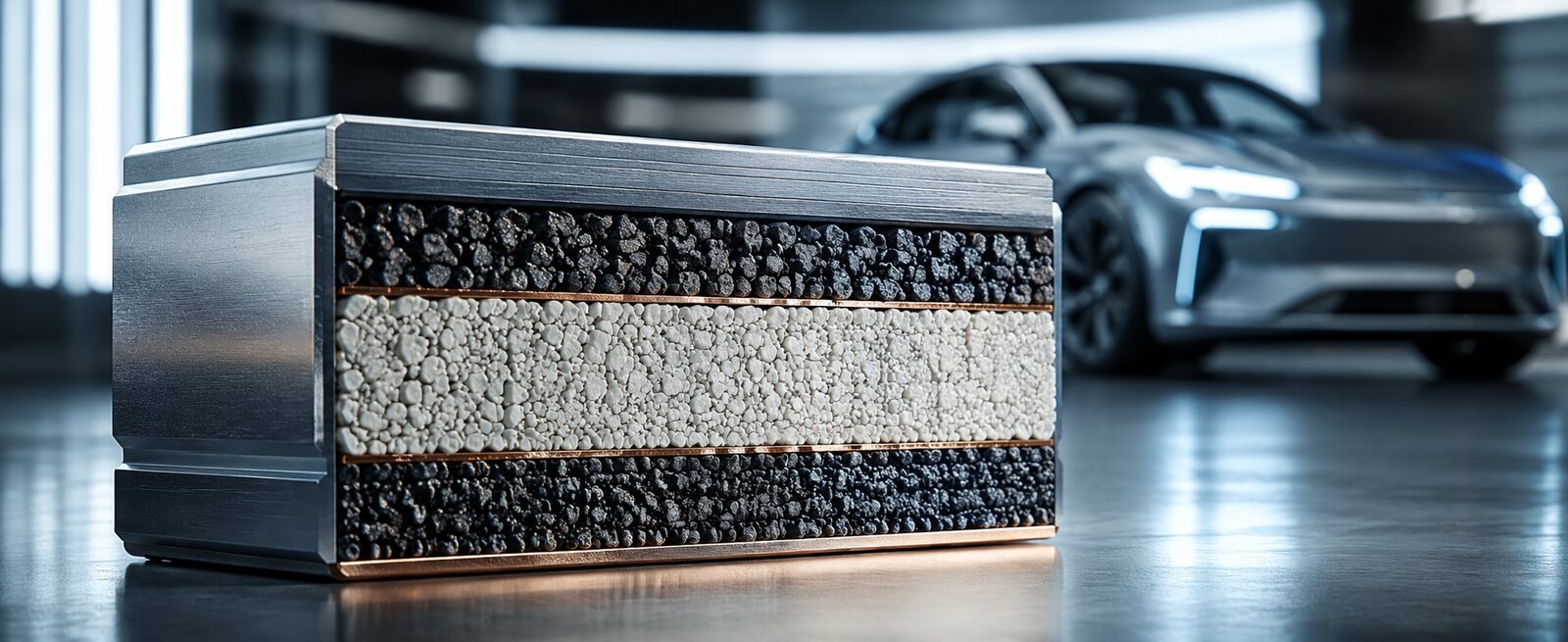
Replacing a flammable liquid with a solid sounds simple. Inside a high-performance battery, it changes almost every interface that must work for thousands of cycles.
Solid-state batteries use a solid electrolyte between electrodes. Toyota and Idemitsu are developing sulphide-electrolyte materials and manufacturing methods, with early production intended to be limited before any mass-market transition. This explainer is based on Toyota and Idemitsu solid-electrolyte agreement and the additional primary or authoritative sources listed below.
How to read this development
Energy technologies must be judged as complete systems, not only by a record cell, well or pilot plant. For solid-state batteries, Toyota and Idemitsu solid-electrolyte agreement supports the central development and Toyota battery technology roadmap update provides a second technical or deployment source. Commercial value also depends on lifetime, efficiency, construction, maintenance, supply chains and the value of energy at the time it is delivered.
A prototype can validate physics without yet proving bankable economics. Equally, a lower-efficiency system can be useful if it stores energy longer, uses cheaper materials or operates when alternatives cannot. Nature Communications lithium-metal solid-state study adds the broader context needed to distinguish a strong technical milestone from a prediction about how quickly the technology will reshape the grid.
What changed with solid-state batteries?
Toyota and Idemitsu announced cooperation on mass-production technology for solid electrolytes and an initial commercialisation pathway (Toyota and Idemitsu solid-electrolyte agreement.)
Toyota’s public roadmap presents solid-state batteries as a later-stage, high-performance option rather than an immediate replacement for all lithium-ion vehicles (Toyota battery technology roadmap update.)
Peer-reviewed studies continue to identify unstable interfaces, dendrites, pressure control and scalable processing as major engineering challenges (Nature Communications solid-electrolyte interface study.)
How solid electrolytes change an EV battery
- 1. Lithium ions cross a solid ceramic, polymer or sulphide electrolyte instead of a liquid-soaked separator. (Nature Communications solid-electrolyte interface study.)
- 2. Some designs pair the solid electrolyte with lithium-metal anodes to increase stored energy per kilogram. (Nature Communications lithium-metal solid-state study.)
- 3. Cells must maintain intimate contact across solid layers as materials swell, shrink and cycle. (Nature Communications solid-electrolyte interface study.)
Why this matters
A stable solid electrolyte could support higher energy density and reduce some liquid-electrolyte fire risks (Toyota battery technology roadmap update.)
Fast charging and longer range could become possible without simply making the battery pack larger (Toyota next-generation battery strategy.)
Automotive investment is creating manufacturing knowledge that may benefit aviation and specialised storage (Toyota and Idemitsu solid-electrolyte agreement.)
What remains uncertain
- Laboratory cells are smaller and easier to control than full automotive packs exposed to vibration and temperature swings (Nature Communications lithium-metal solid-state study.)
- Cracks or tiny gaps at solid interfaces can raise resistance and enable dangerous lithium growth (Nature Communications solid-electrolyte interface study.)
- New materials, dry rooms, pressing and quality control can make early production expensive (Toyota and Idemitsu solid-electrolyte agreement.)
What to watch next
Judge progress by independently tested full-size cells, manufacturing yield, cycle life and vehicles delivered—not revised target dates or isolated energy-density numbers. Initial products may be premium and low-volume.
Quick questions
Are solid-state EV batteries available in mass-market cars?
Solid-state batteries are used in some small devices, but the high-energy automotive versions discussed by carmakers are not yet mass-market.
What is the most important takeaway?
The chemistry is credible, but turning brittle, reactive layers into millions of reliable automotive cells is the real breakthrough still required.
Reporting note: This article distinguishes peer-reviewed or regulator-confirmed findings from company projections and early-stage research. It is general information, not medical, purchasing or investment advice.
For a battery approach focused on material cost, read about sodium-ion batteries and their energy-density trade-offs.
Leave a Reply