
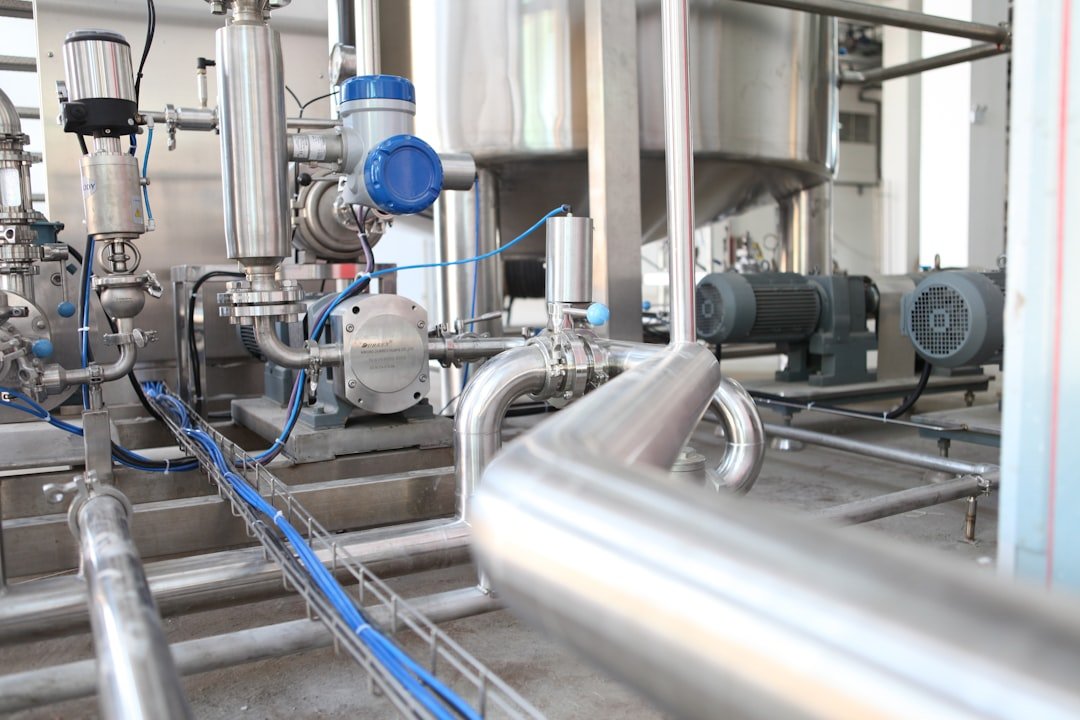
Featured image: Industrial pumps and pipework illustrate process engineering. Contextual photograph; not the TRIG system, Kemper facility or a newly licensed power plant. Photo: Crystal Kwok / Unsplash. Unsplash licence.
A newly licensed coal-gasification system is being offered to developers with an unusually substantial inheritance: engineering and operating records from a project whose coal-gasification operation was suspended. The opportunity is real technology transfer. The unresolved test is commercial delivery.
On 16 October 2026, the US Department of Energy announced its first non-exclusive licence for Transport Integrated Gasification, or TRIG, in the power-generation field. The licensee is Latitude Energy Services. The announcement is not the opening of a new power station.
A licence transfers rights, not megawatts
TRIG converts coal into a fuel gas that can be used in a wider energy process. DOE describes the technology as suited to lower-rank, higher-moisture coals. The new agreement concerns power applications; Latitude separately holds rights for industrial uses.
Non-exclusive means the technology is not reserved solely for this licensee. It does not mean an unlimited right to build anywhere, and a licensing agreement should not be mistaken for construction finance or permission for a particular site.
The distinction matters because energy announcements often combine several different kinds of progress. Access to intellectual property, a project design, an approved site, financing and a commissioned plant are related milestones, but none automatically supplies the others.
The engineering archive is the tangible asset
The National Energy Technology Laboratory’s August 2026 licensing information describes access to process-design packages, heat and material balances, operating procedures and control logic. These are practical details a developer would need to understand how an integrated process should behave.
DOE’s new announcement also points to more than 20,000 historical data logs associated with the Kemper project. These are inherited records, not fresh performance measurements from a new commercial installation.
An engineering archive can be valuable even when the original project’s commercial outcome was disappointing. It can reveal operating limits and integration problems that are absent from a short technology description.
But the value of the archive depends on what a future developer does with it. Reusing the design unchanged and demonstrating that lessons have reduced cost or risk are different propositions. The latter needs evidence from the proposed implementation.
Kemper is essential context for the claim
On 28 June 2017, Southern Company and Mississippi Power announced suspension of the start-up and operation of Kemper’s lignite-gasification portion. The facility continued using natural gas. That history prevents the new licence from being read as the first unveiling of an untested idea.
It also prevents the opposite simplification: that a suspended project proves every future use of its underlying process must fail. A technology, its integration into a particular plant and the commercial conditions surrounding that plant are not identical objects.
The useful standard is therefore specific. A new project should show which assumptions, equipment arrangements or operating conditions differ from the historical case, and demonstrate why those differences matter. A licence by itself cannot make that comparison.
Gasification does not automatically capture carbon
Turning coal into a gas is not the same as removing its carbon emissions. NETL’s carbon-capture overview distinguishes pre-combustion separation, where carbon dioxide can be separated from a hydrogen-containing gas stream, from the wider process of producing and using fuel.
Whether a particular project includes capture, how much it captures and what happens to the separated carbon dioxide must be established separately. The new licensing announcement does not demonstrate a zero-emissions power system.
The same caution applies to costs. Licensing terms and engineering access may support development, but do not establish competitive electricity prices or a dependable construction budget.
The next announcement needs operating evidence
For this technology transfer, meaningful follow-up would include a defined project, transparent financing and an emissions boundary that covers what the plant actually does. Commissioning and sustained operation would then test the design against physical performance.
The new agreement is significant because a substantial engineering record is becoming available for another commercial attempt. Its credibility will depend on learning from that record. The licence opens a route to a test; it is not the result of the test.
Reporting and source checks completed on 17 October 2026. By FutureTechDose Editor.
Leave a Reply