
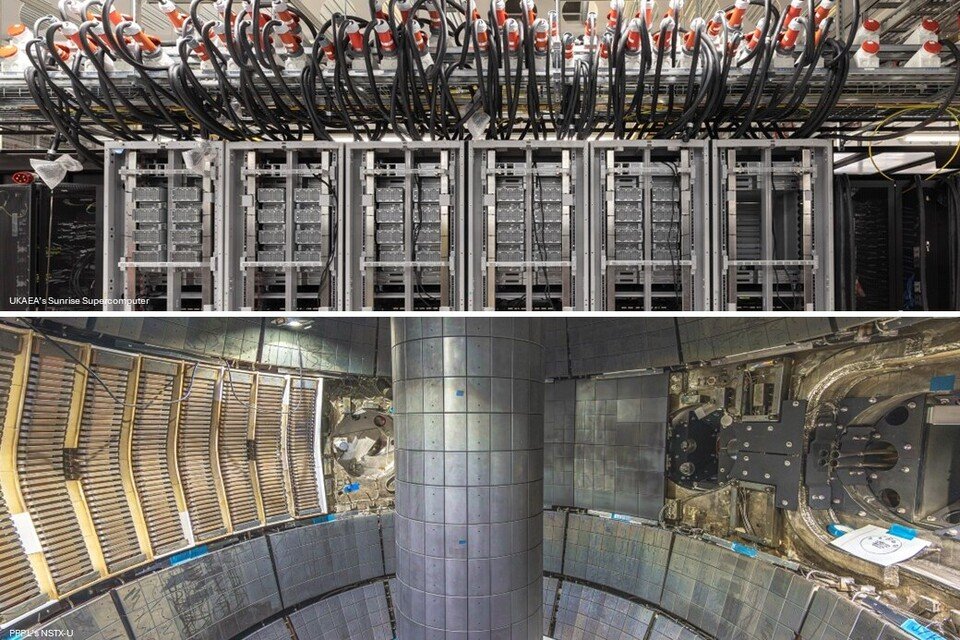
UKAEA’s SUNRISE supercomputer and PPPL’s NSTX-U fusion experiment. Credit: UKAEA / PPPL.
A fusion experiment in Oxfordshire and another in New Jersey could become more useful to each other without moving a single piece of reactor hardware.
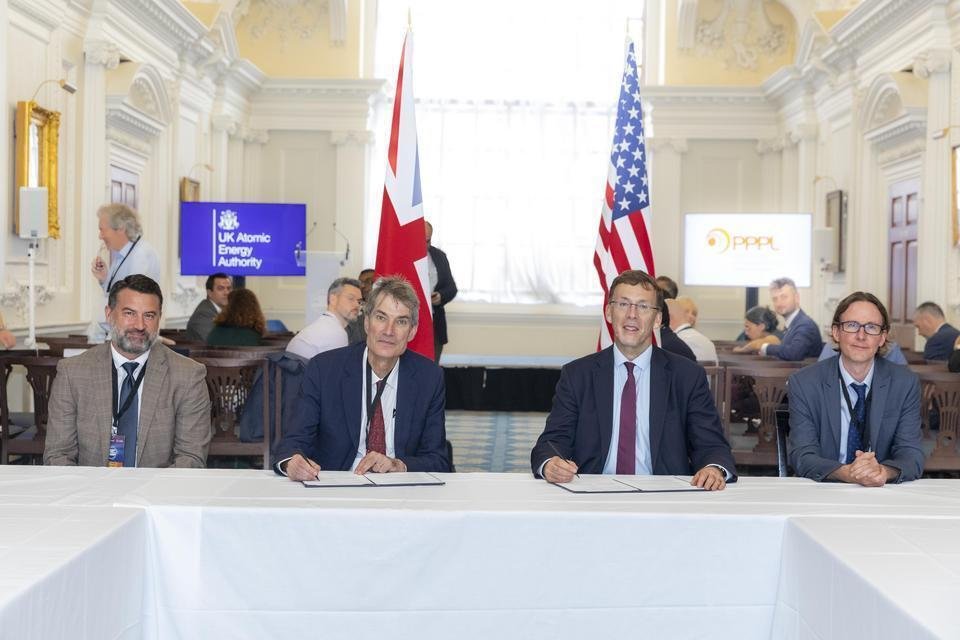
On 14 September 2026, the UK Atomic Energy Authority and the Princeton Plasma Physics Laboratory announced a plan to explore connecting their fusion supercomputing platforms: Britain’s SUNRISE and America’s STELLAR-AI. The agreement is a declaration of intent, not confirmation that the systems are already operating as one connected service. UKAEA announcement
The idea addresses an important weakness in scientific AI. A model can become very good at recognising the behaviour of one experiment and still struggle when the equipment or conditions change.
For fusion research, learning from a wider range of machines could make the difference between a clever demonstration and a dependable tool.
Teaching the model more than one machine
The partnership focuses on MAST Upgrade in the UK and NSTX-U in the United States. Both are spherical tokamaks: experimental devices that use magnetic fields to confine plasma in a compact shape resembling a cored apple. Fusion research seeks to join light atomic nuclei and release energy, while controlling the exceptionally demanding conditions involved. PPPL announcement and explanation
Researchers want to combine experimental information with simulations and develop shared AI models. PPPL describes work towards a foundation model for spherical tokamaks, meaning a broadly trained model that could support several tasks rather than one narrowly defined prediction. It also outlines common data formats and digital twins: computer representations informed by experimental measurements. PPPL project details
An everyday analogy is learning to drive. Memorising the exact turns on one familiar street is useful, but it is not the same as understanding how to navigate an unfamiliar road. A scientific model faces a related test when it meets data from a machine it did not learn from.
Britain’s announcement says the collaboration aims to let researchers share datasets, train common models and move suitable workloads between computing systems. SUNRISE has £45 million in backing. Those resources support the research programme; they should not be confused with funding a completed electricity-producing fusion plant. UKAEA announcement
The result still has to survive an experiment
Our assessment is that the most valuable outcome would be better predictions on unfamiliar experimental data. More computing power is an input. A model that makes useful predictions outside its original training conditions is evidence of progress.
That puts validation at the centre of the story. Researchers need to compare a model’s predictions with measurements, record where it fails and establish when it can be trusted. A visually convincing simulation is not, by itself, confirmation of how a physical device will behave.
The partnership builds on work in machines such as MAST Upgrade, previously covered by FutureTechDose. Its promise is cumulative: make each experiment more informative, then use that knowledge to improve the next one.
No electricity-production milestone has been announced here. The development is a plan to improve how fusion science learns. If that plan succeeds, the most significant connection across the Atlantic may be the knowledge that becomes usable at both ends.
Leave a Reply