
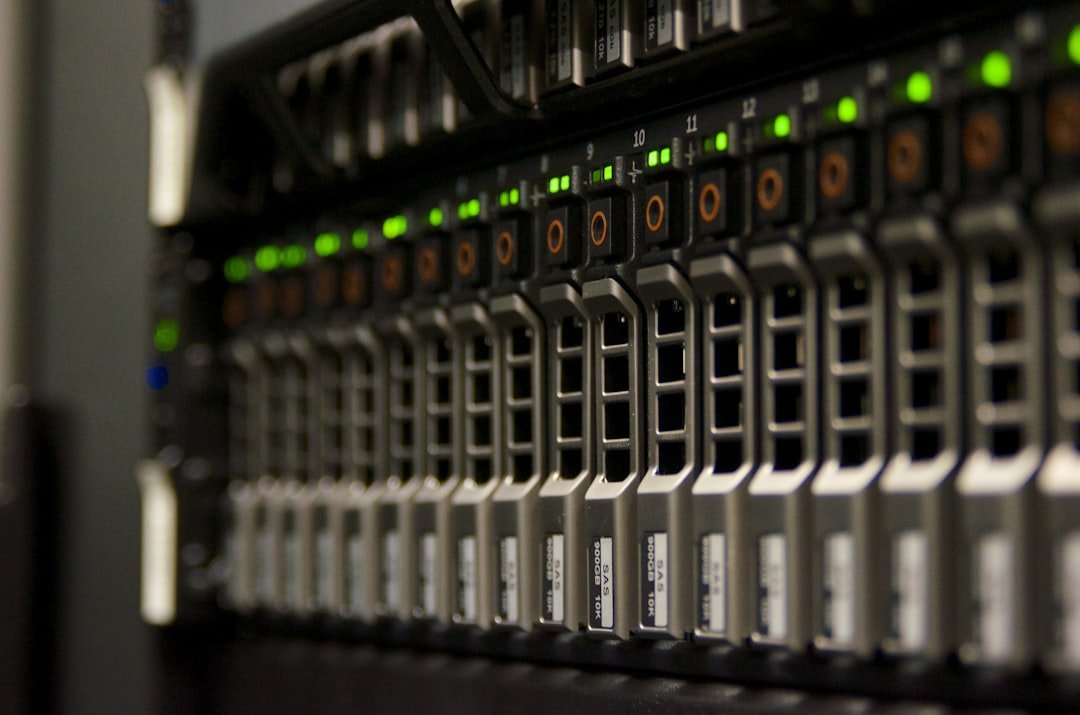
Featured image: Representative data-centre equipment, not HUMAIN’s Saudi installation. Photo: Domaintechnik / Unsplash · Domaintechnik.
The most interesting detail in the latest AMD AI infrastructure announcement is not a giant capacity target. It is that customers are already using the equipment.
On 31 August 2026, AMD said HUMAIN was serving customers in Saudi Arabia and beyond through infrastructure combining AMD Instinct MI355X accelerators, EPYC processors and Cisco networking. The operating service supports AI training and inference: building models and then running them to answer requests. AMD’s deployment announcement
That makes this a more concrete development than another promise to build an enormous AI campus. It also creates a useful test of AMD’s competitive position: whether organisations will choose its complete platform for continuing work.
What is running, and what comes next
The partners also described a next phase of up to 250 megawatts, based on a later generation of AMD hardware, with capacity expected to begin coming online in the second half of 2027. Their broader joint venture targets up to one gigawatt by 2030.
Those figures describe planned infrastructure, not today’s installed computing power. The announcement does not disclose the capacity of the service already operating. Combining the live deployment with the larger targets would give readers a misleading picture of its present scale. Deployment stages and targets
A megawatt is a measure of power, not a count of chips or completed AI answers. Two installations with the same power envelope can deliver different results depending on their hardware, workloads and utilisation. The number is useful for understanding infrastructure ambition, but it cannot substitute for customer performance data.
The software decision behind the hardware order
AMD has also been working on the part of the purchase that does not appear in a photograph of a server rack: the developer experience.
Its 27 August ROCm 10 announcement introduced tools intended to make deploying and improving AI workloads easier. ROCm is the software platform that helps applications use AMD accelerators. One component, Hyperloom, is designed to identify performance bottlenecks, suggest or implement changes, and validate the results. AMD also described tools for giving coding assistants more knowledge of its hardware and software. AMD’s ROCm 10 announcement
The practical significance is straightforward. A cheaper or faster processor is less attractive if a team must spend months adapting its application. Conversely, a smoother transition can make a competing platform worth evaluating. That is an adoption argument, not evidence that every Nvidia workload now transfers unchanged.
Release status matters here too. AMD described the ROCm command-line tool as a technology preview. The broader announcement should not be treated as proof that every new component is equally mature. ROCm release details
Saudi Arabia is buying more than computing capacity
In a 9 September update, AMD framed its regional work around local skills, developer access and control over AI infrastructure. It described training initiatives and an enterprise offering intended to help organisations begin using AI. These are the company’s stated ambitions; their longer-term effect will depend on uptake. AMD’s regional strategy update
This helps explain why a national AI project can be more consequential than a single equipment order. Computing access, the people trained to use it and the applications built on top can reinforce one another. A successful installation gives a supplier a reference customer and gives local developers a reason to learn its tools.
For now, AMD has an operating deployment to point to, alongside a much larger plan. The next meaningful milestone is sustained customer use: reliable service, repeat orders and applications that justify the infrastructure. That is where a challenge to Nvidia becomes a business rather than a headline.
Related reading: Nvidia’s NVLink Fusion partnership with d-Matrix.
Leave a Reply