
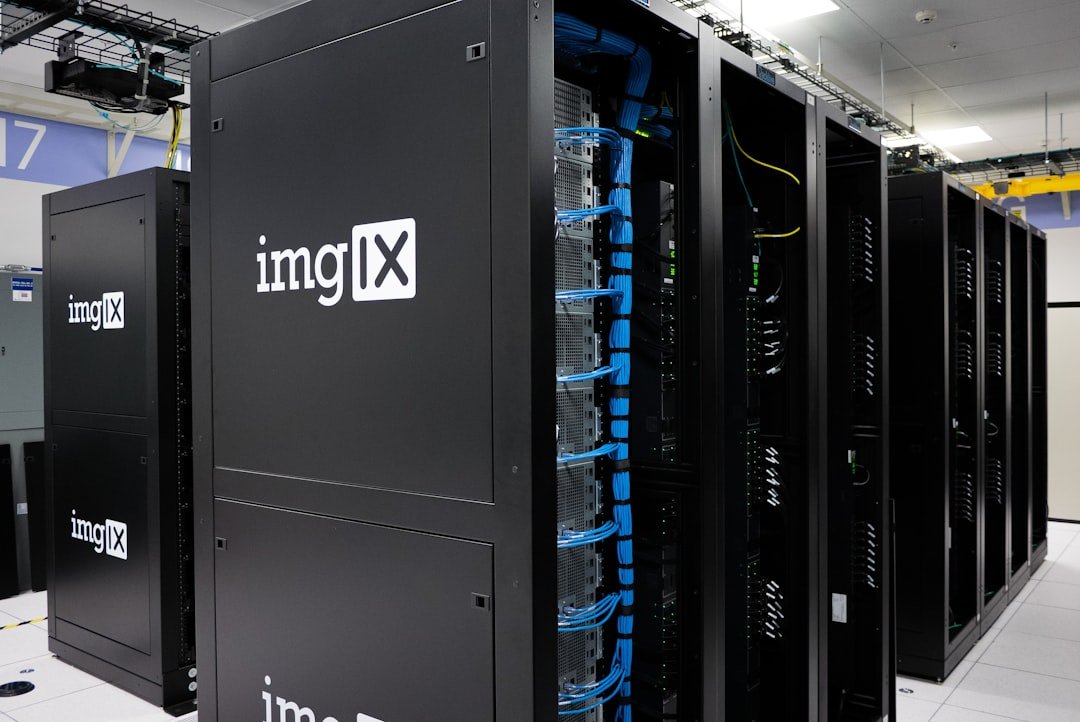
Featured image: Representative server infrastructure, not the planned d-Matrix Raptor system. Photo: imgix / Unsplash.
An AI chip does not need an Nvidia logo for Nvidia to become part of the sale. That is the intriguing possibility behind NVLink Fusion and its latest infrastructure partnership.
On 10 September 2026, d-Matrix announced a collaboration to bring its next-generation Raptor AI processors into systems built around Nvidia’s NVLink Fusion and MGX technologies. The proposed arrangement combines a specialist chipmaker’s hardware with Nvidia’s connections and rack architecture. Initial Raptor availability is planned for the fourth quarter of 2027. This is a development agreement, not a product customers can buy today. d-Matrix announcement
For anyone expecting the AI hardware contest to divide neatly into Nvidia and everyone else, it is a revealing move. A company can challenge Nvidia in one part of a system while depending on it elsewhere.
The opportunity inside every AI answer
Responding to a prompt involves different kinds of work. First, a model processes the material it has been given. Then it generates an answer, piece by piece. Engineers call those stages prefill and decoding.
d-Matrix’s proposed approach gives specialised hardware a role in that second stage. Its Raptor design is intended to pair closely connected memory and computing resources, while Nvidia GPUs can handle other work. The company expects to send the design for manufacturing—a milestone called tape-out—before the end of 2026. Tape-out still leaves fabrication, testing and system qualification ahead. d-Matrix’s Raptor roadmap
That division of labour is appealing in principle. A restaurant does not ask the same appliance to chop vegetables, boil water and freeze dessert. An AI system may also benefit from using different hardware for different jobs. Whether this particular arrangement improves speed or cost requires measurements from finished systems.
Nvidia wants the connections too
NVLink Fusion is Nvidia’s route for bringing customised processors into its wider infrastructure. Instead of requiring every accelerator to be a standard Nvidia GPU, it gives partners a path to use Nvidia’s high-speed connections and system architecture. It is a defined partner ecosystem; it should not be read as a promise that arbitrary chips and software will work together without engineering. Nvidia’s NVLink Fusion overview
The strategic implication is substantial. If buyers choose another company’s accelerator but retain Nvidia connections, networking and system components, Nvidia can remain involved in the installation. That is our reading of the business model, rather than a disclosed prediction of revenue from this agreement.
Nvidia’s account of the partnership stresses another obstacle facing chip start-ups: the surrounding machinery. A usable AI rack needs power delivery, cooling, communications and a supply chain as well as processors. The proposed deployment would put d-Matrix systems alongside Nvidia’s infrastructure for different parts of inference—the process of running a trained model. Nvidia’s partnership explanation
The result to watch is a working system
The announcement does not establish that Raptor outperforms Nvidia GPUs across AI workloads. Nor does it establish that customers will save money after networking, software and electricity are included. Those are questions for production systems and independently reproducible tests.
For buyers, the useful scorecard will include response speed under heavy demand, energy per completed task and the effort required to move an existing application. A quick demonstration is only one part of that assessment.
For Nvidia, the attraction is easier to see. It can sell the infrastructure that competing ideas need to reach customers. The next contest in AI may be decided as much by who connects the chips as by who designs them.
Related reading: AMD’s operating AI deployment in Saudi Arabia.
Leave a Reply