

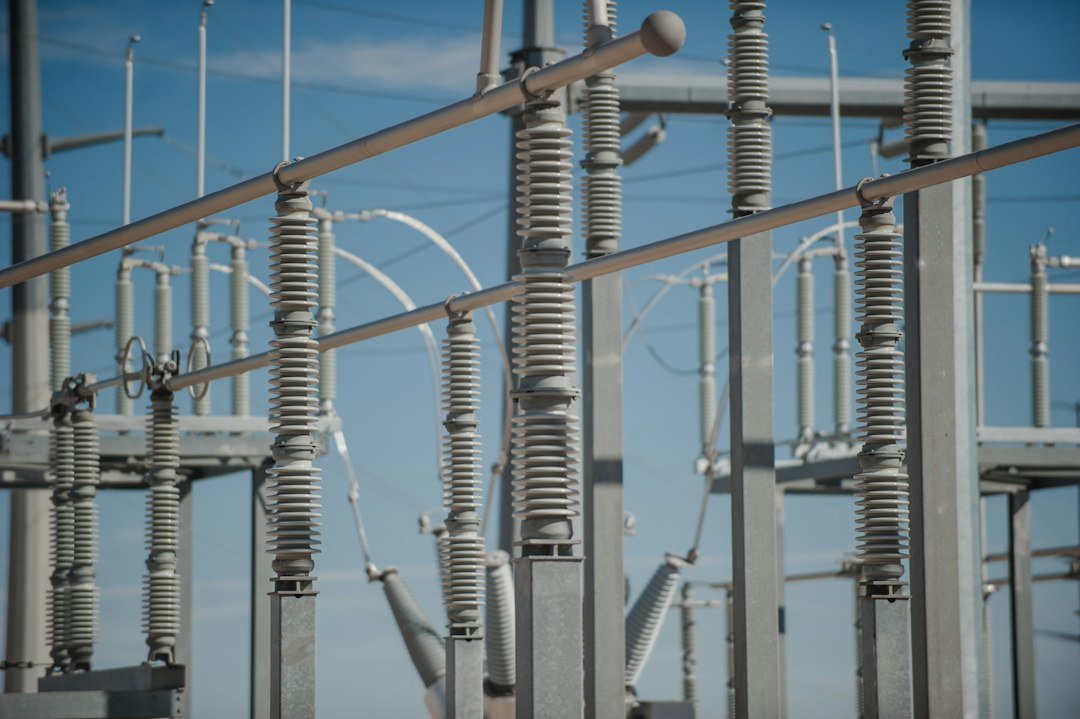
Featured image: A power plant in Germany illustrates existing energy infrastructure. Contextual photograph; not Chalk Point or either Maryland storage project. Photo: Wim van 't Einde / Unsplash. Unsplash licence.
An energy-storage target can be written into law in a sentence. Delivering it requires developers to submit viable projects, regulators to choose them and construction to turn those choices into working infrastructure.
On 1 October 2026, Maryland’s Public Service Commission conditionally selected two projects totalling 440 megawatts in a first solicitation that sought 800 MW. The awards are an intermediate procurement step, not an announcement that 440 MW of new batteries have begun operating. Read the commission’s announcement.
The missing megawatts reveal a selection problem
The selected projects are the 400 MW Chalk Point Storage Project and the 40 MW Jade Meadow III Battery Storage Project. Both have four-hour durations and flat 15-year award terms. The 360 MW shortfall means the first round secured 55% of its target.
Five applicants entered the process. Two withdrew, and another project was not selected on ranking and ratepayer-impact grounds. A proposed expansion of Chalk Point arrived too late for evaluation in that round. Those are procurement outcomes, rather than evidence that batteries failed a technical test. Selection and withdrawal details.
Our reading is that a numerical target must pass several filters before it becomes an award: eligibility, comparative value, developer participation and timing. A large project pipeline is useful, but it does not guarantee that every project remains available on the terms a regulator accepts.
Capacity credits address a revenue uncertainty
The commission describes Energy Storage Capacity Credits as a way to make project revenue more stable against uncertain future PJM capacity-market prices. PJM operates a capacity market intended to secure resources that can supply power or reduce demand when needed. Capacity is a commitment to availability; it is different from the electricity actually delivered in an energy market. PJM explanation of capacity markets.
A battery project needs a way to pay for equipment and operation over years. If one revenue stream is difficult to predict, a longer-term support mechanism can improve the case for financing. That explains the purpose of the award without proving that construction, operating costs or future market conditions are settled.
This is also why a capacity award should not be reported as a guaranteed saving on every future bill. Its value depends on the alternative costs it avoids, the price of support and whether the asset performs when the system needs it.
Four-hour storage is a defined service, not an unlimited supply
Megawatts describe the rate at which a battery can deliver power. Multiplying 440 MW by four hours gives 1,760 megawatt-hours as a simple duration-based calculation. It is an explanation of the specified service, not a separately verified measurement of the projects’ installed battery inventory.
Storage must first be charged. A four-hour resource can move energy from one period to another, but it cannot independently create fuel-free electricity for an indefinite shortage. How it contributes to reliability depends on charging opportunities and the timing of stressed hours.
PJM’s description emphasises performance when resources are called during system emergencies. The relevant engineering question is therefore not just how many megawatts appear on a project sheet, but how much dependable output is available at the required time. Availability and performance in the capacity market.
An award still has to become a site
Independent reporting on 8 October highlighted the shortfall and the next permitting stage. Both selected projects still require commission construction approval, including hearings on safety, siting and environmental impacts. Those reviews are distinct from the competition that selected the capacity-credit awards. PV magazine reporting on the result.
The next evidence of progress should identify approvals, construction milestones and commissioning. The next evidence of value should identify actual operating performance and the costs borne by customers. Combining these into one celebratory capacity number would hide the decisions still ahead.
Maryland’s result illustrates a broader energy-transition constraint: support mechanisms can make a project more feasible, but they cannot substitute for a viable site and a delivered asset. The meaningful count changes as a project moves from target, to award, to operation.
Leave a Reply