
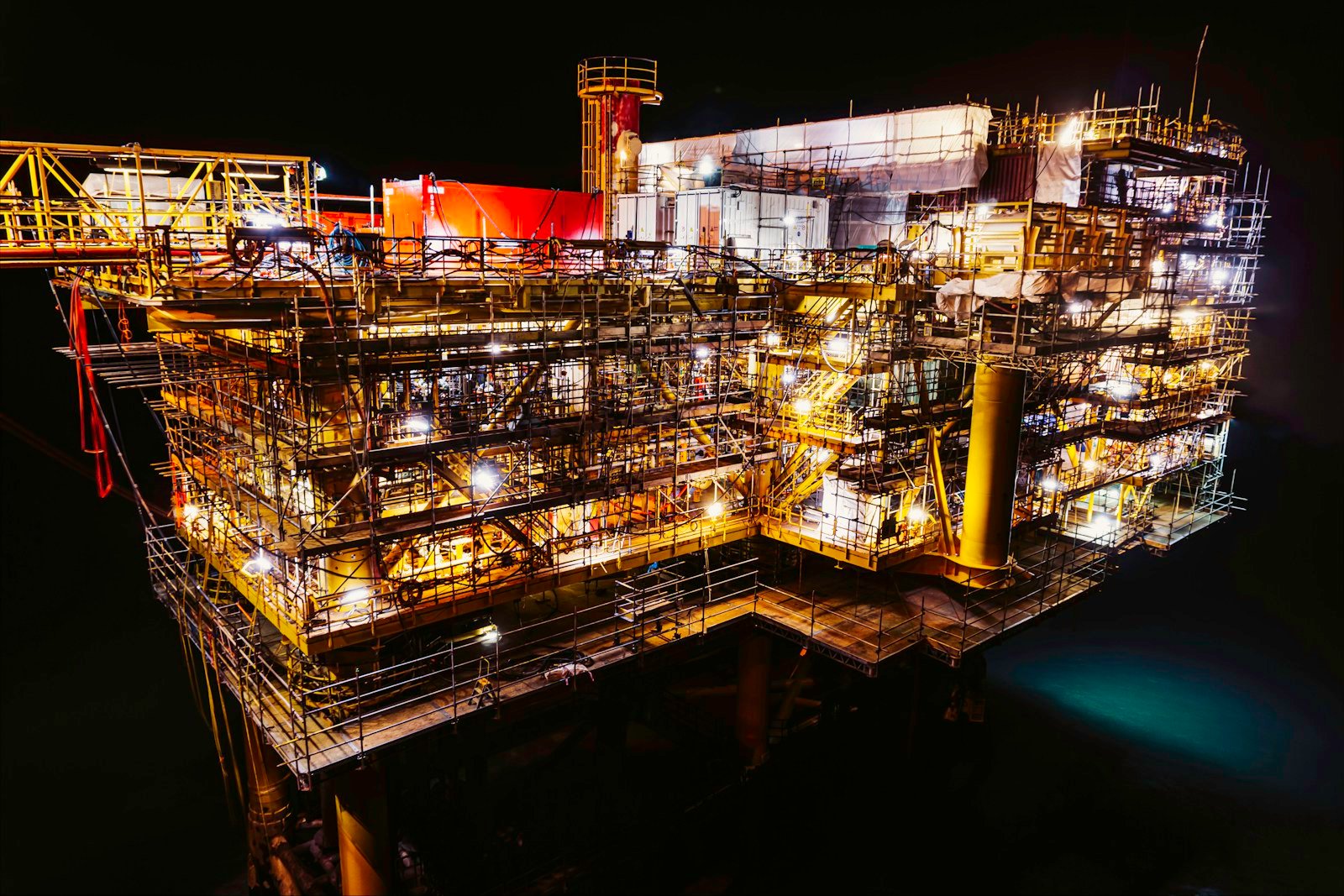
Featured image: An offshore industrial platform illustrates maritime energy infrastructure. Contextual photograph; not Bonaparte, West Peron, Ichthys or an operating carbon-storage facility. Photo: Dean Brierley / Unsplash. Unsplash licence.
A proposed carbon-storage hub off northern Australia has cleared an important geological and regulatory step. The milestone concerns where carbon dioxide could be stored, rather than a new facility already removing emissions.
On 16 October 2026, the Australian Government declared West Peron an identified greenhouse-gas storage formation for the proposed Bonaparte Carbon Capture and Storage project. The declaration recognises a formation deep beneath the seabed as suitable for permanent storage, subject to the further steps needed to develop the project.
Storage capacity is not carbon already stored
The government says INPEX proposes storing up to 443 million tonnes of carbon dioxide, with injection over up to 35 years. Those are the scale and duration of a proposal, not an operating record or a quantity already prevented from entering the atmosphere.
INPEX’s announcement on the same day describes the declaration as Australia’s first for an offshore saline-aquifer storage site. The proposed site is about 260 kilometres from Darwin, and the company targets first injection in the early 2030s, conditional on approvals and commercial agreements.
The difference between potential capacity and delivered storage is fundamental. A large geological resource can support a development case without demonstrating the injection rate, reliability or cost of a completed system.
A saline aquifer is porous rock, not a giant empty tank
Geoscience Australia defines a saline aquifer as a deep, porous and permeable rock formation containing highly saline groundwater. Carbon storage uses geological formations rather than treating the seabed as a cavity waiting to be filled.
Porosity describes the spaces within the rock. Permeability describes how fluids can move through connected pathways. Both help explain why a storage project requires detailed assessment rather than simply a map of a large underground area.
Those geological characteristics are only part of the development problem. A project must also connect emissions sources, transport and injection infrastructure, while establishing how performance will be monitored over time.
The declaration is a step towards an injection title
The National Offshore Petroleum Titles Administrator’s explanation says a storage-formation declaration provides a mechanism to move from an assessment permit towards a holding lease or injection licence. It should not be relabelled as the injection licence itself.
This distinction makes the announcement more precise, not less significant. Geological recognition reduces one category of uncertainty while leaving other technical, environmental, regulatory and commercial work to complete.
INPEX says pre-front-end engineering and design began in April 2025. That work develops a proposal before later commitments and execution. The October declaration does not, by itself, establish that financing, all approvals or construction are complete.
The emissions claim needs the whole chain
The government expects Ichthys LNG to be an initial source of carbon dioxide, subject to the necessary approvals. INPEX likewise identifies the Ichthys joint venture as the expected anchor customer. Other industrial sources are a potential future role, not confirmed current storage activity.
For assessing climate performance, the useful measurements would include how much carbon dioxide reaches the storage system, how much is injected and retained, and the emissions associated with running the chain. Storage capacity alone cannot provide those answers.
Nor does a plan to capture emissions at one industrial facility establish that every emission associated with its products has been eliminated. The boundary of a reduction claim should be stated explicitly rather than implied by the CCS label.
The next milestone needs to move from suitability to delivery
The geological declaration is a concrete advance for Bonaparte. It gives the project a more defined basis for subsequent development than an unassessed storage concept would have.
The next evidence should identify the operating permissions, commercial commitments and engineered system that turn that possibility into a service. Once operation begins, reported injection and monitoring results will matter more than potential capacity.
Bonaparte has advanced the case for using West Peron. It has not yet completed the much larger task of demonstrating a dependable carbon-storage project.
Reporting and source checks completed on 18 October 2026. By FutureTechDose Editor.
Leave a Reply