
An AI system that writes an experimental protocol has not yet carried out the experiment. AutoDNA, described in a Nature paper published on 4 November 2026, tackles the gap by connecting planning, scheduling and physical instruments in a biomolecular laboratory.
The researchers report autonomous coordination of more than 20 instrument types across over 11,000 steps. People still maintained the hardware and replenished reagents and labware. This is a research-platform demonstration, not evidence that a system can independently develop a safe, effective medicine.
The experimental sequence has to survive contact with hardware
Nucleic-acid work includes making DNA, copying it, producing RNA and reading sequences. These operations require more than a plausible written instruction: a sample has to reach the right device, receive the right handling and remain compatible with later steps.
The released software repository separates a web interface, an AI protocol system, a C++ scheduler and hardware firmware. That architecture makes an important distinction visible. Deciding what to do, allocating shared equipment and executing a physical command are different responsibilities.
Four demonstrations test a defined operating envelope
The paper reports matching expert-optimised enzymatic DNA-synthesis yields, accelerating concurrent protocol execution by 3.2-fold, recovering digital content from an end-to-end DNA-storage cycle and identifying a clinically detected KRAS G13D mutation.
These are specific outcomes under the tested conditions. The speedup is not a claim that every biology experiment becomes 3.2 times faster. Identifying a mutation in a demonstration is also not regulatory clearance for a diagnostic test or evidence that the platform discovers a treatment for that mutation.
Instrument capabilities become a software interface
A 6 November institutional account from Shanghai Jiao Tong University describes presenting instrument capabilities as atomic services with natural-language descriptions and unified code interfaces. The system can combine those capabilities rather than treating every device as an unrelated manual workflow.
The university also describes checks on programmes, tracking instrument state and scheduling resources under timing constraints. Those features help explain why the advance is not simply a chatbot attached to a robotic arm. The experimental plan has to remain executable as equipment and sample states change.
Open software does not remove the physical dependency
The repository lists non-standard hardware requirements as well as software components. Our interpretation is that reproducibility therefore has two boundaries: reproducing the computational workflow and reproducing the physical behaviour of the instruments it controls.
A laboratory adopting the code would need to establish that its own devices, consumables and operating conditions satisfy the same assumptions. Downloading software is not equivalent to receiving a validated, instrument-independent laboratory service. The useful question is which parts transfer without redesign and which require new verification.
Autonomy should be measured with failures included
A stronger operating record would report intervention frequency, failed runs, sample losses and recovery time alongside successful demonstrations. It should distinguish planned human replenishment from an unexpected rescue. That makes the autonomy claim measurable rather than dependent on the most polished run.
The next important test is whether the system maintains experimental quality when tasks compete for resources and when something goes wrong. Faster scheduling has value only if the resulting samples and measurements remain trustworthy.
AutoDNA shows how models, laboratory workflows and hardware can be designed together. Its immediate contribution is an engineering route from an experimental request to coordinated nucleic-acid operations. Broader scientific autonomy will depend on how reliably that route works beyond the demonstrations, not on how confidently an AI can describe the next experiment.
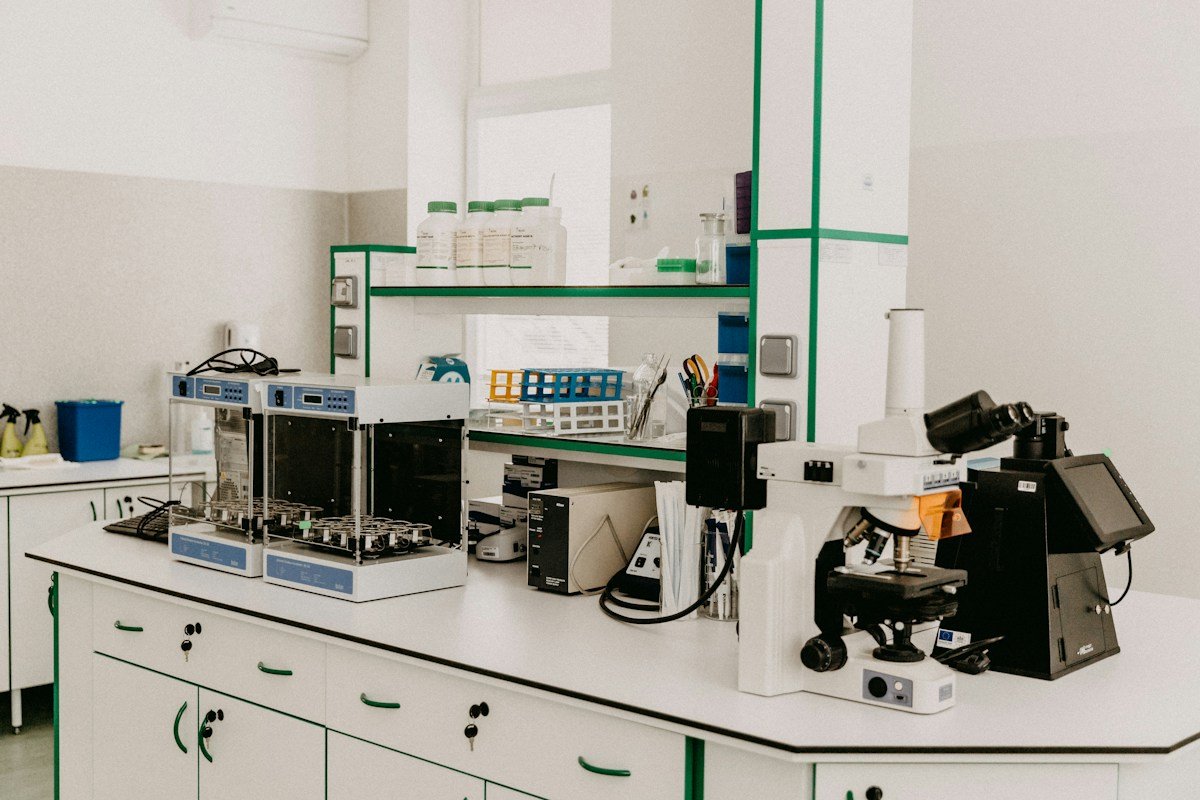
Featured image: Clinical laboratory equipment at Trnava University. Contextual photograph, not the experiment, trial, product or facility described. Photo: Trnava University/Unsplash. Unsplash licence.
Leave a Reply