

On 26 August 2026, the US Food and Drug Administration approved
Rasonque, the brand name for daraxonrasib, for certain adults with
metastatic pancreatic adenocarcinoma. The once-daily tablet is the first
approved treatment in its class to broadly inhibit the RAS family of
proteins, a molecular engine that drives most pancreatic cancers.
The approval rests on a randomized Phase 3 trial in 500 people whose
cancer had spread and had already been treated. Median overall survival
was 13.2 months with daraxonrasib, compared with 6.7 months for
physician-selected chemotherapy, according to the FDA’s
detailed approval notice and the peer-reviewed trial
report indexed by PubMed.
That is a major advance in a disease with few effective later-line
options. It is not a cure, and a median is not a forecast for any one
person. But the result provides strong clinical evidence that a target
once widely described as “undruggable” can be attacked in a way that
changes survival.
Why RAS is difficult to target in pancreatic cancer
RAS proteins work like molecular switches. When they are “on,” they
transmit signals telling cells to grow and divide. In healthy cells,
those signals are tightly controlled. In cancer, mutations can lock RAS
into an overactive state, allowing growth signals to keep flowing.
More than 90% of pancreatic ductal adenocarcinomas carry
cancer-driving RAS mutations, most often in the KRAS gene. The US
National Cancer Institute identifies altered KRAS as a central target in
current pancreatic-cancer
research.
The difficulty is that RAS has a smooth, flexible surface with few
obvious pockets for a conventional drug to grip. Earlier breakthroughs
produced medicines aimed at individual variants, such as KRAS G12C, but
that variant is relatively uncommon in pancreatic cancer. Most patients
carry other RAS alterations.
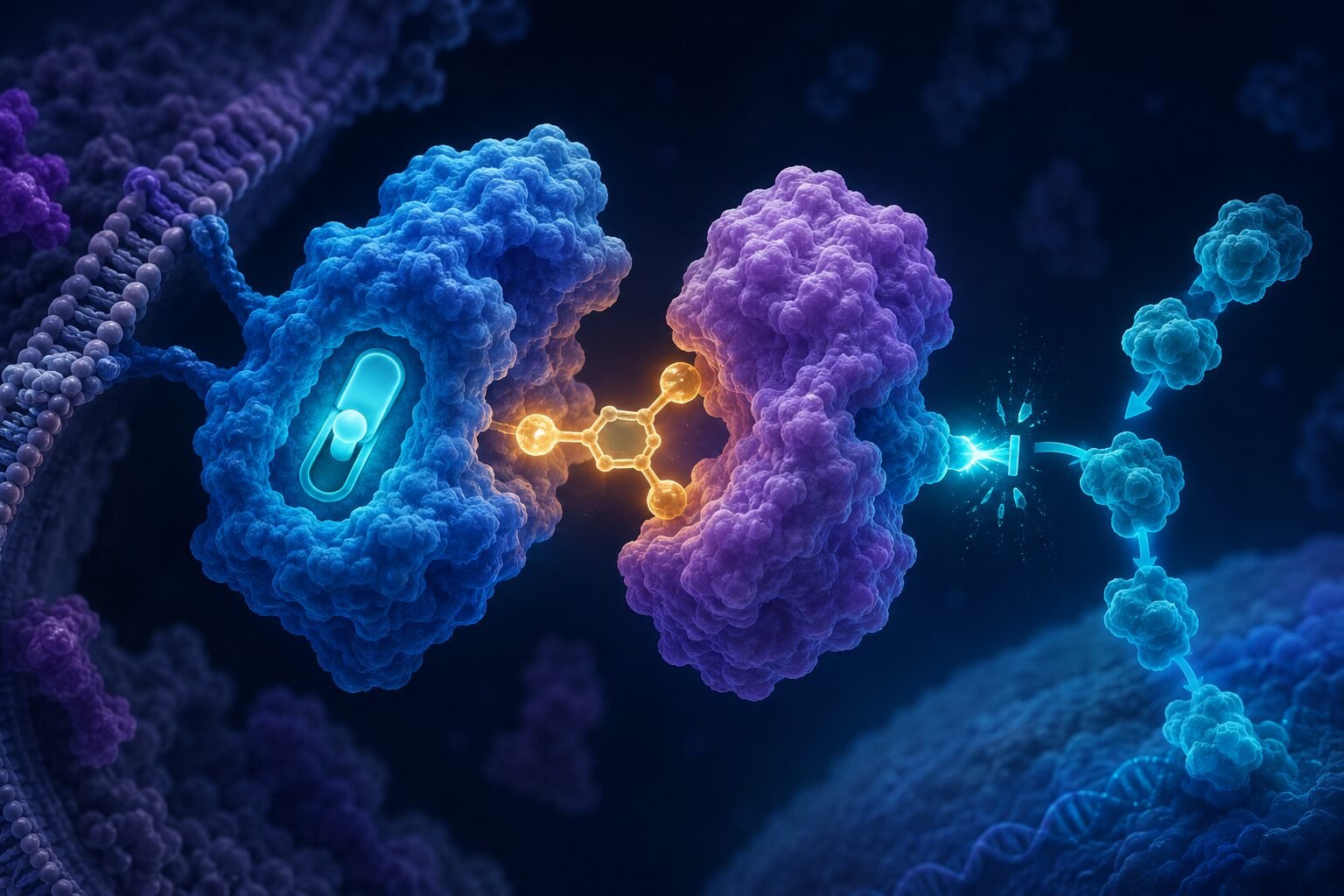
Daraxonrasib takes a broader approach. It targets the active,
GTP-bound—or “RAS(ON)”—state of several mutant and normal RAS proteins.
The drug first associates with a cellular protein called cyclophilin A.
Together, drug and cyclophilin form a three-part complex with active
RAS, covering the area RAS uses to communicate with downstream growth
machinery. The discovery team describes this as a non-covalent
“molecular glue” mechanism in the Journal of Medicinal
Chemistry paper indexed by PubMed.
In plain language, daraxonrasib borrows a protein already inside the
cell to help clamp the cancer-driving switch and interrupt its
signal.
What the Phase 3 trial found
RASolute 302 was an international, open-label Phase 3 trial. Its ClinicalTrials.gov
record enrolled people with metastatic pancreatic ductal
adenocarcinoma whose disease had progressed after one previous line of
systemic treatment. Participants were randomly assigned to daraxonrasib
or the treating physician’s choice of standard chemotherapy.
Among all 500 participants:
- Median overall survival was 13.2 months with daraxonrasib
versus 6.7 months with chemotherapy. - Median progression-free survival—the time before cancer worsened or
death—was 7.2 months versus 3.6 months. - The objective response rate, meaning measurable tumour shrinkage
meeting trial criteria, was 30% versus 11% in the FDA
analysis. - The hazard ratio for death was 0.40, indicating a
60% lower risk of death at any given point during the trial period—not a
60% cure rate.
About 91.8% of participants had a RAS G12 mutation. Importantly, the
survival advantage was also seen in the trial’s overall population,
which included other RAS variants and a small number of people without
an identified RAS mutation.
The study was open-label, so participants and clinicians knew which
treatment was given. However, progression-free survival was assessed
using blinded independent central review, reducing the risk that
knowledge of treatment influenced scan interpretation.
Daraxonrasib side effects and treatment limits
Daraxonrasib is taken by mouth at the FDA-recommended dose of 300 mg
once daily until the cancer progresses or toxicity becomes unacceptable.
That convenience should not be confused with a mild medicine.
In the peer-reviewed trial, grade 3 or higher adverse events occurred
in 61.8% of people receiving daraxonrasib and 69.6% of those receiving
chemotherapy. Treatment-related side effects caused discontinuation in
1.2% and 11.2%, respectively.
The FDA
announcement lists common effects including rash, diarrhoea, mouth
inflammation, nausea, fatigue, vomiting, abdominal pain, swelling,
reduced appetite and bleeding. The prescribing information also warns
about serious skin and soft-tissue reactions, gastrointestinal
perforation, interstitial lung disease or pneumonitis, and embryo-fetal
harm.
These are population-level trial findings. Treatment suitability and
side-effect management require specialist oncology care.
Who the approval
covers—and who it does not
The US approval covers adults with metastatic pancreatic
adenocarcinoma who have received at least one previous systemic therapy,
or who are not candidates for multiagent systemic therapy. It does not
approve daraxonrasib as a preventive drug, a treatment for early-stage
pancreatic cancer, or a universal replacement for chemotherapy.
Nor does the result prove that the same drug will work across all
RAS-driven cancers. RAS mutations are common in lung and colorectal
tumours as well, but each cancer has its own biology and must be tested
in dedicated trials.
The FDA reviewed the application through Project Orbis in
collaboration with Health Canada, while European and Japanese regulators
participated as observers. The US approval does not automatically create
approval in those jurisdictions; their regulatory decisions remain
separate.
Resistance remains the next
problem
Even strong targeted therapies can lose effectiveness as tumours
evolve. A 2026 Nature
Medicine study analysed resistance signals from patients treated in
earlier daraxonrasib studies and investigated them in laboratory models.
Researchers identified several possible escape routes, including
amplification of KRAS or MYC and increased receptor-tyrosine-kinase
signalling.
The team tested rational drug combinations that delayed or overcame
resistance in cell and animal models. Those combination results are
preclinical: they do not yet prove greater safety or survival in
people.
An ongoing Phase 3 programme is also evaluating daraxonrasib, alone
or with chemotherapy, earlier in metastatic pancreatic cancer. The next
important questions are whether the benefit holds in first-line
treatment, how long responses last in routine practice, which tumours
resist from the outset, and whether combinations can extend control
without unacceptable toxicity.
Why this approval matters
Pancreatic cancer has repeatedly defeated promising targeted drugs.
Daraxonrasib is different because it moved beyond laboratory activity
and early response data to a large randomized trial showing longer
survival, followed by regulatory approval.
The achievement is both clinical and technological. It gives eligible
US patients a new later-line option now, while validating a
molecular-glue strategy that can engage multiple active RAS variants.
The broader promise is real, but it must be tested cancer by cancer and
combination by combination.
For now, the accurate conclusion is substantial enough: a difficult
molecular target has yielded to a drug, and patients in a rigorous Phase
3 trial lived longer. That is progress—not a cure, and not the end of
the RAS story.
Reporting note: The FDA approval and Phase 3
survival results are established regulatory and peer-reviewed findings.
Research on resistance-blocking combinations remains preclinical, and
their effectiveness in people is unproven.
Another strategy aims to deliver a cancer drug more selectively. Explore HMPL-A830’s experimental antibody-guided KRAS delivery.
Sources and further reading
- FDA:
approval notice and efficacy details for daraxonrasib - FDA:
first-in-class targeted therapy announcement, 26 August 2026 - New England
Journal of Medicine Phase 3 report, via PubMed - ClinicalTrials.gov:
RASolute 302, NCT06625320 - Journal of
Medicinal Chemistry: discovery and mechanism of daraxonrasib, via
PubMed - Nature
Medicine: acquired resistance and preclinical combination
strategies - National
Cancer Institute: advances in pancreatic-cancer research
FutureTechDose covers biotechnology, AI, data-centre and
energy-sector research and industry progress for a general audience.
This article is informational and does not provide medical or investment
advice.
Leave a Reply