
A nerve cell and a skin cell can contain essentially the same DNA and still perform very different jobs. Their identity depends on which instructions they use, when they use them and which instructions stay silent. A new review proposes that the maintenance of this identity deserves a central place in ageing research.
Published in Nature on 30 September 2026, the paper by A. Doğa Yücel, Adrian Molière and Vadim Gladyshev describes a regulatory “grammar” established during development that gradually becomes harder to preserve. This is a peer-reviewed review and theoretical framework, not a clinical trial or a new demonstration that an ageing treatment works. Nature review and abstract
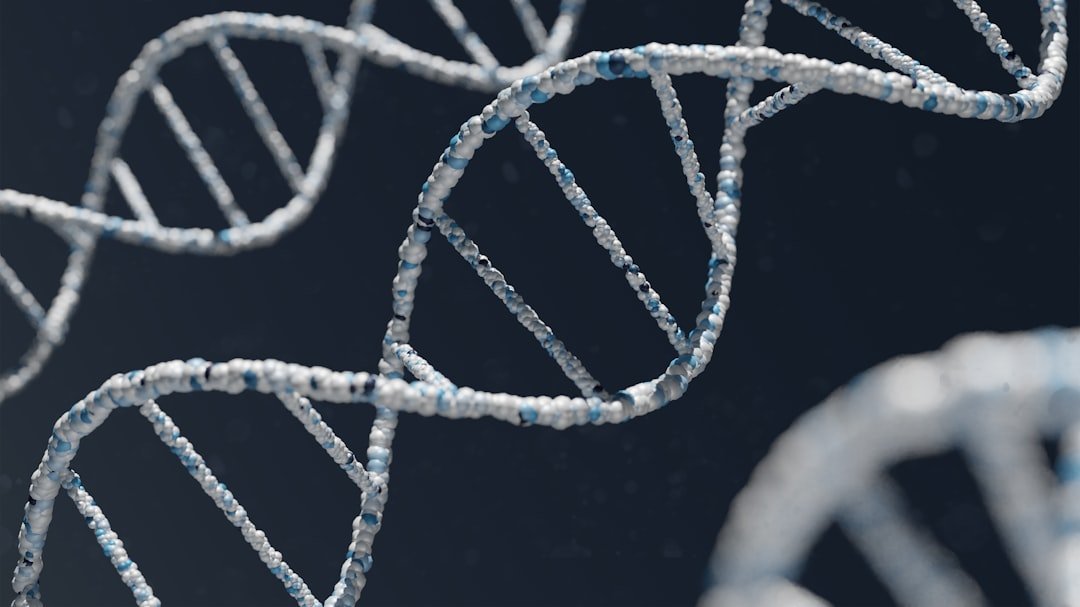
Featured image: Warren Umoh / Unsplash. Conceptual DNA illustration; it does not show an experimental result.

The rules that let cells keep their jobs
The relevant biology includes the epigenome: chemical marks and associated proteins that influence how a cell reads DNA without changing its sequence. Marks on DNA and on the proteins around which it is wrapped help regulate gene activity. Some are maintained as cells divide, supporting specialised function. NHGRI explanation of epigenomics
The authors propose an imbalance between the coordinated creation of cellular identity during development and its less precise local maintenance later in life. Small changes could accumulate, weakening the boundaries that keep a specialised cell operating as it should. The proposed maintenance model
A useful analogy is a set of instructions repeatedly copied and updated. Errors in how the instructions are organised can matter even when the original text remains available. The analogy describes the hypothesis; it is not a literal account of every process in ageing.
A hypothesis needs to make predictions
The review connects its model with patterns in age-associated DNA methylation, the attachment of small chemical tags to DNA. It proposes experiments aimed at stabilising the regulatory architecture that supports cell identity. Those predictions give researchers something to test rather than simply a new description of decline. Ageing signatures and testable predictions
For longevity biotechnology, the practical implication is a research question: can preserving useful cellular organisation improve function? Answering it requires experiments that measure what cells and tissues actually do, not just whether an age-related marker moves.
What this paper does not establish
The framework does not resolve every cause of ageing, identify a proven human therapy or show that resetting molecular marks makes an organism younger. Its value is in organising evidence and generating tests that could confirm, refine or challenge the idea.
Leave a Reply