
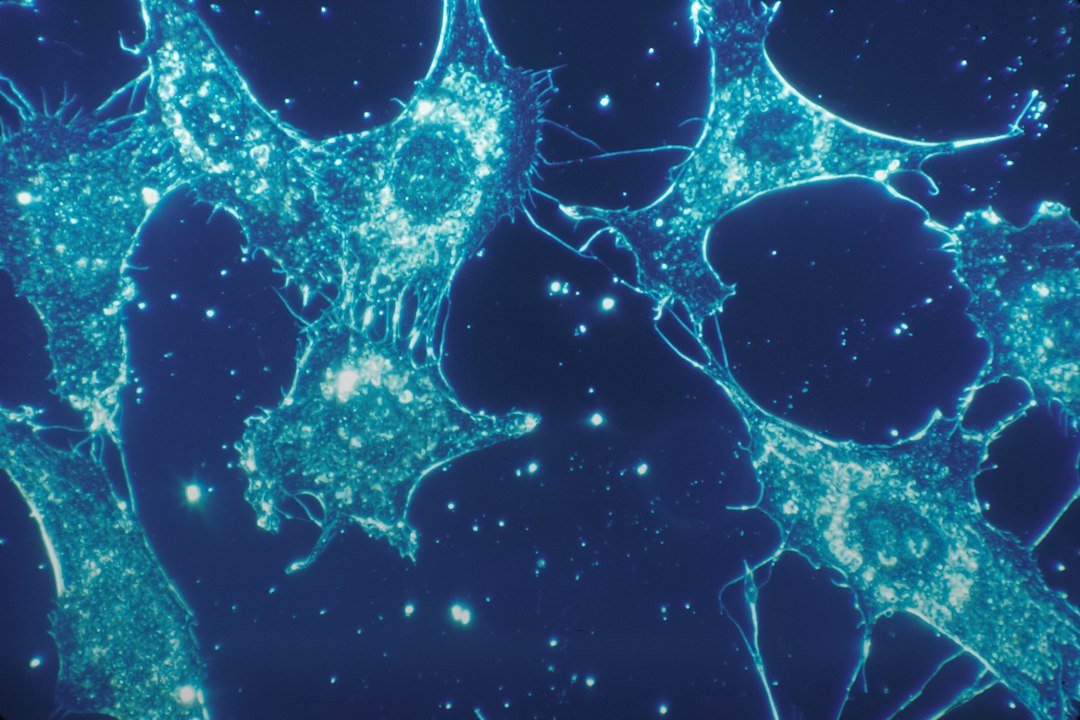
Featured image: Human connective-tissue cells illustrate laboratory cell culture. Contextual photograph; not the adipose–liver tissue chip or its results. Photo: National Cancer Institute / Unsplash. Unsplash licence.
Ageing takes decades in a person, which makes it difficult to reproduce inside a laboratory schedule. A new tissue-chip study tried a narrower approach: expose human cell models to molecular signals circulating in younger or older blood.
Nature Biomedical Engineering published the work on 25 March 2026. Researchers connected models of white fat and liver tissue, then perfused them for four days with serum from young or older donors. The resulting changes resembled several features associated with ageing. This was a laboratory model, not a treatment in people. Read the peer-reviewed study.
A tissue chip is a controlled miniature environment
Tissue chips are small devices containing living cells arranged to reproduce selected features of human organs and their environment. Flow channels can deliver nutrients and signals, while sensors and sampling reveal how the cells respond. They are models, not miniature complete people. NCATS fact sheet on tissue chips.
The researchers began with human induced pluripotent stem cells, which can be guided into specialised cell types. They created white adipose tissue and liver-like tissue, then linked the two in a microphysiological system. The connection matters because fat and liver exchange metabolic signals in the body.
The team used serum, the liquid portion left after blood clots, from donors aged 21 to 34 or over 62. Exposing the chip to that serum asks whether circulating factors can drive different tissue responses while genetics and much of the physical environment are held steady.
Four days produced markers, not decades of literal ageing
After four days with older-donor serum, the models showed more cellular senescence, oxidative DNA damage and inflammatory signalling. They also showed reduced insulin sensitivity and changes in glucose and lipid handling. The linked system revealed communication between fat and liver-like tissues. Experimental findings and methods.
The phrase ageing-on-a-chip can sound as if researchers made tissue live through decades. They did not. The study reproduced a set of measurable responses associated with older biological environments over a short exposure. It cannot capture a lifetime of immune changes, organ structure, behaviour and disease.
The serum set was small: eight donors in total, divided by age and sex. That design can reveal a reproducible laboratory pattern, but it cannot represent the full diversity of ageing populations or separate every contributor carried in blood.
Drug tests on the chip are preclinical screens
The team exposed the system to compounds including dasatinib plus quercetin, rapamycin, oxytocin and an ALK5 inhibitor. Some interventions shifted selected markers. The experiments help researchers compare mechanisms under controlled conditions; they do not show that any of the compounds rejuvenates a person or is appropriate for self-treatment. Intervention experiments in the tissue model.
A response in a chip can fail to translate because a whole body changes how a drug is absorbed, distributed and cleared. Other organs can add benefits or toxicities that the model lacks. Dose and duration also differ between a microfluidic device and clinical use.
Organ-on-chip research is valuable precisely because it can sit between simple cell culture and expensive animal or human studies. Reviews also note challenges in standardisation, manufacturing, validation and reproducing organ-level complexity. Review of organ-on-chip opportunities and limits.
The strongest use is as a better filter
The model could help scientists investigate which circulating signals drive tissue dysfunction, test whether effects persist after the serum changes, and screen combinations before deciding what deserves an animal study or trial. A linked system may reveal interactions that isolated cells miss.
Validation will require more donors, repeated manufacturing batches and comparisons with tissue from people of different ages and health states. A marker should be shown to track a meaningful biological function, not merely respond consistently inside one device.
The chip does not compress a human lifespan into four days. It compresses a particular experiment about ageing-related signals. That narrower achievement may be more useful than the slogan, because it creates a faster and more testable bridge between molecular hypotheses and clinical research.
Leave a Reply