
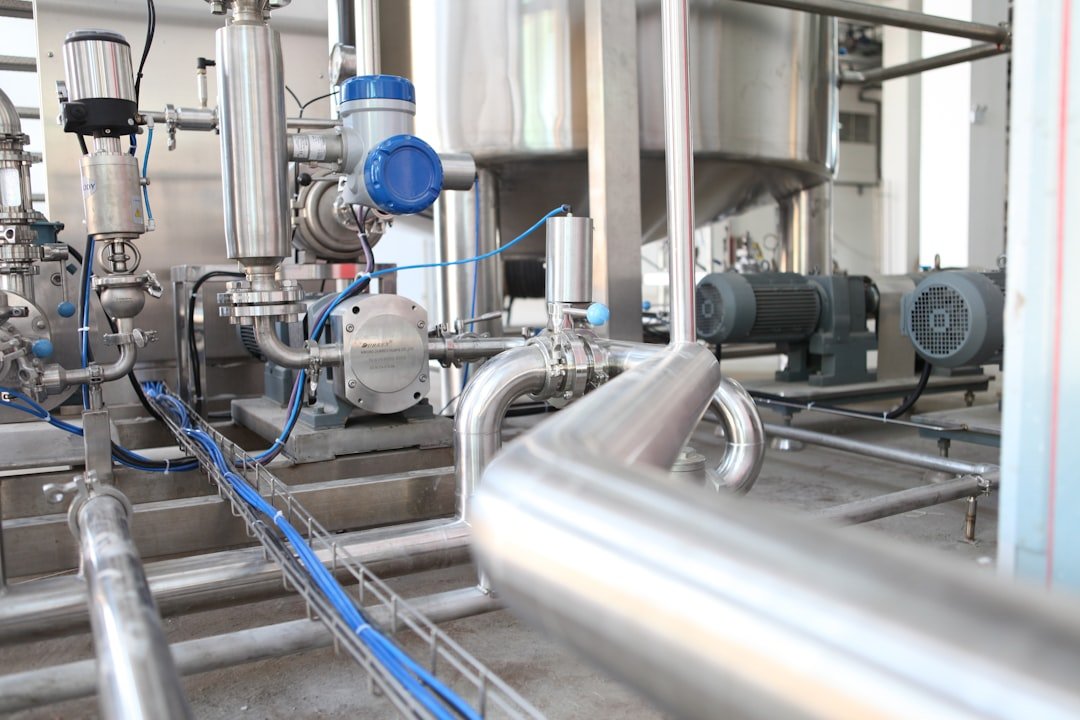
Featured image: Industrial pumps and pipework illustrate fluid handling. Contextual photograph; not a UQD coupling, AI-server cooling loop or an OCP qualification test. Photo: Crystal Kwok / Unsplash. Unsplash licence.
A liquid-cooled server needs a way to disconnect from its coolant supply when equipment is serviced. That makes a small mechanical coupling part of the computing system’s reliability, not merely a plumbing accessory.
This engineering explainer examines the Open Compute Project’s Universal Quick Disconnect, or UQD. Its published revision 1.0 specification dates from 2020; it is not a new announcement this week. The current OCP Cold Plate project shows why interfaces and testing remain active areas of work.
A removable server needs a controlled fluid connection
A quick-disconnect joins two sides of a coolant line. In a dry-break design, valves limit fluid escape when those sides separate. The aim is to make servicing practical without treating an open hose as an acceptable consequence of removing equipment.
The historical UQD specification covers hand-mated connectors for non-combustible, single-phase water–glycol systems cooling electronics. Single-phase means the fluid remains in one physical phase during the intended heat-transfer process, rather than deliberately boiling and condensing.
That scope matters. A connector suitable for one cooling architecture should not automatically be assumed suitable for a different fluid, pressure or operating method. A common label cannot replace the conditions under which the part was designed and tested.
Dry-break does not mean a universal zero-loss guarantee
The 2020 specification gives explicit fluid-loss limits, measured with water. For its four connector sizes, maximum loss per connection-and-disconnection cycle at zero pressure ranges from 0.020 to 0.070 millilitres.
Those are requirements in a specification, not measurements from every connector bearing a similar description. The stated fluid, pressure and cycle definition are part of the claim. Dropping them would make the small numbers sound more general than they are.
The document also sets durability requirements, including 5,000 make-and-break cycles. Again, that is a qualification requirement, not evidence that every product in a server rack has independently completed the test.
Interchangeability includes materials and operating limits
OCP’s Amphenol product listing illustrates the range of choices behind a UQD label: connector size, orientation, terminations and seal materials. The listed seals are selected for compatibility with fluids such as deionised water or glycol mixtures.
Two parts can therefore share an interface while still requiring care about their wider configuration. A mechanical fit answers whether the pieces mate. It does not, by itself, answer whether every material exposed to the coolant suits the planned chemistry and service conditions.
The listing is supplier product documentation, not a benchmark proving that all combinations of brands, hoses and coolant behave identically. The comparison needs to be made for a defined assembly.
The standard’s revision is part of the evidence
OCP’s current project page lists a UQD version-two workstream and a beta draft intended to address gaps in design, production and testing. It also lists separate hand-mate and blind-mate contributions.
A draft under development, a published specification and a product declaration of conformity have different meanings. Treating them as one interchangeable endorsement would hide the details an operator needs to assess compatibility.
This is also a system-level issue. The US Department of Energy’s data-centre design guidance considers cooling and electrical systems together. Keeping liquid inside a connector is necessary, but does not establish the heat-removal performance or total efficiency of the installation.
Serviceability needs a complete cooling-loop plan
The useful test is whether the assembled system can be installed, monitored and serviced reliably within its stated conditions. That includes the interfaces, coolant, hoses and the procedures used when equipment is exchanged.
For AI infrastructure, the broader lesson is that a good component must remain good at the point where people connect and maintain it. Quick-disconnect standards help define that boundary. They do not make the rest of the cooling loop disappear.
Reporting and source checks completed on 18 October 2026. By FutureTechDose Editor.
Leave a Reply