
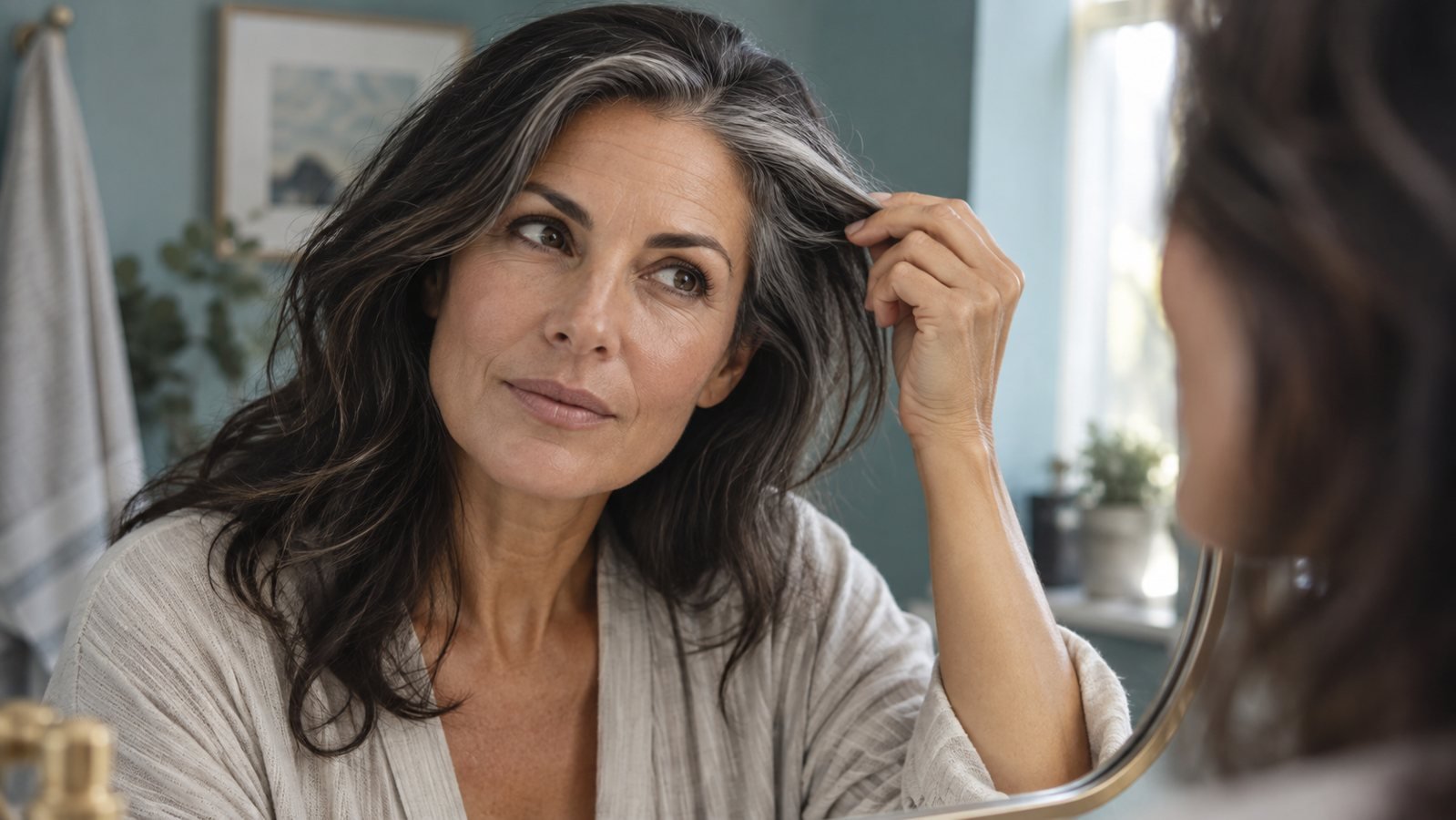
A grey hair seems like a tiny announcement: time has passed, and there is no going back.
Biology is less tidy. Researchers have documented individual human hairs that lost pigment and later produced it again. Experiments in mice also suggest that some colour-producing stem cells can remain present while becoming unable to do their job.
That makes grey hair a fascinating window into ageing. It does not yet make it a solved problem—or prove that restoring someone’s hair colour would make the rest of their body younger.
The most useful evidence comes from several studies published between 2021 and 2025. Together, they tell a more interesting story than either “greying is completely irreversible” or “scientists have found the cure”.
Why hair turns grey: pigment and stem cells
Hair gets its colour from pigment called melanin, supplied by specialised cells inside the follicle. Stem cells help replenish that pigment-making system as hairs go through cycles of growth and replacement.
In a 2023 mouse study, NYU researchers found that these stem cells moved between different parts of the follicle and shifted between stages of maturity. With repeated ageing and regrowth, more became stuck in a location where they no longer received the signals needed to become pigment-producing cells. The hair could keep growing while its colour system faltered. NYU’s explanation of the Nature study describes the mechanism.
The intriguing possibility is that a cell may be present but in the wrong place or state. However, moving those cells safely in a human scalp is a proposed research direction. The mouse experiment did not demonstrate a treatment that reverses human greying.
Scientists have seen human hairs regain pigment
A 2021 study published in eLife examined 397 hairs from 14 selected participants. Researchers mapped pigmentation along individual strands and documented examples of greying followed by repigmentation.
A strand can preserve a record of what its follicle was doing as it grew. A darker section near the root after a paler section suggests that pigment production resumed. It does not mean the already-grown white part suddenly changed colour.
In some participants, pigmentation changes lined up with reported changes in psychological stress. That is an association from a small observational study, not a controlled trial showing that relaxation reliably restores hair colour.
The recruitment also matters: these were selected people with suitable hairs, not a representative population survey. The study cannot tell us what percentage of everyone with grey hair can expect reversal. Its value is narrower and still remarkable: some individual human follicles were capable of resuming pigmentation.

Why “switch it back on” may be too simple
A further complication emerged in research published in Nature Cell Biology on 6 October 2025. Mouse experiments investigated how pigment stem cells respond to damage and stress, and how their fate relates to greying or melanoma, a cancer of pigment-producing cells.
Under certain conditions, damaged stem cells committed to differentiation and were lost from the renewable stem-cell pool. That could produce greying while limiting the persistence of damaged cells. Other conditions favoured continued survival and expansion of cells with a potential route towards cancer.
This does not mean grey hair itself protects a person against cancer. The University of Tokyo’s explanation explicitly cautions against that interpretation. It means that the same cellular machinery can influence both appearance and tissue safety.
For any future attempt to restore pigment, “did the hair get darker?” would therefore be only one question. Researchers would also need to understand which cells changed, how long the effect lasted and whether the intervention created other risks.
What would count as a real breakthrough?
The evidence so far consists of human observations and laboratory animal experiments—not a clinical demonstration that these stem-cell discoveries can reliably reverse ordinary age-related greying.
A convincing next step would require an intervention tested in people, meaningful comparison groups, consistent measurements of new hair growth and adequate follow-up. A few before-and-after photographs would leave too many questions unanswered.
And darker hair would remain darker hair. It would not, on its own, demonstrate younger organs, a longer life or reversal of biological ageing throughout the body.
Still, the science changes the question. Instead of assuming every grey hair marks a permanently exhausted system, researchers can ask when pigment production has been lost, when it has merely stalled, and whether the difference can be used safely. That is a much more useful starting point than a miracle claim.
Our guide to biological-age tests explains why measuring ageing requires more than a visible change.
Leave a Reply