
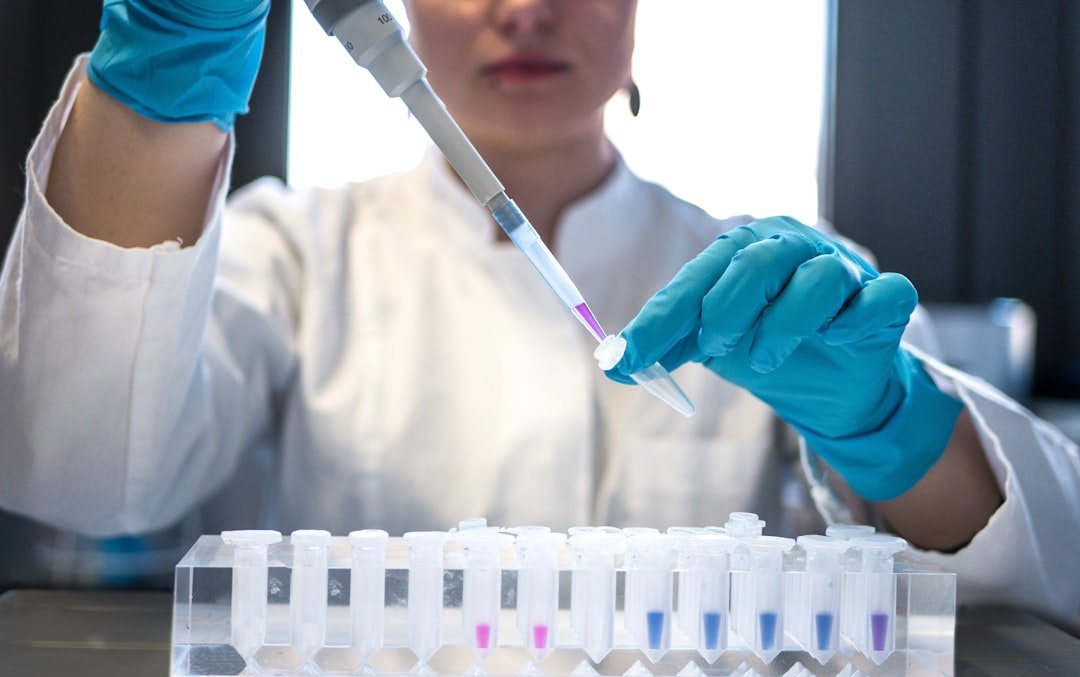
Featured image: A scientist handles laboratory samples. Contextual photograph; not tissue from the twins or equipment identified with the reported study. Photo: Julia Koblitz / Unsplash. Unsplash licence.
Two genetically identical children with the same cancer present a difficult puzzle. Similarity alone cannot show whether the tumours began independently or whether cancer cells moved from one child to the other before birth.
A peer-reviewed paper released by Nature Communications on 6 October 2026 used whole-genome sequencing to reconstruct that history in one twin-pair. The available early accepted version traces a soft-tissue cancer to one twin and infers a single transfer across the placenta to the other. This is molecular investigation, not a cancer-treatment trial.
Identical starting genomes do not freeze every cell in place
Identical twins begin with the same fertilised egg, but DNA can acquire changes as cells divide. Those later changes can become records of which cells descended from which earlier cells.
The US National Human Genome Research Institute’s mutation glossary explains the distinction between germline changes, which can be inherited, and somatic changes acquired in body cells. A somatic mutation can be carried by the descendants of the cell in which it arose.
That makes a mutation more than a possible disease-causing event. It can also act as a historical marker. Not every marker needs to drive cancer to be useful for reconstructing the ancestry of a tissue sample.
In this setting, the informative differences are those that arose after the twins’ shared starting point. Simply confirming that the children were genetically identical would not answer the question about the tumours’ origins.
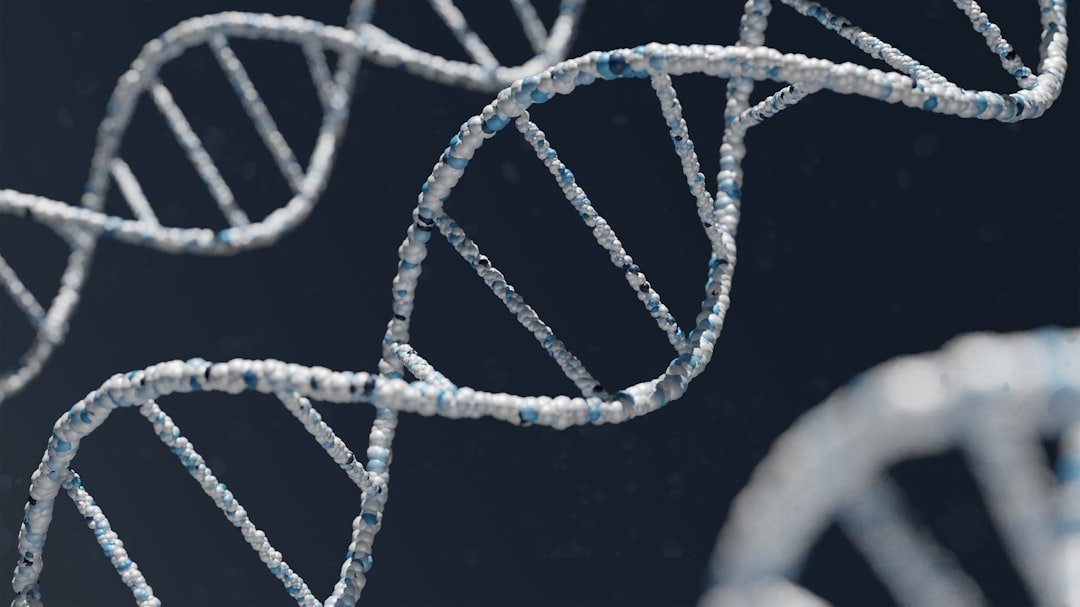
Healthy tissue gives tumour DNA its reference point
The study compared multiple tumour, normal-tissue and placental samples. Together, they allowed the researchers to build a phylogeny: an evolutionary family tree showing relationships between the sampled cell populations.
The finding of a common origin was therefore not based only on the cancers looking similar. It came from placing their genetic changes within the wider developmental history of the twins and placenta.
As the US National Cancer Institute’s definition of genetic analysis explains, testing tumour tissue for acquired changes is different from looking for inherited variants. Both examine DNA, but they ask different questions about where a change came from and what it means.
A good reference sample can be as important as the tumour sample. Without it, researchers may know that a variant is present while having less confidence about which part of the biological history it belongs to.
The placenta is part of the developmental record
The paper also reports uneven contributions of early embryonic lineages to the placenta and the twins. That result gives the work relevance beyond cancer, because the same comparisons can illuminate how genetically related tissues formed.
This does not mean one family settles every question about identical twinning. It shows how a rare, carefully sampled case can expose developmental details that are difficult to observe directly.
The method is retrospective. Researchers are reconstructing events from the genetic evidence left in tissues, not watching each early cell division happen. Its conclusions depend on the samples available and the relationships supported by their data.
A rare route is not ordinary contagion
The result should not be turned into a warning that cancer spreads through everyday contact. The National Cancer Institute’s public explanation states that cancer is generally not contagious and distinguishes cancer itself from infections that can increase cancer risk.
The twin study concerns a highly specific prenatal biological setting. It supplies neither a population frequency for this event nor evidence for a new general screening programme. A detailed explanation of one event is not an estimate of how often it happens.
Its significance is methodological: DNA can preserve a record of a cancer’s origins and movement, even when the crucial events occurred before birth. That kind of reconstruction can sharpen cancer biology without immediately producing a new medicine. Here, the advance is a more rigorous history of the disease, with the limits of the case kept intact.
Reporting and source checks completed on 18 October 2026. By FutureTechDose Editor.
Leave a Reply