
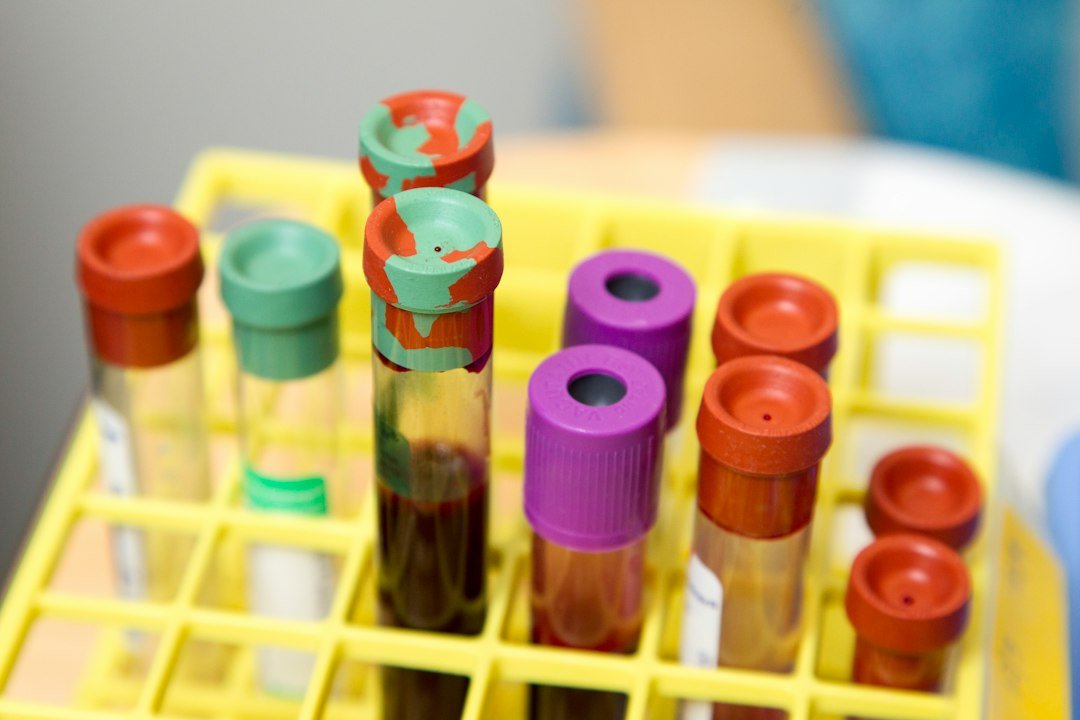
Featured image: Blood vials at the NIH Clinical Center illustrate haematology research. Contextual photograph; not samples from the trem-cel trial. Photo: National Cancer Institute / Unsplash. Unsplash licence.
A drug can attack leukaemia cells and still damage healthy blood-forming cells that display the same target. Researchers have tested a radical workaround: remove that target from donor stem cells before transplantation.
Nature Medicine published the final report on 12 May 2026 from an early trial of tremtelectogene empogeditemcel, or trem-cel, followed by gemtuzumab ozogamicin in acute myeloid leukaemia. The work shows that edited donor cells can engraft and tolerate subsequent targeted treatment. It does not establish that the strategy improves survival. Read the peer-reviewed study.
The edit creates a protective mismatch
Gemtuzumab ozogamicin is an antibody-drug conjugate. Its antibody recognises CD33, a protein found on most acute myeloid leukaemia cells but also on normal myeloid cells, and carries a toxic payload into the target cell. That overlap can suppress healthy marrow. NCI background on gemtuzumab and CD33.
Trem-cel starts with blood-forming stem and progenitor cells from a donor. CRISPR-Cas9 is used outside the body to disrupt CD33, and the edited cells are then transplanted. The intended result is marrow that no longer presents the drug target while residual leukaemia cells still do. NCI definition of the edited cell product.
This is an ex vivo edit: cells are modified in a manufacturing process, tested and infused. It is not a gene editor injected directly into a patient. It also does not edit the leukaemia itself. The genetic change is meant to alter the replacement blood system.

Engraftment answers one safety question
The paper reports 30 treated people: 29 with acute myeloid leukaemia and one with myelodysplastic syndrome. All achieved neutrophil engraftment by day 28, with a median of ten days. Manufacturing edit efficiency had a median of 90%, with a reported range of 71% to 94%. Manufacturing and engraftment results.
Engraftment means the transplanted cells begin producing blood cells. It is essential, but it is not proof that leukaemia has been eliminated. Researchers must separately examine relapse, transplant complications, treatment toxicity and longer-term function of the edited cells.
Nineteen participants received gemtuzumab maintenance. The authors report no prolonged high-grade cytopenias, or severe persistent shortages of blood cells, after that treatment. Cytopenias and infections were nevertheless among common adverse events.
Serious events and an incomplete programme limit the conclusion
The report records three transplant-related deaths after day 100: renal failure considered related to trem-cel with other contributing factors, sinusoidal obstruction syndrome considered related to gemtuzumab, and sepsis judged unrelated. These events show why a protective edit cannot be described as removing the risk of intensive treatment. Safety findings in the final report.
The registered Phase I/II study is listed as terminated, with lack of funding given as the reason. The publication says the trial ended early for fiscal reasons and primarily completed its Phase I work. The registry’s total enrolment is larger than the 30 treated participants analysed in the paper, so those figures should not be treated as interchangeable. ClinicalTrials.gov record.
An early termination does not erase the data collected. It does mean the planned development path was not completed, leaving fewer people and less comparative evidence than a mature programme would require.
A platform idea now needs a stronger test
The study demonstrates a form of target engineering: alter healthy replacement tissue so a later drug can attack disease more selectively. The concept might eventually extend to other shared targets, but every new combination would bring its own editing, transplant and drug risks.
A stronger test would compare outcomes with an appropriate standard approach and follow edited blood production over longer periods. It would also need enough participants to distinguish a treatment effect from selection and transplant-related variation.
The result is technically important because the edited graft behaved as intended in people. Clinically, it remains an early and incomplete experiment whose most ambitious claim still awaits a later trial.
Leave a Reply