

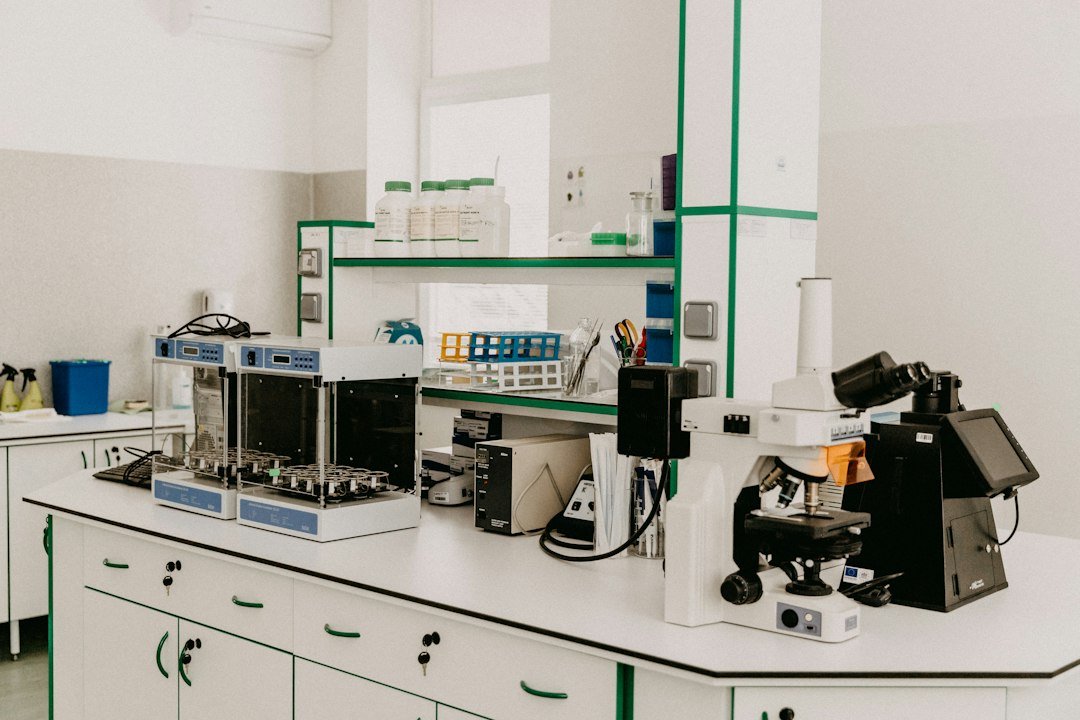
Featured image: A researcher examines a laboratory sample. Contextual photograph; not an Arlotta laboratory researcher or an organoid from the study. Photo: DIANA HAUAN / Unsplash. Unsplash licence.
Human brain development unfolds over years. That creates a practical problem for researchers who want to study it in a dish: a model observed for a few months may show only the beginning of the process.
A Nature paper published on 19 August 2026 reported human cortical organoids grown for five years. This explainer examines that previously published research. It is a cell-culture study of development and maturation, rather than a clinical trial or a demonstration of extending a person’s lifespan.
An organoid represents selected features of an organ
An organoid is a three-dimensional collection of cells grown to reproduce aspects of tissue. Harvard describes these models as small clumps containing cerebral cortex cells derived from human donors. The cortex is the brain’s outer region, involved in many kinds of information processing.
The interest lies in whether human cells continue along a developmental programme when cultured outside the body. Keeping tissue alive is one necessary condition. Showing that it develops in a useful, human-relevant way is another.
That distinction is central to interpreting the work. A long-running culture can provide more observation time, but elapsed time alone cannot certify that the model resembles the biological stage a researcher wants to investigate.
The study examined change as well as survival
The researchers combined cell-specific gene-expression measurements with DNA methylation profiling and structural and functional analyses. Gene expression measures which genetic instructions cells are using. Methylation involves chemical marks on DNA associated with regulation and developmental state.
They found age-related patterns that tracked time in culture, including features resembling aspects of human brain maturation. In experiments mixing neural progenitors of different ages, older progenitors generated later neuronal types. A progenitor is a cell that can produce particular descendants.
These observations support a model that can preserve information about developmental time. “Memory” in this context refers to a retained cellular state. It should not be read as an organoid recalling an experience.
Our assessment is that the useful shift is from a survival record to a way of asking how cell identity changes over a prolonged period. The model gives researchers a setting in which to compare stages, rather than treating all cultured neurons as interchangeable.
A model has to match the question being asked
The International Society for Stem Cell Research’s standards for model systems emphasize reproducibility, cell composition and the validity of the biology represented. They also recommend documenting the starting material because it can influence variation.
Those principles become especially consequential in a study spanning years. Researchers need to know whether a difference reflects developmental change, donor characteristics or the culture process. Recording those factors makes another laboratory’s comparison more informative.
For a proposed experiment, the useful starting point is the phenomenon being studied. A model of a changing cell type may be suitable for one question while remaining incomplete for a question requiring interactions across a whole organ.
A drug-screening result would also need its own validation. Showing that a compound changes a marker in an organoid would establish an experimental effect in that model. Predicting benefit in people would require further evidence.
The research standards describe these systems as simplified tissue representations. Their value depends on which aspects of physiology they reproduce and how consistently they do so.
Long development is different from human longevity
The word longevity can describe how long a culture survives. In this work, that long survival creates access to later developmental stages. It does not demonstrate rejuvenation, prevention of age-related disease or extension of healthy life in people.
The ISSCR guidelines also caution against language implying human consciousness or cognitive abilities in brain organoids. Cellular activity and developmental signatures need precise descriptions; neither warrants presenting a cultured model as a tiny person.
Future uses will be most convincing when investigators state the stage, cell populations and measurements their model reproduces, then test the claim across relevant comparisons.
The five-year result matters because it extends the period over which human cell development can be studied directly in culture. That longer window is a research resource. What it can reveal depends on the quality of the experiment built around it.
Leave a Reply