

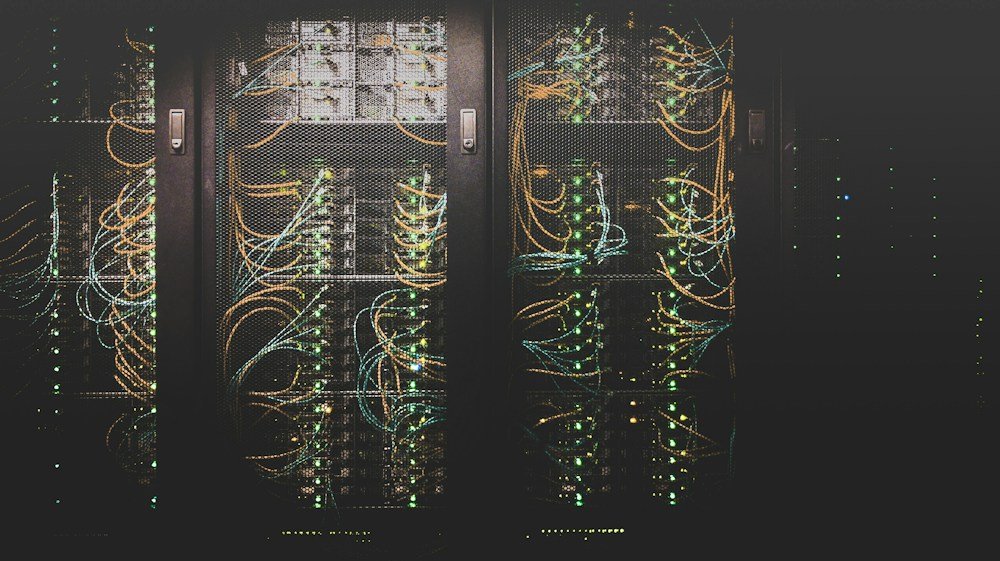
Server hardware shown for context, not Huawei’s Peerium system. Photograph: Domaintechnik via Unsplash.
The next challenge to Nvidia may not be a single chip with a better benchmark. It may be a different way of making an enormous number of chips work together.
That is the pitch behind Huawei Peerium, a computing architecture announced on 17 September 2026. Huawei says it is designed to coordinate processors at the million-processor scale. This is a company announcement about a system architecture—not independent evidence that a completed million-processor machine has beaten Nvidia. Huawei announcement.
The Huawei Peerium idea in plain English
Imagine hiring thousands of people for a project but giving them a slow, unreliable way to share their work. Adding more people would not necessarily finish the job faster.
Huawei’s answer combines a common memory-addressing approach, coordinated parallel work and fast links between components. Its UnifiedBus technology connects processors, memory, storage and networking equipment. The intention is to make a vast collection of resources behave more like one coordinated computer. Huawei’s architecture description.
The important word is coordinated. A headline processor count says little about how long the system spends calculating versus waiting for information to arrive.
A deployment claim, a testing programme and a bigger ambition
Huawei says a 256,000-card Atlas 950 SuperCluster is being deployed. It separately describes the Atlas 960 system, using near-packaged optics, as undergoing testing. Those are different stages of progress; neither statement should be rewritten as proof that the full million-processor ambition is already operating at commercial scale. Huawei.
The commercial pressure is real. Reuters reported on 17 September that rotating chairman Eric Xu said domestic demand exceeded Huawei’s production capacity, limiting overseas expansion. The report also said Huawei planned to accelerate two Ascend 960 chip launches in 2027. These are company plans and demand statements, not an audited comparison of market share or delivered performance. Reuters reporting.
Nvidia is already fighting at the system level
Nvidia’s own NVLink platform addresses the same broad problem: moving information quickly between GPUs. Its Vera Rubin NVL72 design connects 72 GPUs within a rack-scale system, while networking connects systems into larger deployments. Nvidia also emphasises software, libraries and integrated infrastructure—not just processors. Nvidia’s NVLink documentation.
Comparing that 72-GPU figure directly with Huawei’s million-processor ambition would be misleading. They describe different system boundaries. A rack, a tightly connected group of racks and a much larger cluster are not interchangeable units.
The numbers that will decide the contest
Our assessment is that the revealing comparisons will be end-to-end ones: the same model, the same quality target, measured completion time, energy use and total operating cost. Reliability and the work needed to move existing software also belong in that comparison.
A machine that looks formidable in a presentation still has to earn its place in a developer’s workflow. Equally, a competitor does not need to win every benchmark to become a credible option for particular customers.
We recently examined AMD’s attempt to make its AI software easier to use. Huawei Peerium brings another dimension to the same contest: not simply who makes the most impressive chip, but who can turn hardware and software into useful computing at scale.
The million-processor headline attracts attention. The evidence to watch next is what customers can actually run on the systems being delivered.
Leave a Reply