
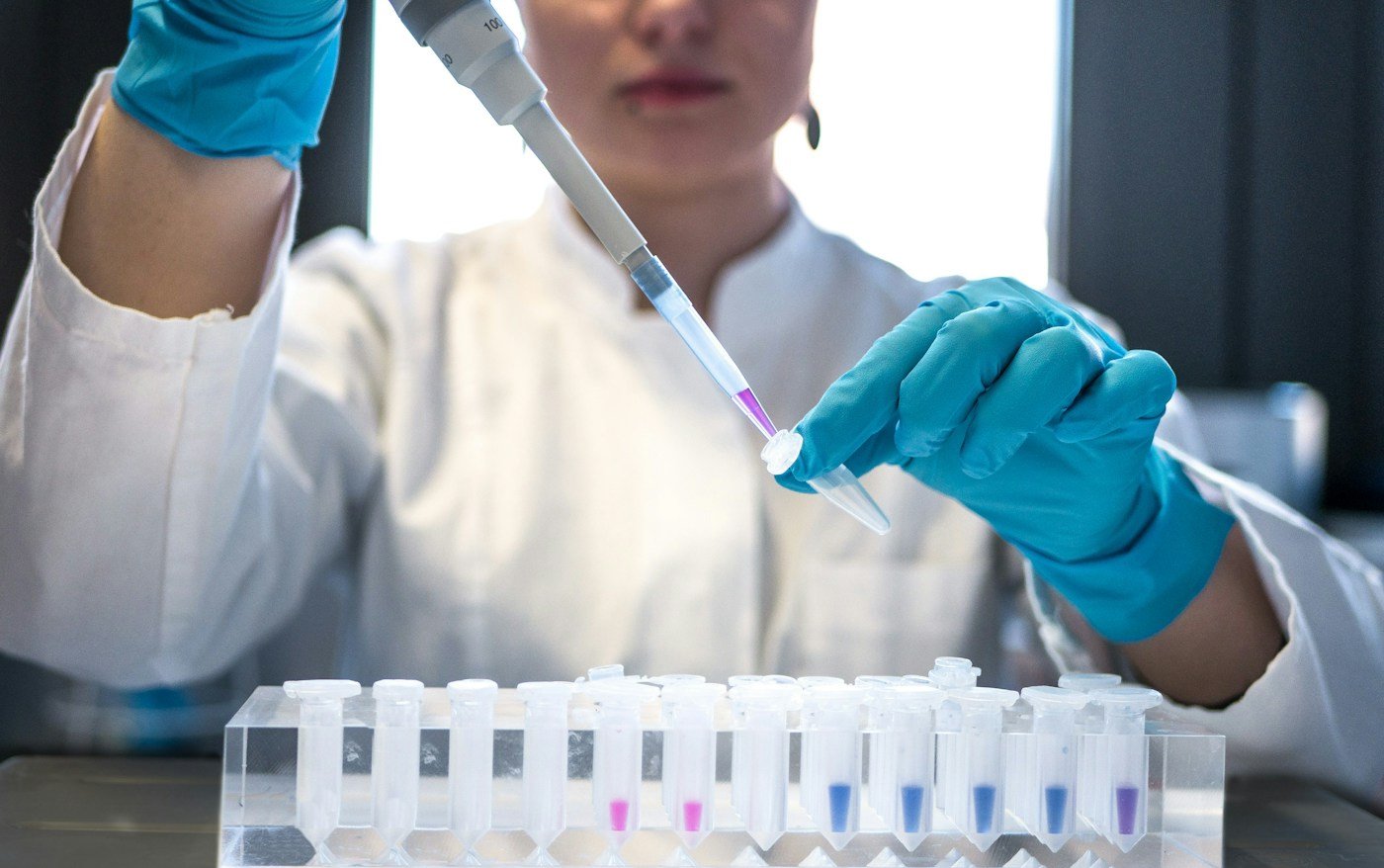
Laboratory research, shown as a stock photograph. This is not an image of the Stanford experiment. Credit: Julia Koblitz / Unsplash.
Human brain organoids have reached a striking new stage: researchers have grown substantial amounts of the tissue inside specially engineered mice, creating a way to watch developing human nerve cells function within a living system.
The study, published in Nature on 16 September 2026, is preclinical research. It introduces an experimental model for investigating brain development and injury. It does not report a treatment for patients or demonstrate human consciousness in an animal. Original research
The result is compelling because the organ researchers most want to understand is also one they cannot routinely sample or experiment on in living people.
Giving human brain organoids room to develop
An organoid is a small, laboratory-grown structure that reproduces some features of an organ. Brain organoids contain interacting nerve cells, but calling them complete miniature brains would overstate what they are.
The Stanford team used reprogrammed human cells to grow cortical organoids: tissue resembling parts of the developing cerebral cortex, the brain’s outer layer. Its specially engineered mouse hosts lacked much of the corresponding cortical tissue, creating space for the grafts. The mice still had other parts of their own nervous system. Stanford Medicine’s account
This builds on earlier transplantation research. The advance is a different host environment that lets a much larger human-derived graft develop, rather than the first attempt to put human neurons into a rodent.
A living model that can reveal injury
The researchers observed human nerve cells connecting with the mouse nervous system and patterns of electrical activity resembling developing circuits. They also found differences in aspects of coordination and spontaneous behaviour, despite broadly preserved movement.
A low-oxygen experiment produced injury in the human-derived tissue alongside changes in a walking test. That gives researchers both cellular observations and an animal-level readout of an injury model. It does not establish that the model reproduces every aspect of a human neurological condition. Study findings and limitations
Stanford describes potential uses in investigating developmental disorders and finding candidate medicines. Those possibilities require further work. A response in transplanted tissue would still be a step toward understanding disease, not proof that a drug works safely in people. Research context
The ethical questions belong inside the science
Growing human neural tissue in an animal calls for careful oversight. The International Society for Stem Cell Research recommends animal-research review with relevant stem-cell or developmental expertise, alongside monitoring for changes in welfare and behaviour.
That is an ongoing responsibility as a model develops, not a one-off permission slip. The guidelines also recognize uncertainty in interpreting the internal experiences of modified animals. ISSCR research guidelines
The most useful way to read this result is as a new scientific instrument. Like the mini-liver tissue platforms explored on FutureTechDose, it tries to capture more human biology than a simple dish of cells can provide.
Its value will depend on the questions it answers reliably. The next achievement to watch is a reproducible insight into disease that simpler models missed—not a sensational claim that scientists have manufactured a human mind.
Leave a Reply