
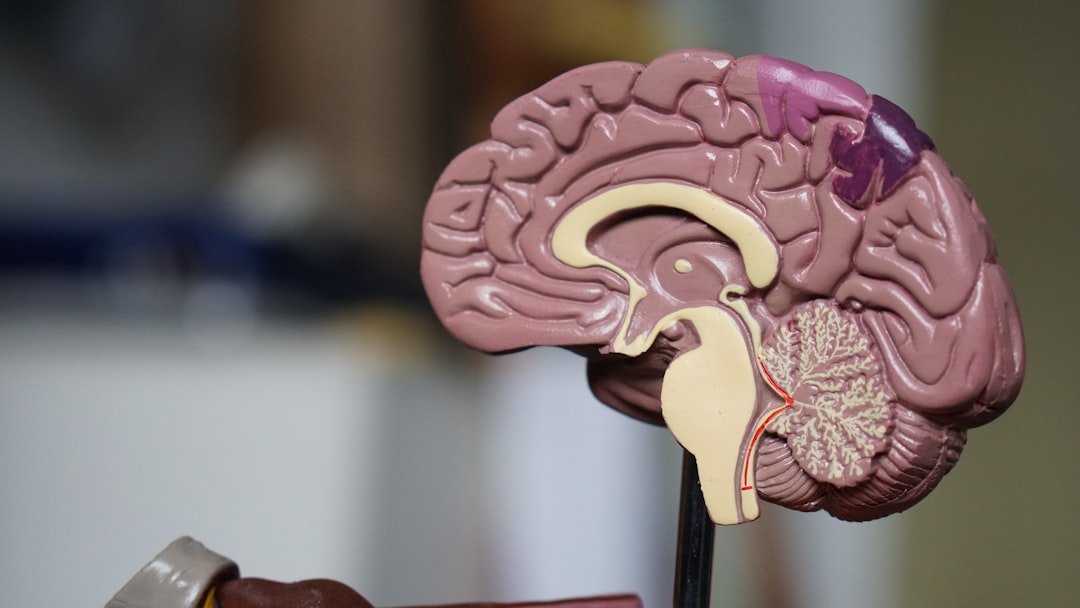
An anatomical brain model, used to illustrate neuroscience research. Credit: Robina Weermeijer / Unsplash.
For someone struggling to think clearly after COVID, “brain fog” can feel like an unsatisfying name for a problem that reaches into work, memory and everyday life.
A human observational study published in eBioMedicine on 10 July 2026 used PET imaging to examine a dopamine-related brain marker in long COVID. It investigated a possible biological clue, rather than testing a treatment. Original research paper
The Centre for Addiction and Mental Health, which led the research, highlighted lower marker binding in several parts of the striatum, a brain region involved in functions including motivation and movement. Lower measurements were associated with symptoms including apathy and slower movement. The finding gives researchers a more specific target to investigate. CAMH research summary
A useful clue from a deliberately narrow study
The main comparison involved 24 adults with long COVID and 24 age-matched healthy controls. Patients were selected for neuropsychiatric symptoms, including apathy, limiting how widely the results apply.
The measurement targeted VMAT2, a protein involved in packaging chemical messengers inside nerve cells. Reduced binding may indicate impaired nerve-terminal integrity. The authors acknowledge alternative explanations involving the marker, so the scan does not directly count permanently lost neurons. Study methods and limitations
The researchers also acknowledge that the imaging associations do not establish causation. Finding a difference between groups does not, by itself, identify its cause or a way to reverse it. Original paper
The authors also published a correction on 5 September 2026. They state that the changes do not alter the paper’s interpretation or conclusions. Readers following the research should use the study alongside that correction. Published corrigendum
A research direction still needs a treatment test
CAMH’s announcement proposes investigating whether treatments aimed at dopamine-related function could help. That is a hypothesis for clinical testing. The imaging study did not demonstrate that such a treatment improves long COVID symptoms. CAMH announcement
There are other biological clues, too. An earlier CAMH study, announced in 2023, reported elevated markers associated with brain inflammation in people experiencing depression after COVID. It examined a different marker and a specific participant group. The two studies should not be collapsed into one universal explanation of long COVID. Earlier CAMH inflammation study
The distinction is useful far beyond this paper. Medicine progresses through linked but separate questions: identifying a measurable difference, establishing its role in illness and testing whether changing it helps patients. Success at the first stage creates an opportunity; it does not complete the remaining work.
The appeal of this research is its specificity. It turns a broad symptom label into a hypothesis that can be challenged with further studies. Larger independent investigations and controlled treatment trials will decide how much that clue changes the understanding of long COVID.
For now, the strongest story is a clearer scientific question and a route to testing it—not a proven remedy.
Leave a Reply