
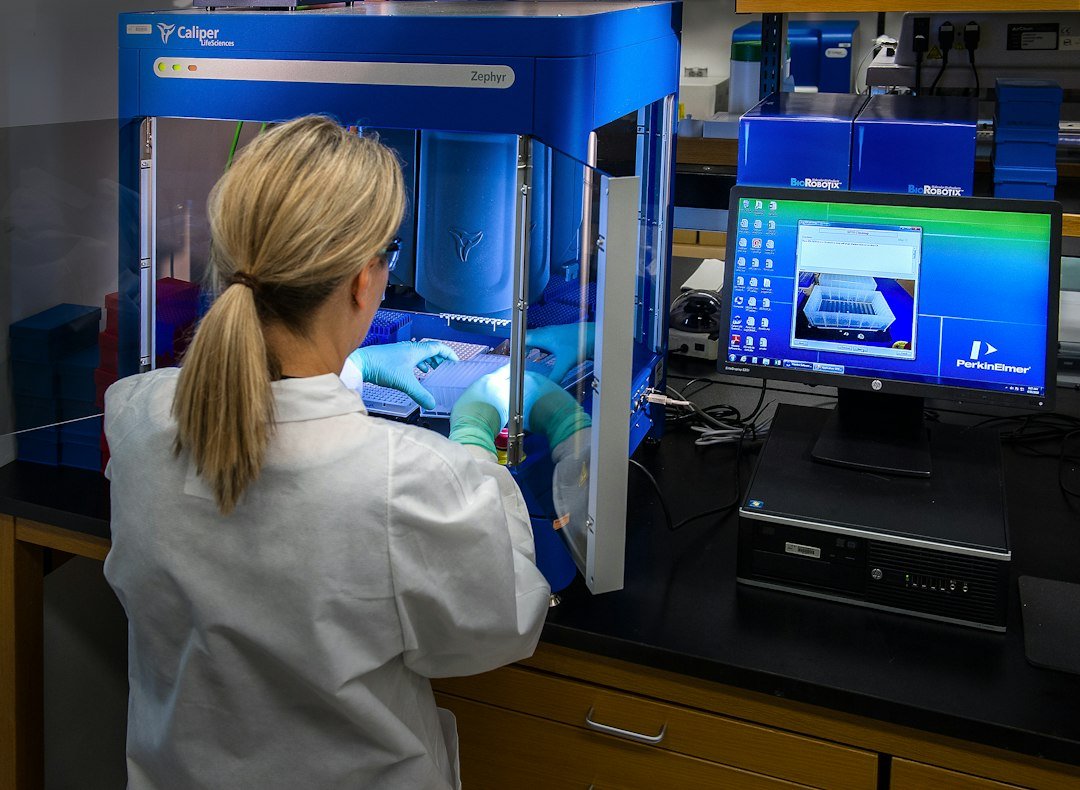
Featured image: A molecular-biology workstation illustrates the laboratory development of gene therapies. Contextual photograph; not visual evidence of the specific development. Photo: CDC via Unsplash. Unsplash licence.
A potential gene therapy for a rare form of childhood blindness can now enter human testing in the United States. Opus Genetics said on 21 October 2026 that the FDA had cleared its Investigational New Drug application for OPGx-RDH12. The company plans to begin a Phase I/II trial during the current quarter.
The regulatory verb is important. IND clearance allows a proposed clinical investigation to proceed. It is not approval to market the therapy, and it does not establish safety or effectiveness. At the time of the announcement, no human results for OPGx-RDH12 had been reported.
RDH12 disease damages light-sensing cells early
Pathogenic variants in the RDH12 gene can cause Leber congenital amaurosis type 13 and related inherited retinal degeneration. RDH12 helps retinal cells handle molecules produced during the visual cycle and protects them from toxic stress. When both copies of the gene do not function properly, photoreceptors—the rods and cones that detect light—can deteriorate.
A natural-history study of 57 affected people reported an average age of symptom onset of 4.1 years and macular atrophy in every participant, sometimes visible by age two. Natural-history work does not test a treatment. It documents how disease changes without the experimental intervention and helps researchers choose endpoints and a window for treatment.
The therapy delivers a working gene to photoreceptors
OPGx-RDH12 uses an adeno-associated viral vector to carry a functional copy of RDH12. The planned route is subretinal delivery, which places the vector beneath the retina near the target cells. The aim is to restore production of the missing protein before too many photoreceptors are irreversibly lost.
Opus says cell and mouse studies restored RDH12 activity and produced functional improvements. Those are preclinical findings. Laboratory cells simplify human biology, and mouse eyes cannot fully reproduce the anatomy, immune responses, genetic diversity or long-term risks present in children and adults.
The company’s pipeline description places OPGx-RDH12 among several programs for inherited retinal disease. Platform experience can improve vector design and trial operations, but every gene, dose, route and patient population still creates its own evidence problem.
Phase I/II combines early safety and signal finding
A Phase I/II study typically begins by assessing safety and dose, then looks for preliminary evidence that the therapy affects a biological or clinical outcome. In a rare, progressive eye disease, researchers may measure adverse events, inflammation, retinal structure, visual sensitivity and functional vision over time.
Small early trials are not designed to prove broad effectiveness or detect every uncommon harm. They can also be difficult to interpret when participants begin with different mutations, ages and amounts of remaining retina. Comparisons with carefully collected natural-history data may help, but they are not always equivalent to a randomized control group.
IND clearance is a safety-review gate
The FDA’s drug-development definitions explain that sponsors submit an IND with animal pharmacology and toxicology, manufacturing information and a clinical protocol. Regulators review whether the proposed study exposes participants to unreasonable risk and may impose a clinical hold.
Clearance therefore means the package was sufficient to let the investigation start under its protocol. It does not mean the FDA has concluded that the treatment works. Recruitment, dosing, follow-up and analysis must still happen before the field has human evidence.
Opus estimates that roughly 30,900 people worldwide live with RDH12-related disease, but prevalence estimates and trial eligibility are different things. A future study will have defined inclusion criteria and may enrol only a small group.
OPGx-RDH12 has reached a genuine milestone: a preclinical program can become a human clinical study. The next responsible headline depends on what the first participants actually experience. Until then, the advance is permission to test a promising idea—not restored sight and not a commercial treatment.
Reporting and source checks completed on 22 October 2026. By FutureTechDose Editor.
Leave a Reply