
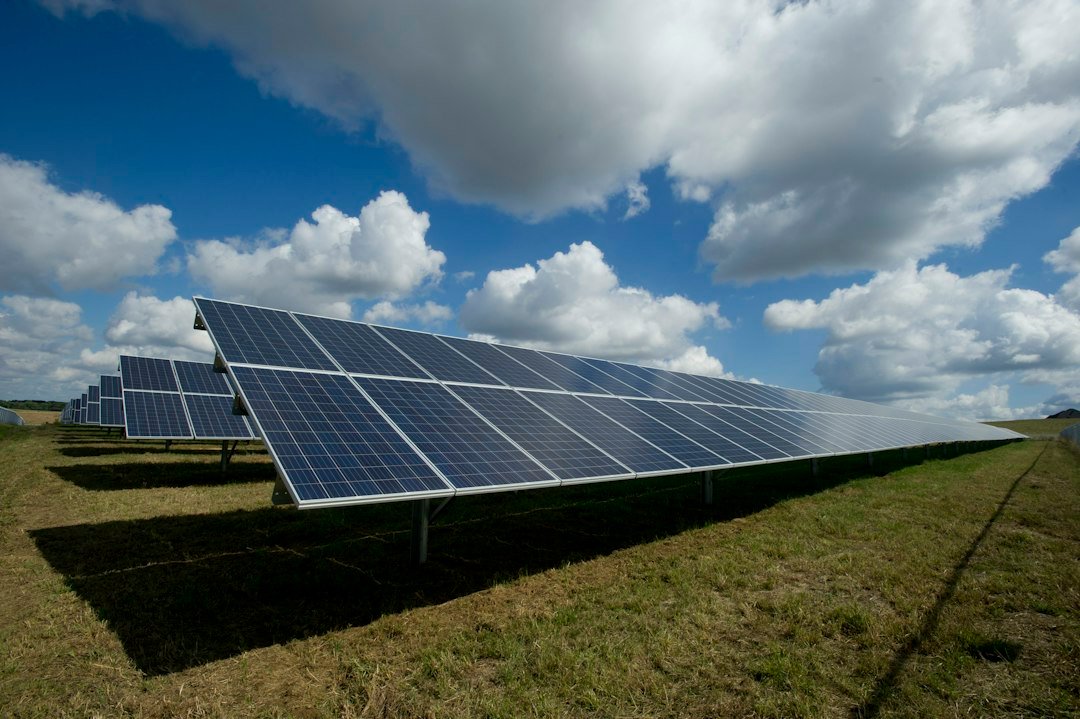
Featured image: Solar panels illustrate electricity-generation technology. Contextual photograph; these panels are not verified to contain perovskite or the lead-capture layers discussed. Photo: American Public Power Association / Unsplash. Unsplash licence.
A solar cell’s efficiency answers how much incoming light it converts into electricity. It does not answer what happens to its materials after damage or retirement. For lead-containing perovskite solar cells, those are central engineering questions.
This is a background explainer about lead capture and recycling, drawing on earlier peer-reviewed demonstrations and current official technology guidance. It does not describe a new October product launch or certify that a commercial panel is environmentally safe.
A thin absorber can change the device design
Metal-halide perovskites are light-absorbing materials used in thin-film solar cells. The US Department of Energy’s overview explains that they can also be combined with silicon in a tandem cell, where two absorber layers use different parts of the light spectrum.
Many well-studied formulations contain lead. Keeping lead in the device, replacing it with another material and recovering it later are different approaches. They should not be collapsed into one label such as lead-safe, because they address different stages and mechanisms.
The public comparison needs more than a record from a small test cell. A usable module is a packaged product exposed to operating conditions. Its materials, seals, protective components and recovery route all contribute to the outcome over its life.
Capture adds a second barrier after damage
A Nature paper published on 19 February 2020 demonstrated on-device lead sequestration. Sequestration means trapping lead so that less escapes into the surrounding environment. The researchers incorporated lead-absorbing materials into the device and tested their role under damage conditions.
The engineering distinction is between enclosing the material and capturing it if it becomes mobile. Encapsulation provides a protective package. An absorber offers another mechanism when a damaged device encounters conditions that could release lead.
A successful laboratory capture test demonstrates performance under its specified conditions. It does not prove zero release for every possible damage event, weather pattern or module design. Evaluating the protective component must include the circumstances under which it was tested.
Recovery turns a waste problem into a materials loop
A separate Nature Communications paper published on 6 October 2021 demonstrated recovery of lead and transparent conducting glass from perovskite modules. The reported lead recycling efficiency was 99.2% in the demonstrated process. Devices rebuilt with recovered materials performed comparably to those made with fresh materials.
Transparent conductors let light pass through while carrying electric current. Preserving useful glass and conducting layers can therefore be relevant alongside lead recovery. The study also included a cost analysis, rather than treating the metal’s recovery alone as a complete economic argument.
That recovery percentage belongs to the experiment’s process and denominator. It is not a claim that 99.2% of lead in every deployed panel will be collected. Modules that never reach a recovery facility are outside that laboratory success.
The difficult connection is between a device and a system
Our assessment is that capture and recovery should be evaluated together. A protective layer must coexist with electrical performance and durability. A recovery method must accommodate the packaged module that eventually arrives, rather than an idealised material sample.
A complete materials account would identify what is recovered, what remains in residues, which processing inputs are consumed and what happens to unrecovered material. This is a framework for assessing evidence, not a claim that a particular commercial recycling plant has already met those requirements.
Collection and transport also matter to the total outcome. Even a technically strong process needs a route for retired or damaged modules to reach it. Those practical steps are part of a product’s lifecycle, not information supplied by a solar-cell efficiency measurement.
Better solar claims describe several outcomes separately
Efficiency, lifetime, release under damage and material recovery each need their own evidence. A result for one cannot substitute for the others. Current DOE guidance describes ongoing work on efficiency, durability and commercial competitiveness; it does not turn earlier research demonstrations into a universal product guarantee.
Perovskite research has produced credible tools for retaining and recovering lead. The next assessment is how those tools perform in complete modules and a functioning recovery system. That is the standard a lifecycle claim must meet alongside the electricity the panel produces.
Leave a Reply