
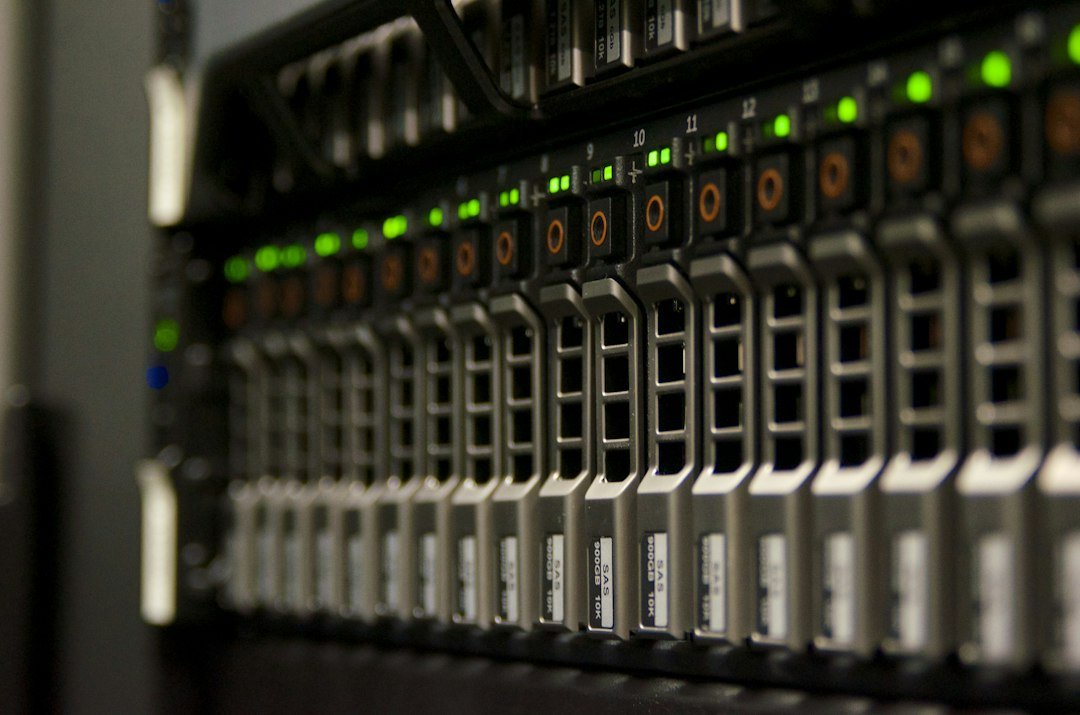
Featured image: Server bays illustrate data-centre equipment. Contextual photograph; not a facility assessed in the noise review or visual evidence of community sound levels. Photo: Domaintechnik / Unsplash. Unsplash licence.
A data centre can be quiet in a promotional photograph and conspicuous to someone living nearby. The relevant evidence is sound measured in its operating environment, with enough detail to identify what the listener is exposed to.
A research manuscript posted on 2 October 2026 examines gaps in that evidence. Its record reports acceptance for publication in Noise & Health, with the journal version forthcoming. It is a narrative review of existing sources, not a new multi-site measurement campaign or a clinical study of nearby residents.
A number needs a place, a duration and a definition
A reading beside a machine, at a property boundary and inside a home describes three different situations. An equipment specification is different again. Without location and measurement details, two values expressed in decibels may answer different questions.
The US Federal Highway Administration’s measurement handbook provides useful general acoustics definitions. Sound pressure describes the sound at a measurement position. Sound power describes emission from a source. They are different quantities, even when both are reported using decibels.
A maximum over a brief event also differs from an average over a stated period. These distinctions are not reasons to dismiss an observation. They are the information needed to compare it fairly and determine what it establishes.
Frequency changes what a summary can reveal
Frequency describes how rapidly a sound oscillates. A tonal sound concentrates energy around particular frequencies, producing a hum or whine rather than a broad, even spectrum. Its character can matter alongside its overall level.
A-weighting applies a standard frequency filter to a measurement and is commonly reported as dBA. The FHWA handbook explains that this weighting reduces the contribution of low frequencies. A single weighted total therefore cannot reveal the full frequency pattern.
The October review highlights continuous tonal sound in several documented cases and calls for frequency-resolved measurements. It cautions against treating scattered values from different locations, instruments and durations as a pooled distribution of community exposure.
Earlier public assessment supports a narrower concern
Virginia’s Joint Legislative Audit and Review Commission examined data centres in a report issued in December 2024. It found that constant low-frequency noise could be disruptive near residential areas, including where existing noise limits were met.
The same assessment said most Virginia data centres did not generate noise complaints because of their locations or designs. Both findings matter. They support attention to particular settings and equipment, rather than a claim that every facility creates the same problem.
That is a dated assessment, not a statement of current law in every jurisdiction. It also does not quantify a specific disease risk or establish the health effect of a newly proposed facility.
Cooling design is a hypothesis to test at the boundary
The October manuscript identifies cooling architecture as a candidate influence on sound emissions. It explicitly separates equipment-level sound-power estimates from measured differences at facilities or homes. A quieter equipment specification cannot simply be copied into a claim about a neighbour’s exposure.
Our engineering interpretation is that a useful comparison must follow sound through the complete installation. Equipment location, operating state and the surrounding environment belong in that assessment. A design proposal and an observed result should remain separate.
Likewise, indoor server photographs cannot establish outdoor acoustic performance. They show computing equipment, not how much sound reaches a dwelling, which frequencies dominate or how the pattern changes overnight.
Measurement is the foundation for a credible conclusion
A meaningful record would state where and when measurements were made, the instruments and calibration, the frequency detail and how background sound was handled. Comparable observations could help identify which designs reduce sound under relevant operating conditions.
The review describes why exposure characterisation is needed before reliable health inference. It does not establish that data-centre sound has caused a particular illness. Community testimony, acoustic measurements and epidemiological evidence each add information, but they are not interchangeable.
The practical advance is a clearer research agenda. Data-centre noise deserves evidence detailed enough to test both concerns and claimed improvements. A single decibel number is a starting point; a well-documented sound environment is the result the debate needs.
Leave a Reply