
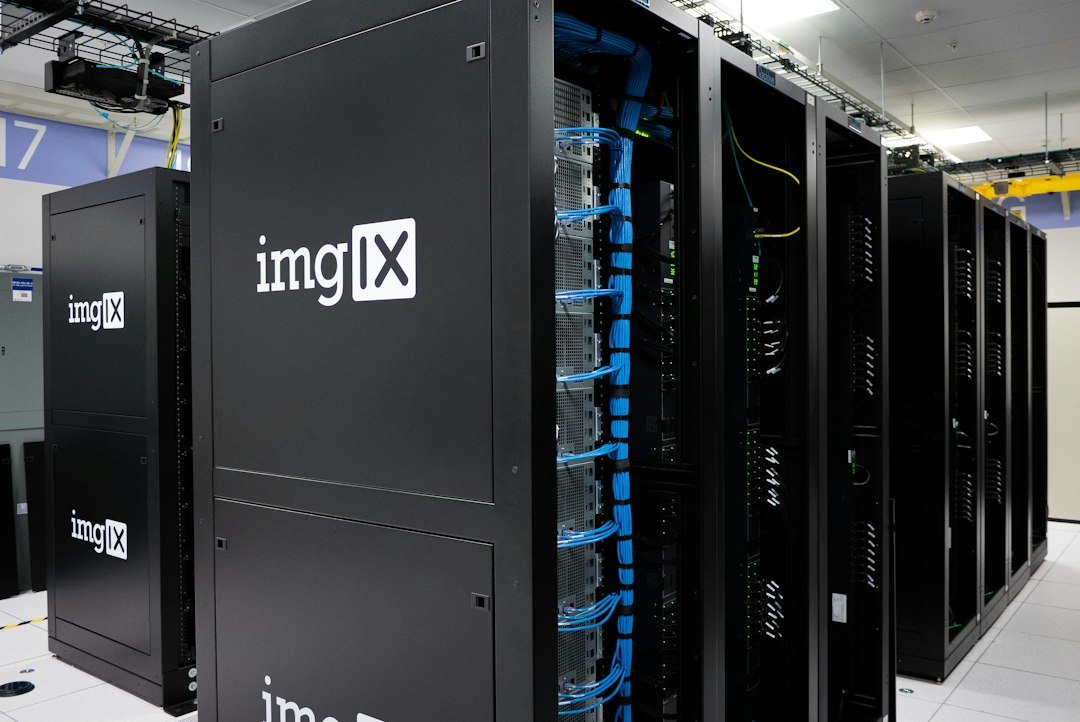
Featured image: Server cabinets illustrate commercial AI infrastructure. Contextual photograph; not Scaleway’s planned Swedish or Copenhagen facility. Photo: imgix / Unsplash. Unsplash licence.
Europe’s debate about sovereign AI often compresses several questions into one word: where data sits, which law applies, who operates the cloud and who controls the underlying technology. Scaleway’s latest expansion shows why those layers should be separated.
On 13 October 2026, the French cloud provider announced an AMD-powered commercial AI supercomputer in Sweden and an Nvidia HGX B300 computing site in Copenhagen. Both target European customers seeking local capacity under European Union law. They are commercial project announcements, not completed facilities with published uptime, customer benchmarks or audited environmental performance.
Two Nordic sites broaden accelerator choice
The Swedish system will use AMD Instinct MI355X accelerators and the ROCm software ecosystem. Reuters reports that Scaleway calls it Europe’s first AMD-based AI supercomputer intended for commercial use. Bull will assemble and maintain it, with servers from Giga Computing, networking from HPE, storage from VAST Data and cooling fluid from Motul.
The Copenhagen site will use Nvidia HGX B300 systems built around Blackwell Ultra accelerators. Scaleway cited Denmark’s technology sector, relatively low-carbon electricity and cool climate. The company already serves local customers, including the City of Copenhagen and health-AI firm Corti, according to the separate announcement reported by Reuters.
Using both AMD and Nvidia can reduce dependence on one accelerator platform and give customers different price, memory and software options. It does not make workloads automatically portable: CUDA and ROCm have different toolchains, supported kernels and operational maturity.
Data sovereignty is not supply-chain independence
Hosting a workload in the EU can simplify data-residency commitments and place operations within European regulatory jurisdiction. A European operator may also offer contracts, support and security governance designed for public-sector or regulated customers.
The Swedish system nevertheless demonstrates a global supply chain. Its accelerators, servers, networking and storage come from multiple US, Taiwanese, Japanese and European companies. The Copenhagen system relies on Nvidia’s proprietary platform. Sovereignty here means greater control over data, contracts and operations—not that every transistor, memory stack or software dependency originated in Europe.
That distinction is not a flaw; it is a more useful definition. Full technological autarky would be unrealistic for modern semiconductors. The practical policy question is which dependencies are diversified, visible and replaceable, and which could interrupt critical workloads.
The commercial evidence is still incomplete
Scaleway and Swedish telecom operator Tele2 announced their partnership in May. Tele2 described a hybrid offering that combines its private cloud with Scaleway’s public cloud and said it had secured an energy-sector customer. The new supercomputer gives that strategy a physical anchor, but neither company disclosed the full accelerator count, investment, opening date or customer pricing in the material reviewed.
Likewise, no independent comparison shows how the Nordic services perform against European regions run by global hyperscalers. Claims about low-carbon electricity require hourly energy and emissions data, not national averages alone. A cooler climate can reduce cooling energy, but server utilisation and power-delivery design still dominate total impact.
Customers will also need evidence about operational control: who can access management systems, where telemetry and backups reside, which subcontractors can intervene and what happens when sanctions or export rules change. Contractual jurisdiction matters, but technical access paths and recovery plans determine whether control survives a crisis.
Capacity disclosure is equally important. A handful of premium servers and a multi-thousand-accelerator supercomputer can both be described as an AI site, yet they support very different model sizes and queues. Published accelerator counts, network topology and reservation terms would make the scale testable.
The important development is expanded European choice at the infrastructure layer. Scaleway is pairing two rival chip ecosystems with EU-based operations rather than claiming that sovereignty demands a single domestic stack. The next evidence should be concrete: launch dates, capacity, portability tests, service levels, energy reporting and real customers moving sensitive workloads. That is where a sovereignty promise becomes an operating capability.
Reporting and source checks completed on 13 October 2026. By FutureTechDose Editor.
Leave a Reply