
Most tissue engineering is additive. Scientists expose stem cells to growth factors, switch genes on and assemble cell types in an attempt to reproduce a developing organ. A new study takes the opposite approach: identify cells that took a wrong developmental turn and program them to remove themselves.
Researchers describe the method as “subtractive multicellular engineering.” In a Cell Stem Cell paper published online on 22 October 2026, they used synthetic genetic circuits to detect unwanted cell states and trigger apoptosis—programmed cell death. The system improved markers of maturity in human stem-cell-derived liver organoids and refined cavity formation in a post-implantation embryo model.
This is laboratory research in cultured cells. The organoids were not transplanted into patients, and the embryo model was not a viable human embryo or used for reproduction. The result is a platform for improving research models, not a therapy.
Organoids contain developmental mistakes
Organoids are three-dimensional cell structures that reproduce selected features of an organ. They are useful for studying development, disease and drug responses, but they are not miniature organs in every respect. Cells can stall in immature states or adopt identities that do not belong in the target tissue.
Embryonic development also generates surplus or misplaced cells, but living organisms have “proofreading” mechanisms. Apoptosis removes cells that fail to integrate correctly and helps sculpt structures such as cavities and separated digits. Conventional organoid protocols mainly supply instructions for growth; they do not reproduce this selective pruning.
A logic circuit decides which cells disappear
The researchers built what they call SynBITE, a synthetic-biology system with three parts: sensors recognise a cell state, logic gates combine those signals, and an actuator triggers apoptosis. The actuator was an optimized version of inducible caspase-9, a protein switch that can initiate a cell’s self-destruction when activated.
In a liver-like tissue derived from human induced pluripotent stem cells, the circuit targeted developmentally stalled hepatocyte-like cells that lacked albumin expression. Removing those cells allowed more mature albumin-positive cells to occupy the tissue. The team also used microRNA-based gating to protect endothelial-like cells from unintended elimination.
The embryo-model result needs precise language
The team also tested the strategy in a human post-implantation embryo model made from induced pluripotent stem cells. It used spatially controlled cell elimination to improve formation of the pro-amniotic cavity, a structural feature that emerges during early development.
An embryo model can reproduce selected developmental events, but it lacks the complete biological organisation and reproductive potential of an embryo. The experiment happened in vitro. It does not show that engineered apoptosis is safe in a pregnancy, nor was that the objective.
Useful precision, with new failure modes
Subtractive engineering could make organoids more reproducible by reducing unwanted cell populations after they appear. Cleaner models could improve experiments in developmental biology, toxicity testing and early drug discovery. The deeper idea is that building complex tissues may require both positive instructions and an error-correction layer.
But a system designed to kill cells creates its own safety problem. Sensors may misclassify a healthy cell, genetic circuits can behave differently as cells mature, and incomplete activation could leave a mixed tissue. Researchers would need extensive off-target testing, circuit stability measurements and fail-safes before considering therapeutic transplantation.
The paper’s disclosure notes patent filings and company interests connected to the technology. Independent replication across different stem-cell lines and organoid protocols will therefore be valuable.
From sculpting materials to sculpting cell populations
The comparison with subtractive manufacturing is apt: a machinist removes material to reveal a desired form. Here the material is a living population, and the cuts are made by genetic logic rather than a tool.
That does not make the process ready for medicine. It does offer a fresh answer to a persistent problem: when development produces the wrong cells, adding more signals may not be enough. Sometimes a better tissue begins with a controlled way to take cells away.
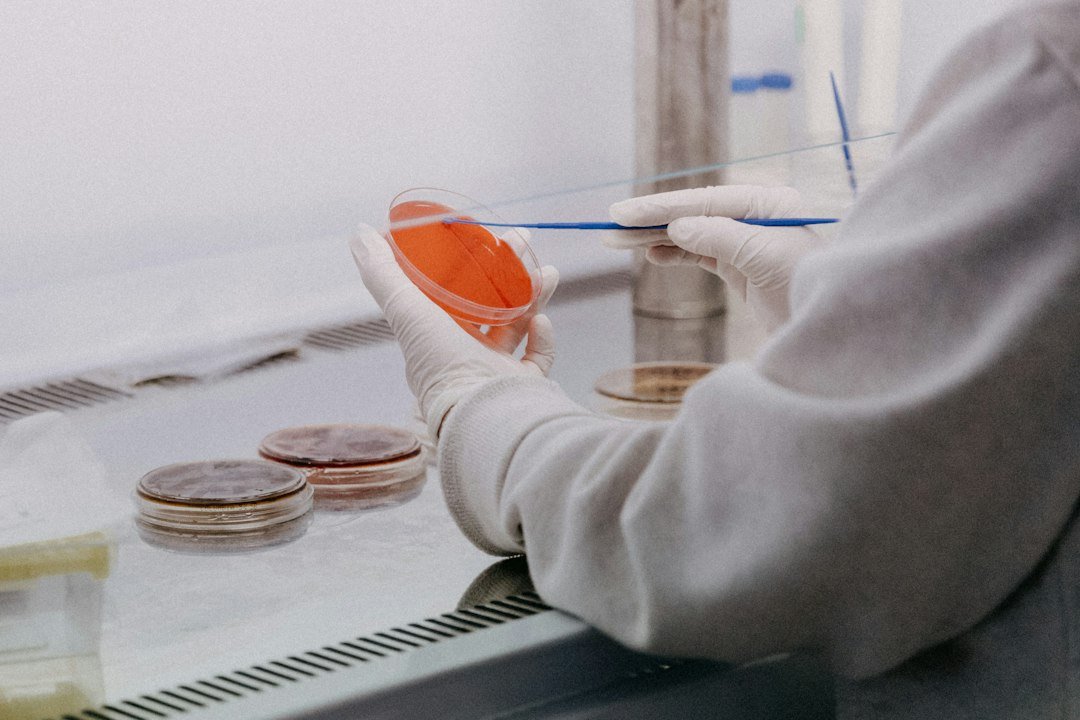
Featured image: Trnava University/Unsplash. Contextual laboratory photograph; not from the study.
Leave a Reply