
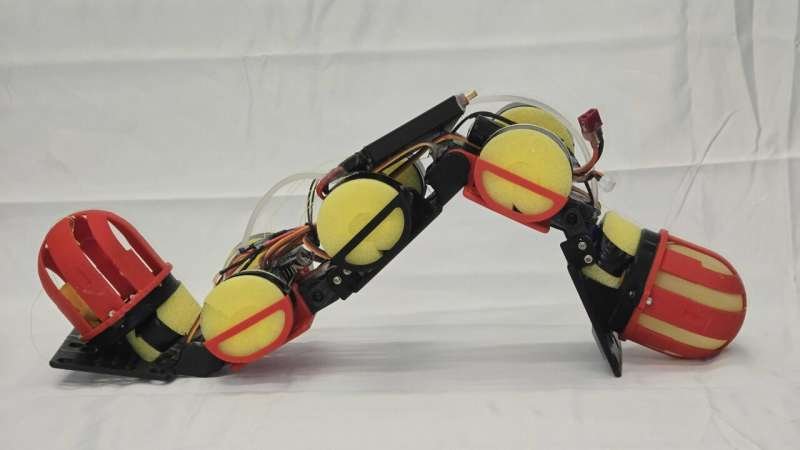
The WorMa amphibious robot takes on a neglected obstacle: the edge of the pool. A machine can handle water and still struggle to climb out.
NYU researchers have built WorMa, a small amphibious robot that adapts by shifting water between its front and rear. It keeps a broadly similar wave-like motion while changing where its mass sits. NYU described the work on 17 September 2026. NYU’s account, distributed through Tech Xplore
It is an appealingly physical idea. Before asking for more motors or a more elaborate movement pattern, change how the existing body presses against the world.
The WorMa amphibious robot carries useful weight
WorMa is about half a metre long and carries roughly 300 grams of movable water. In the reported tests, a heavier front helped it climb. A heavier rear improved its swimming. Clearing a step required a sequence of weight shifts rather than leaving the water at one end throughout. NYU
The research paper, published on 14 September, reports slopes up to 19.5 degrees and steps up to 15 centimetres. It also demonstrates transitions into and out of water. These are results from the prototype’s test conditions, rather than a rating for every outdoor surface it might encounter. Advanced Robotics Research
The attraction for future inspection equipment is easy to imagine. A useful route might include a pavement, a bank and a shallow waterway. The transitions could determine whether the mission succeeds, even if each individual environment looks manageable.
The pump exposes the current limit

One detail in the paper is especially important: fully transferring the water takes about 110 seconds. Reported movement-performance measurements exclude that transfer interval. The present system is also teleoperated; automatic terrain recognition and adjustment are proposed improvements. Research methods and limitations
That means the device should not be portrayed as rapidly flowing over obstacles while autonomously shifting its balance. The experiment establishes the usefulness of different configurations, with pauses and operator input still part of the process.
Adaptability has more than one form
Related work from researcher Nana Obayashi explores a different problem with ScaFi, a robotic-fish design built at several sizes. That project preserved similar swimming motion across scales, while also finding that efficiency did not scale as neatly. NYU’s ScaFi research account
Together, the projects suggest a useful way to judge bio-inspired machines: identify the exact feature that transfers well, then test where it stops helping.
For WorMa, the next persuasive demonstration would combine faster adjustment with reliable sensing and a less predictable route. A future field robot would need to spend its time completing the mission, not waiting for its internal water to move.
For now, it is a memorable piece of engineering. Sometimes adapting a machine starts with rearranging what it already carries.
Featured image: WorMa moves water between tanks in its head and tail. Image: Nana Obayashi / NYU Tandon.
Related reading: the gap between home-robot promises and practical autonomy.
Leave a Reply