
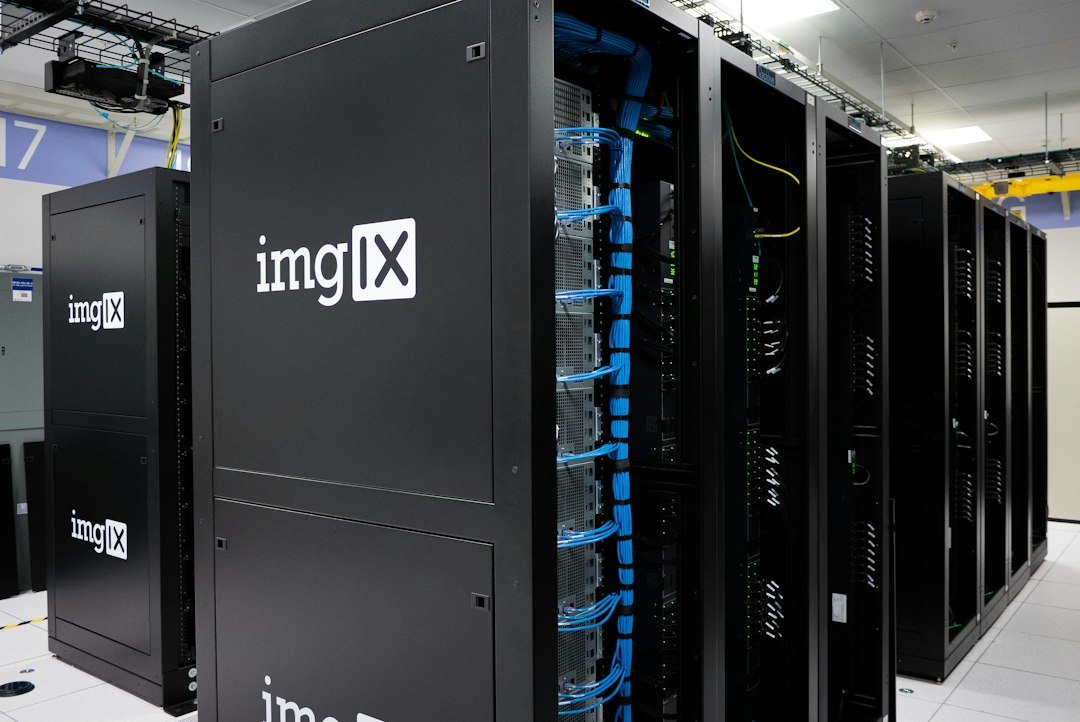
Featured image: Server cabinets in an imgix facility illustrate data-centre infrastructure. Contextual photograph; no Tier certification or AI-service availability is asserted for the pictured site. Photo: imgix / Unsplash. Unsplash licence.
A data centre can have redundant power equipment and carefully separated distribution paths while a service inside it still fails to answer a request. The building and the application are parts of the same delivery chain, but they require different evidence of reliability.
That distinction matters as AI facilities advertise resilience alongside computing capacity. This explainer uses Uptime Institute’s current Tier guidance and cloud reliability documentation. It does not report a new facility certification, an actual outage or a measured failure rate for a named operator.
A Tier defines infrastructure capabilities
Uptime Institute’s classification progresses from Tier I to Tier IV. The criteria concern site infrastructure, including power, cooling, maintenance and fault capabilities. The classification does not prescribe a single technology or mean that the highest Tier is the right business choice for every workload.
Tier III adds concurrent maintainability: components and distribution paths can be taken out for maintenance without shutting down the supported IT operation. Tier IV adds fault tolerance, with independent, physically isolated systems and continuous cooling requirements.
Those are engineering capabilities within the defined topology. They should be distinguished from an assertion that every possible event, software fault or external service dependency has been eliminated.
Design, construction and operation are separate assessments
Uptime Institute’s certification programme distinguishes design documents, the constructed facility and operational sustainability. Reviewing a design establishes something different from inspecting the facility that was built or assessing how it is operated.
This makes the exact wording of a claim consequential. A statement about a design, a constructed-facility certification and an operator’s description of Tier-like features should not be treated as identical records. The relevant certificate and its scope identify the evidence behind the claim.
Our assessment is that reporting should name the assessment actually achieved. That provides a more useful account of resilience than repeating a Tier number without saying what was examined.
Operations determine how the installed capability is used
Operational sustainability certification examines practices and procedures intended to avoid preventable errors and support effective operation. Its assessment includes the human and organisational side of keeping a facility working.
That addresses an important gap between a redundant design and daily performance. Equipment has to be maintained, changes have to be managed and teams need procedures that match the installed systems. The existence of an alternate path does not by itself show how an organisation will use it during a problem.
Operational certification is another piece of evidence. It should not be silently substituted for an application-level availability measurement or a customer’s contractual service terms.
An application depends on more than the room around it
AWS’s reliability guidance defines availability over a stated period and also discusses measuring successful requests. It distinguishes hard dependencies, where another system’s failure directly interrupts the application, from dependencies whose failure can be handled without stopping it.
Its illustrative calculation shows that three independent, essential components each designed for 99.99% availability yield about 99.97% overall. The number is a theoretical example under assumptions, not a measured result for an AI service.
Consider an illustrative AI application with a request gateway, a model-serving system and a required database. A healthy electrical installation does not establish that all three software components are responding correctly. Their behaviour requires its own monitoring, recovery design and testing.
Reliability should be traced to the user’s outcome
A service-level agreement sets contractual terms for a service; a facility Tier classification describes infrastructure capabilities. Useful reporting should state the measurement period, the definition of success and the dependencies included, rather than treating those two records as interchangeable.
Our view is that facility certifications and application evidence strengthen each other when their boundaries are clear. The facility can be assessed for maintainability and fault tolerance, while the service is assessed for the requests it successfully handles.
AI infrastructure needs both. A Tier rating provides meaningful information about the building’s support systems. A dependable AI service is the broader result of those systems, the people operating them and the software delivering the answer.
Leave a Reply