
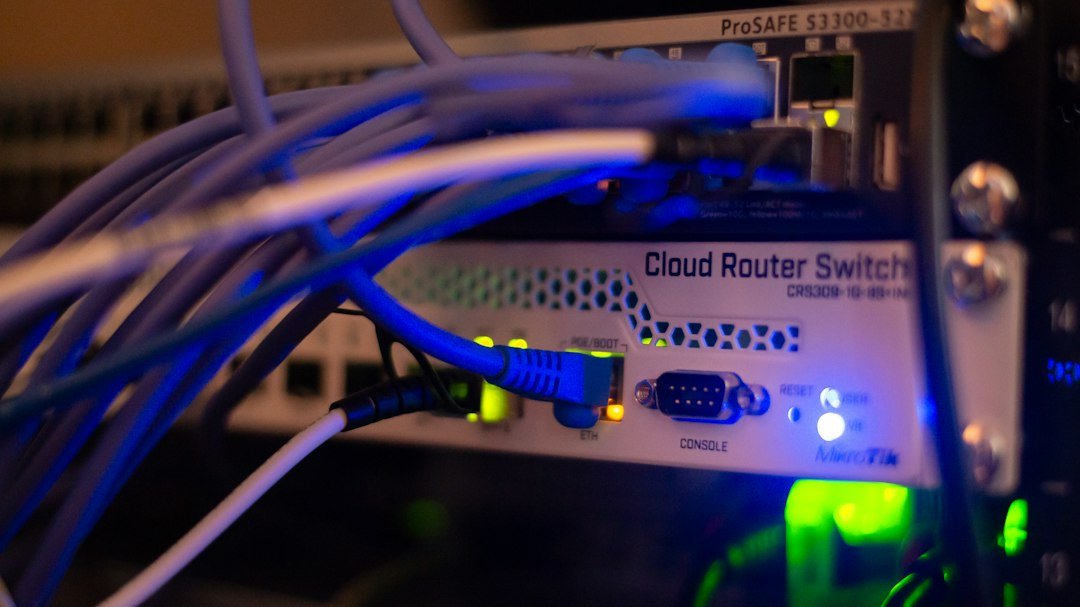
Featured image: Ethernet cables illustrate physical network connections. Contextual photograph; these are not the announced ZeroFlap optical cables or a demonstration of their performance. Photo: Albert Stoynov / Unsplash. Unsplash licence.
AI infrastructure needs more than a fast connection on a specification sheet. The connection must reach the next machine, fit within a power budget and avoid interruptions that disrupt work. Credo’s newest optical-cable plan tackles those constraints with an unusual design choice: use many slower optical channels instead of pushing a few channels harder.
The company announced its 1.6-terabit ZeroFlap active light cable on 12 October 2026. It targets connections across data-centre rows, with shipments planned for 2027. The announcement presents an architecture and design targets, not an independent record of installed-fleet performance.
More parallel paths change the optical trade-off
Credo describes arrays of tiny light emitters and detectors connected by flexible fibre bundles. Higher-rate electrical lanes are divided across many lower-rate optical channels, using a simpler signalling approach than the complex processing associated with some high-speed optical links.
The intended advantage is a different balance of power, reach and reliability. The company targets distances up to 50 metres and 12 watts per cable end. Those numbers describe the proposed product boundary, not the electricity consumed by a complete server or AI cluster.
Parallelism is not automatically better in every setting. It moves the design trade-off towards the number of channels, their packaging and how the system handles a problem in one path. The practical result must be judged in the intended connection, rather than from a slogan about slower or faster signalling.
Keeping a link up is different from avoiding every fault
The design includes redundant channels and link monitoring intended to support failover without interrupting the connection. That is the principle behind the ZeroFlap branding in this announcement.
A link flap is a connection going down and coming back up. Preventing an individual channel fault from becoming a link interruption can be useful even when the hardware is not literally fault-free.
The distinction matters when interpreting reliability claims. One design might tolerate a component problem, another might detect it more quickly, and a third might reduce the probability of the problem occurring. These mechanisms should not be treated as identical simply because they can improve availability.
A large MTBF figure is not a product lifespan
Credo gives a target of 100 million hours mean time between failures, or MTBF. It is a statistical reliability measure, not a promise that one cable will operate for that many hours or a statement that it has already done so.
The US National Institute of Standards and Technology’s reliability handbook describes how MTBF requirements can be tested using statistical models, with assumptions, test duration and confidence bounds. A headline number is more useful when those supporting details are available.
NIST’s discussion of parameter estimation also makes clear that reliability estimates come from data interpreted through a model. The estimate and the uncertainty surrounding it belong together.
For a buyer or researcher assessing a future deployment, useful evidence would therefore include the failure definition, operating conditions and the relationship between component failures and visible link interruptions. The release does not supply a complete public field-validation record for the new cable.
The meaningful comparison is useful work delivered
A lower-power interconnect can matter without producing the same proportional saving across an entire data centre. The rest of the network, computing hardware and cooling remain within that larger boundary.
Likewise, a reduction in interruptions would need to be connected to a particular workload before it could be translated into more useful AI output. A bandwidth label alone cannot establish how much training or inference work a system completes.
The next tests are qualification, delivery and operation under representative conditions. Comparisons should keep distance, throughput, power boundary and reliability criteria consistent.
Credo’s proposal is significant because it questions whether every optical channel must become faster to make the network better. The wide-parallel route offers a concrete alternative to examine. Its eventual value will be measured in dependable connections and useful work, not in treating forward-looking specifications as completed results.
Reporting and source checks completed on 18 October 2026. By FutureTechDose Editor.
Leave a Reply