
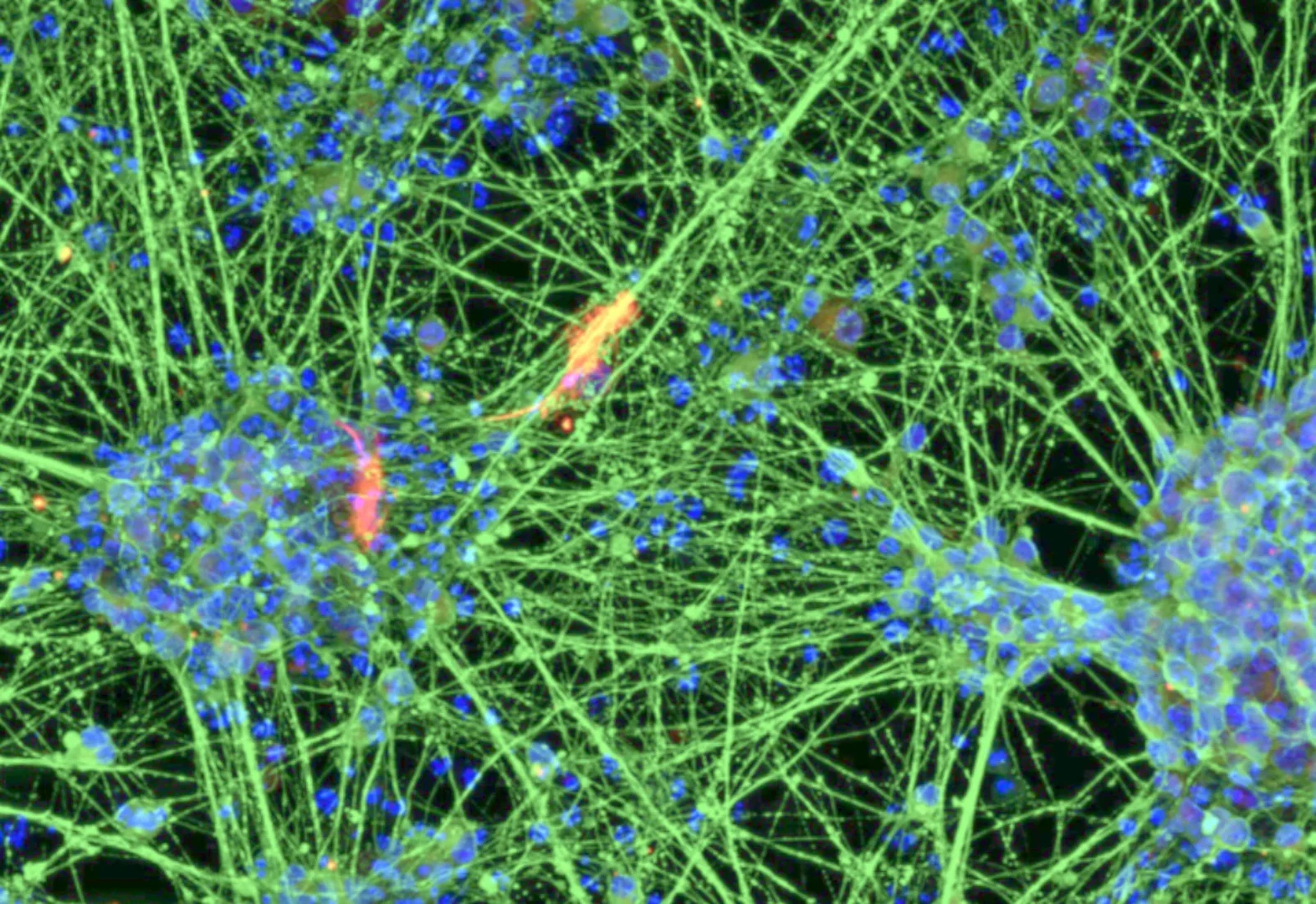
Featured image: Neurons generated by differentiating blood-derived induced neural stem cells, supplied with the University of Bonn’s report. Cultured cells, not a brain scan or a human treatment outcome. © Brüstle Research Group / University of Bonn. Editorial reuse with attribution permitted by the university’s press-image terms.
Making an old cell look younger on a molecular test is one scientific task. Watching how that change unfolds is another. A new human-cell study gives researchers an unusually extended view of the transition, while leaving the question of human rejuvenation firmly open.
The Aging Cell paper, first published on 3 October 2026, examines the conversion of blood-cell precursors into induced neural stem cells. The University of Bonn described the work on 9 October. These are experiments in cultured cells, not a treatment given to people.
A change of identity without a universal blank slate
The team used two transcription factors, SOX2 and cMYC, to convert erythroid progenitors, which are precursors of red blood cells. Donors ranged from newborns to a person aged 101. Transcription factors influence which genetic instructions a cell uses.
The destination matters. Neural stem cells are not mature neurons, and they are not pluripotent stem cells. The US National Institutes of Health’s stem-cell guide explains that pluripotent cells can generate the specialised cell types of the adult body, while tissue-specific stem cells have a narrower range.
That distinction stops a misleading shortcut in the story. Producing a cell capable of making neural descendants is not the same as rebuilding an aged brain. It is a laboratory platform on which more specific questions can be tested.
A slow reset makes the intermediate stages visible
The researchers tracked DNA methylation and RNA activity over time. Methylation is a chemical marking of DNA; an epigenetic clock uses patterns in such markings to estimate an age-related state. It does not count a donor’s lived years backwards.
The paper reports that the molecular acquisition of neural stem-cell identity continued beyond the appearance of early marker-positive cells. Epigenetic de-ageing also continued for weeks, including under conditions that inhibited proliferation. A recognisable early cell state was therefore not the end of the conversion process.
Bonn’s explanation describes tracking the gradual change for more than 100 days. It gives the example of cells from an 80-year-old reaching an estimated molecular age below 20. Those numbers describe cells and an algorithm, not a person becoming decades younger.
For experimental design, the slowness is useful. It creates opportunities to compare earlier and later stages, or test whether a candidate factor changes the trajectory. Such tests would investigate mechanism; they would not, on their own, establish a clinical benefit.
Preserving age can be useful in a different experiment
Rejuvenation is not automatically the ideal outcome for every laboratory model. Scientists studying late-life disease may need cells that retain features of an older donor rather than losing them during preparation.
For historical comparison, a 2015 Cell Stem Cell study by Mertens and colleagues found that directly converted human neurons retained age-associated expression patterns, whereas an induced-pluripotent-cell route did not retain those signatures in the same way. That is background research, not a result newly announced this month.
The routes should not be treated as interchangeable. Direct conversion to a mature neuron and conversion to a renewable neural stem-cell population ask different biological questions. A method that removes age-related features can be valuable for studying resetting, while another can be valuable for studying age-related damage.
A research tool still needs a separate therapeutic case
The NIH guide distinguishes laboratory stem-cell research from the testing needed to establish a cell-based treatment. Questions about identity, purity, survival, unwanted growth and function cannot be answered by an age estimate alone.
The present advance is the ability to examine an extended cellular transition. It does not demonstrate longer human life, recovery from dementia or safe transplantation of these cells into patients. Its strongest contribution is a more observable experimental model: one in which becoming a different cell type and losing age-associated signatures can be studied together, without assuming they are the same event.
Reporting and source checks completed on 19 October 2026. By FutureTechDose Editor.
Leave a Reply