

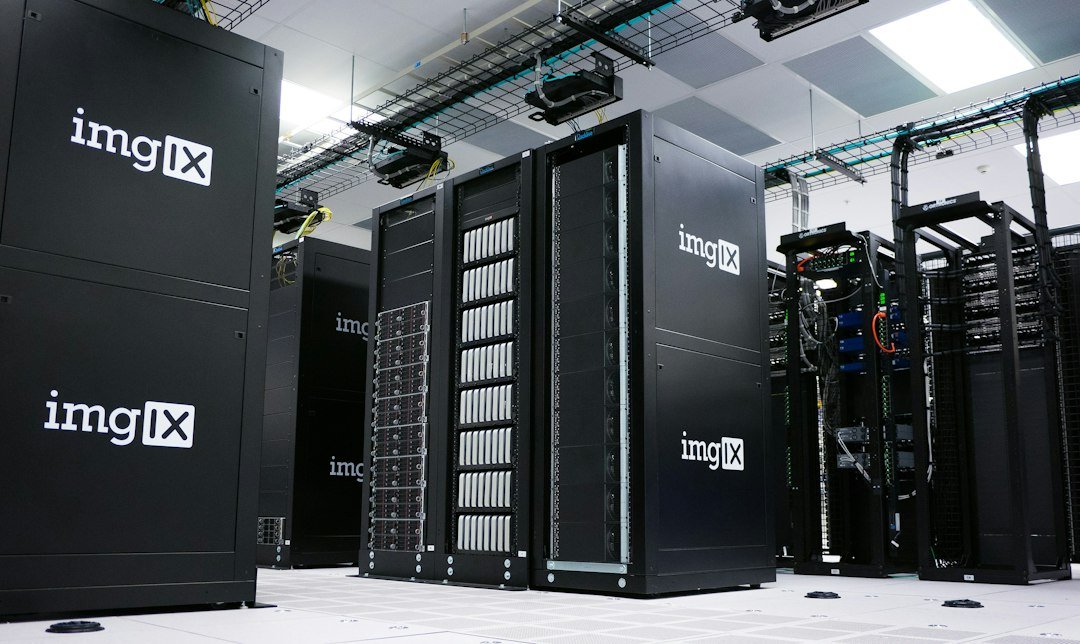
Featured image: Server racks illustrate cloud infrastructure. Contextual photograph; not Google hardware serving OpenAI models or evidence of the private-preview configuration. Photo: Kevin Ache / Unsplash. Unsplash licence.
Cloud competition is not only a contest over who owns the largest data centre. It is also a contest over where companies can buy, govern and connect artificial-intelligence models. On 21 October 2026, OpenAI announced that its frontier models and Codex workflows are coming to Google Cloud’s Model Garden.
The immediate stage is a private preview for selected enterprise customers, according to the Google Cloud announcement. General availability is planned in the coming weeks. This is a commercial distribution and platform-integration deal, not a new model launch or proof that one cloud runs the models faster or more cheaply than another.
Model Garden is a catalogue and deployment layer
Google describes Model Garden as a place to discover, evaluate and deploy models from Google and other providers. Adding OpenAI expands that catalogue. Customers are expected to access the models within Google Cloud tooling rather than establishing a completely separate purchasing route.
The announcements say customers will be able to transact through Google Cloud Marketplace. Companies with committed Google Cloud spending can use those commitments for eligible purchases. This may matter as much as an API endpoint: large organisations negotiate budgets, controls and vendor processes before developers can put a model into production.
Centralised identity and access controls can also make it easier to determine who may call a model, which project pays and where logs or policies are managed. These are control-plane features around the service. They do not reveal the model’s weights, transfer ownership of the model or make governance automatic.
Private preview is not broad availability
The initial preview includes selected customers and a named set of OpenAI models. A private preview normally exists so the providers and customers can test integration, support and policy behaviour before a wider release. Features, regions, quotas and pricing can still change.
Google says zero-data-retention support and Confidential Computing are coming soon. “Coming soon” means those capabilities should not be reported as universally available today. Zero data retention concerns how request data is stored by the service. Confidential Computing aims to protect data while it is being processed. Neither phrase means an application is private by default if it sends unnecessary sensitive information or grants overly broad access.
The companies also refer to OpenAI models appearing in Google Antigravity and Gemini Agent. Those are planned integrations. The current verifiable milestone is the Model Garden private preview, with wider availability still ahead.
A new storefront does not settle performance or cost
OpenAI’s models do not become Google models because Google sells access to them. OpenAI remains the model provider; Google supplies the cloud marketplace, infrastructure and enterprise control layer described in the partnership.
The release contains no controlled benchmark comparing latency, quality, reliability or total cost with buying the same model elsewhere. A cloud commitment can change the effective procurement economics for one customer, but it does not prove a lower list price or a universally lower cost per useful task.
Real application cost depends on token volume, input and output lengths, retries, surrounding databases, network movement, engineering time and the amount of human review required. Model choice can improve one task while worsening another. A catalogue expands options; evaluation still decides which option fits.
Multi-cloud choice is growing around a primary partnership
OpenAI explicitly states that Microsoft remains its primary cloud partner. The Google arrangement therefore broadens distribution without erasing existing partnerships or implying that all OpenAI training has moved to Google Cloud.
For enterprises, the strategic change is reduced distance between an existing Google Cloud environment and an OpenAI model. Teams may be able to use familiar billing, access controls and data services. That could simplify adoption, especially where creating another vendor relationship is slow.
The evidence to watch after general availability is operational rather than ceremonial: supported regions, service-level terms, data-handling options, model-version controls, quotas and transparent pricing. Customers will also need to test whether policies extend across the complete application, not just the model call.
The partnership is significant because it makes model distribution look more like a multi-vendor cloud marketplace. Its limits are equally clear. This is a new route to OpenAI models, not a transfer of ownership, a performance result or a newly commissioned AI factory.
Reporting and source checks completed on 21 October 2026. By FutureTechDose Editor.
Leave a Reply