
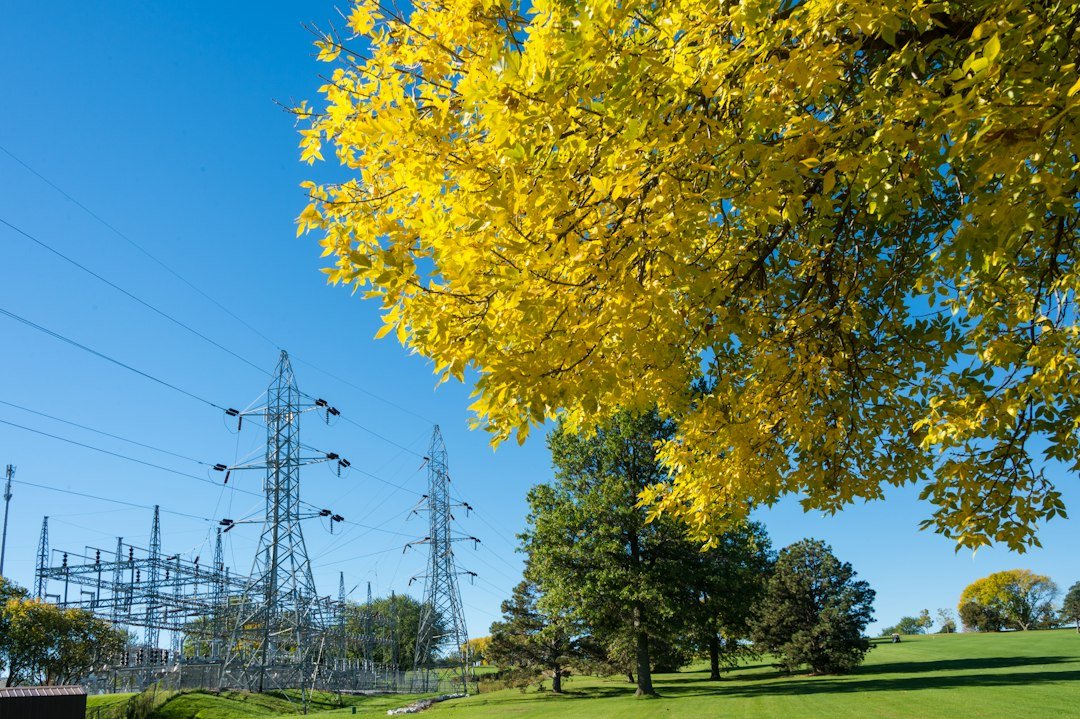
Featured image: Transmission infrastructure illustrates the grid connections needed by data centres. Contextual image; not visual evidence of the specific study, treatment, project or facility. Photo: American Public Power Association. Unsplash licence.
AI infrastructure is increasingly governed by electricity policy rather than technology policy alone. A new International Energy Agency review catalogues 134 policies and regulations across 34 jurisdictions representing about 90% of global data-centre capacity. Roughly 40% of the measures had been announced or implemented during the previous 12 months.
The 14 October report, “Powering Artificial Intelligence” shows governments trying to reconcile fast, concentrated compute demand with grid queues, generation needs, emissions, water constraints and public expectations. It is a policy survey and scenario analysis, not a guarantee that every announced data centre will be built.
Connection rules are becoming a central bottleneck
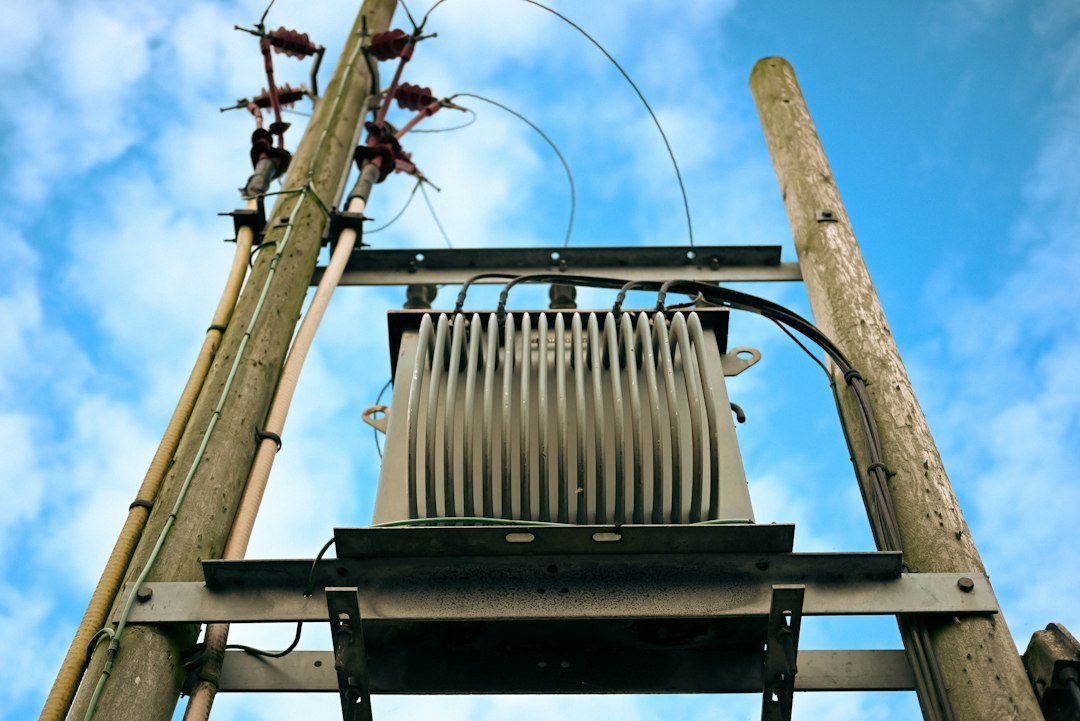
Traditional grid planning often assumes a large user will request a firm connection capable of serving its full peak load. Data centres can arrive faster than new transmission and generation. Some jurisdictions are therefore exploring flexible or non-firm connections that permit a facility to reduce demand when the network is constrained.
The IEA estimates that such approaches could unlock 750 to 900 gigawatts of hosting capacity globally under suitable conditions. “Hosting capacity” does not mean that much new data-centre load is approved or supplied continuously. It is an estimate of the load networks might accommodate with flexibility, location signals and operational limits.
Flexible connections also shift risk. Operators need software, contracts and perhaps onsite generation or storage to manage curtailment. Grid companies need credible controls and penalties so flexibility is delivered when required rather than assumed on paper.
Capital spending is running ahead of the policy framework
The executive summary says hyperscaler capital expenditure is expected to exceed US$700 billion in 2026, with most directed to data centres. That figure covers global company plans and estimates, not only physical buildings or electricity equipment. Capital expenditure can be delayed, redirected or cancelled as demand and financing change.
Corporate power-purchase agreements reached about 45 terawatt-hours in the first half of 2026, up roughly 20% year on year, according to the report. About 70% was in the United States. A PPA can support new generation financially, but annual matching does not prove that a facility uses carbon-free electricity every hour or that power is delivered on the same constrained part of the grid.
Carbon and water depend on place and time
The IEA estimates data centres currently account for around 150 million tonnes of carbon dioxide emissions. In its central scenario, that rises to about 350 million tonnes by 2035, around 1.5% of energy-related emissions. These are modelled outcomes shaped by workload growth, hardware efficiency and the electricity mix—not measurements of an inevitable future.
Water risk can be local even when a company’s global total appears manageable. The report says about 40% of AI-dedicated data-centre capacity is in areas of high or extremely high water stress. Cooling technology, climate and power-generation water use all affect the footprint. Publishing site-level water consumption and seasonal peaks would make policy more accountable.
Six principles point toward coordinated planning
The IEA urges governments to improve data transparency, coordinate electricity and digital planning, use location signals, enable flexibility, align clean-energy procurement with system needs and address community and environmental impacts. The exact policy mix will differ across grids.
Fast connection is not the only objective. A poorly located load may require expensive network upgrades or raise prices for other users. Conversely, a flexible facility near abundant generation could absorb power that would otherwise be curtailed and fund new grid assets.
The report’s most important finding is institutional: data-centre policy can no longer be written only by digital ministries, and electricity planning cannot treat AI demand as a distant forecast. Compute, substations, generation, water and community consent now form one infrastructure problem. The numbers are uncertain; the need for joined-up planning is not.
Reporting and source checks completed on 23 October 2026. By FutureTechDose Editor.
Leave a Reply