
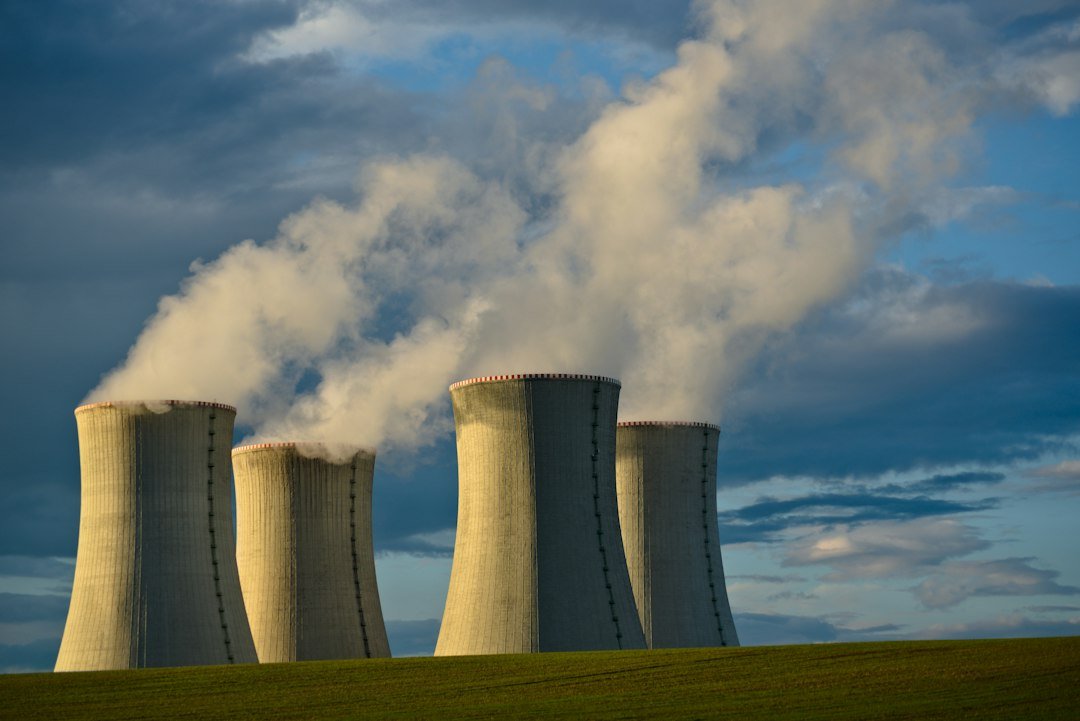
Featured image: Contextual nuclear power station; not a PreussenElektra site selected for an AI data centre. Photo: Lukáš Lehotský / Unsplash. Unsplash licence.
In brief: German nuclear-decommissioning company PreussenElektra and NVIDIA will examine whether former power-station sites can meet the technical needs of large AI data centres. Existing land, grid access and industrial services may be valuable, but no site, investment or construction project has been approved.
A closed power station can lose its reactor and still retain something scarce: a place built to move large quantities of electricity. That makes retired energy sites attractive candidates as AI developers search for land with grid connections and heavy industrial infrastructure.
PreussenElektra and NVIDIA announced in October 2026 that they will assess former German nuclear sites for future “AI factories.” The company statement says the work will compare available land and existing energy and site infrastructure with the technical and operating requirements of high-performance data centres.
The proposal is about sites, not nuclear generation
Germany shut its last operating nuclear reactors in April 2023. PreussenElektra is responsible for decommissioning and dismantling eight plants. The new assessment does not propose restarting those reactors or using them to power servers.
The value lies in non-nuclear assets that may survive the energy transition: high-voltage grid connections, switchyards, roads, security perimeters, water access, buildings and a skilled regional workforce. A brownfield industrial site may also face less land-use conflict than a greenfield campus.
Even so, a retired reactor site is not a plug-and-play data centre. Grid equipment may need replacement, transmission capacity may be committed elsewhere, and demolition or radiological controls can restrict where and when construction occurs.
Decommissioning and redevelopment must coexist
Nuclear decommissioning is a regulated, multi-year process involving removal of fuel, decontamination, dismantling and waste management. An AI facility could only occupy areas released for suitable use, while maintaining safe access and security around ongoing work.
Site-specific investigations would need to address contamination history, ground conditions, cooling design, noise, backup generation, fibre connectivity and emergency planning. Water infrastructure built for a thermal power station may be useful, but modern liquid-cooled servers have different quality, circulation and heat-rejection requirements.
Tom’s Hardware reported that the initiative remains a preliminary feasibility exercise, with no investment amount, selected project or construction timetable disclosed.
A grid connection has become a strategic asset
AI clusters concentrate electrical demand at a scale that can exceed the capacity of local distribution networks. New substations and high-voltage lines often take longer to permit and build than server halls. Reusing a generation site can shorten part of that path if the connection is technically available.
It does not create new electricity. A data centre consuming power at a former plant can increase demand on the wider system unless matched by generation, storage, demand response or network upgrades. Regulators and communities will need to decide who pays for those investments and how reliability is protected.
The phrase “AI factory” also describes computing output, not a conventional manufacturing plant. It can include dense accelerator clusters, networking, storage, cooling and operations. The number of jobs and local economic spillovers may differ from those of the power station that previously occupied the site.
Reuse could be rational without being inevitable
Retired power sites are increasingly considered for batteries, renewable-energy connections, industrial projects and data centres because their infrastructure is difficult to reproduce. Each alternative competes for the same grid capacity and land.
The PreussenElektra–NVIDIA study is therefore a commercial feasibility announcement. It shows how valuable power-system geography has become, but it does not demonstrate that an AI campus will be built. The meaningful milestones will be a named site, grid study, land-release plan, planning application, financing and a construction decision.
Until those steps appear, the accurate headline is reuse under examination—not nuclear-powered AI and not a reactor comeback.
Leave a Reply