

Imagine being offered a place in an Alzheimer’s drug trial while your memory still feels completely normal. You remember appointments. You recognise everyone at the dinner table. There is no obvious problem to treat.
That is the starting point for PrevenTRON, a Phase III trial investigating whether an experimental medicine can delay or prevent symptoms in people at high risk. On 5 September 2026, Surrey and Borders Partnership NHS Foundation Trust announced that it had opened the first UK and European site for the study. The international programme aims to recruit about 1,600 adults aged 55–80. NHS announcement
The appealing idea is to intervene while everyday life is still intact. The difficult part is proving that doing so makes a lasting difference.
Moving the starting line
PrevenTRON is studying trontinemab, an investigational drug from Roche. Participants are being selected for elevated Alzheimer’s risk despite having no memory or thinking symptoms, with blood tests forming part of screening. This is a targeted study, rather than a proposal to give the medicine to everyone above a particular age. NHS study information
You may see researchers describe this as “preclinical Alzheimer’s disease”. Here, preclinical refers to the disease being present before clinical symptoms. The trial itself is in people. It is not an experiment in cells or mice.
Roche distinguishes this prevention programme from its TRONTIER studies in people with early symptoms. Results in one population cannot simply be assumed to apply to the other. Roche’s July 2026 research update
Getting a medicine past the brain’s security gate
Trontinemab is an antibody: a protein engineered to recognise a particular target. Its target is aggregated amyloid-beta, the protein that forms plaques associated with Alzheimer’s.
There is also a delivery challenge. The blood-brain barrier tightly controls what passes from the bloodstream into the brain. Roche’s “Brainshuttle” design is intended to help the antibody cross that barrier and reach its target. Think of it as combining a delivery pass with a protein-recognition tool. Roche’s explanation of trontinemab
That makes the drug scientifically interesting. It does not establish that an otherwise well person will remain free of dementia after receiving it.
A cleaner scan is not the same as protected memory
One early result helps explain the enthusiasm. In July 2025, Roche reported that 49 of 54 participants in one dose group of its Phase Ib/IIa study fell below the trial’s amyloid PET-scan positivity threshold after 28 weeks. These were company-reported conference results from an earlier study, not prevention results from PrevenTRON. Roche’s 2025 results
A PET scan can measure a biological change. Families care about a different outcome: whether someone keeps their memory, judgement and independence for longer. A reduction in plaques is a reason to investigate that possibility, not a substitute for demonstrating it.
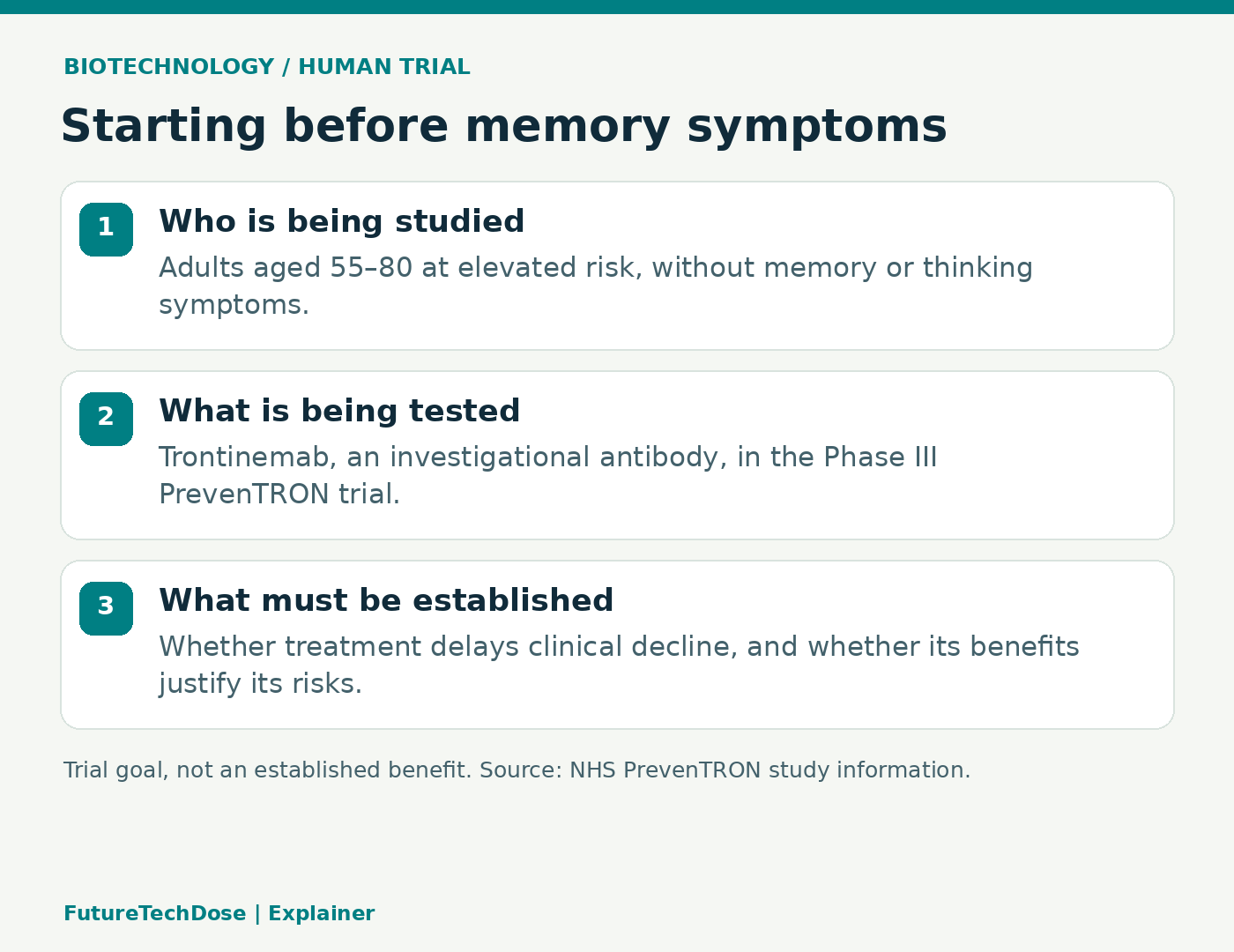
The trial’s goal is prevention. A benefit has not yet been established.
The safety standard becomes especially important
Preventive treatment asks people who currently feel well to accept medical risks in exchange for a possible future benefit. That makes the balance between benefit, burden and harm central to the study.
In the earlier programme, Roche reported four cases of ARIA-E among 149 participants across two dose cohorts in blinded data. ARIA-E describes brain swelling or fluid changes detected on scans. Those observations cannot establish the long-term safety of treating a much larger group before symptoms begin. Roche’s safety report
Phase III means the programme has reached a large, later stage of human testing. It does not mean the medicine has succeeded, received approval or become a proven way to prevent Alzheimer’s.
The result worth waiting for
The decisive story will be the clinical outcome: whether treated participants experience meaningfully less decline, how long any difference lasts and what risks come with it.
Even a positive result would need careful reading. Delaying symptoms for some people would be valuable, but would not mean that all dementia had been prevented or that ageing itself had been reversed.
For now, PrevenTRON represents an attempt to move treatment earlier in the story. Its promise lies in protecting ordinary moments before people begin to lose them. Whether this particular medicine can deliver that promise is what the trial must establish.
Leave a Reply